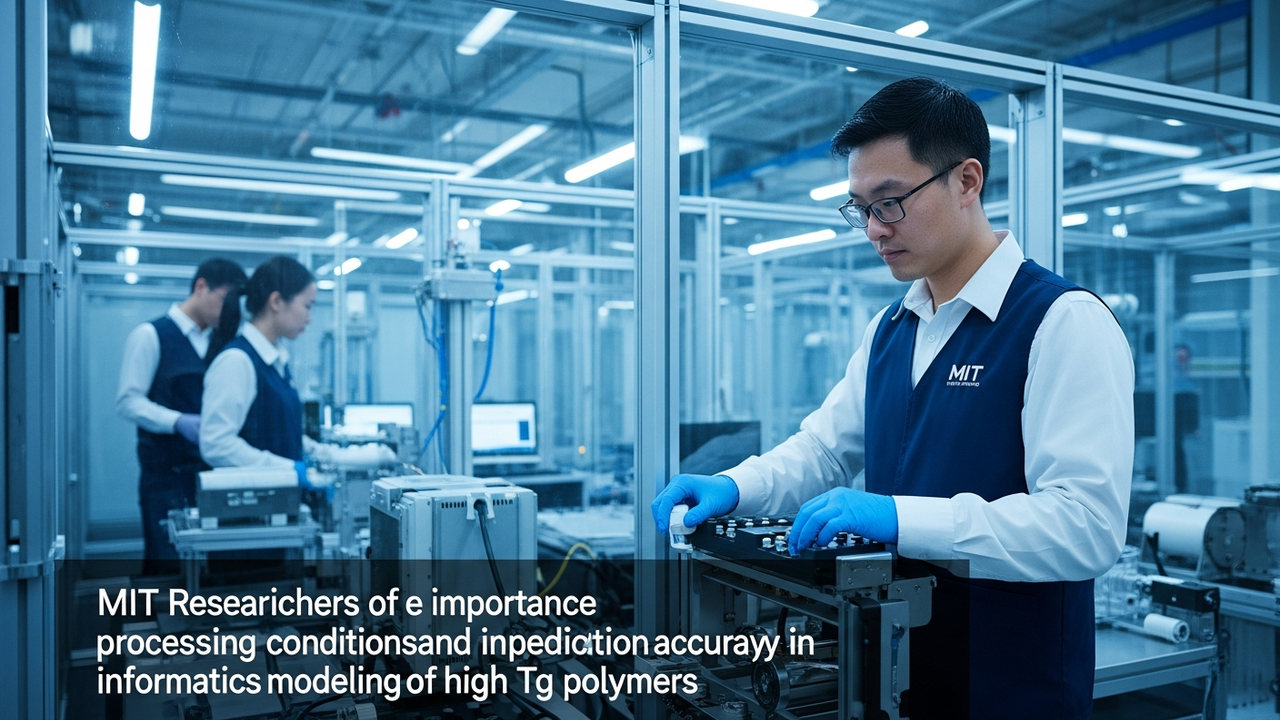
Key Findings: Processing Conditions Prove Critical for Enhancing Predictive Accuracy in High Tg Polymer Informatics Modeling
Researchers at the Massachusetts Institute of Technology (MIT) have published a study evaluating the significant role that processing conditions play in the informatics modeling of high glass transition temperature (Tg) polymers. This research overcomes the limitations of conventional predictive models based solely on chemical composition and structure, enabling more realistic and highly accurate polymer design.
Technical & Business Details: Improved Predictive Capability Through Integration of Processing Parameters into Machine Learning Models
Previously, machine learning models for predicting polymer Tg were primarily based on chemical topology descriptors, i.e., molecular structural information. This study introduces a novel approach by integrating “processing parameters” into this feature set. This integration was shown to improve the predictive accuracy and broaden the applicability of the models across a wider range of polymers. Specifically, for polymers with strong intermolecular interactions or those whose properties are highly dependent on processing conditions, considering these parameters significantly reduces deviations from predictions, leading to more reliable forecasts. This translates to a reduction in experimental iterations during polymer design, leading to substantial savings in development time and cost.
Background & Industry Context: Challenges in Polymer Material Development and the Evolution of Data-Driven Approaches
High Tg polymers are indispensable materials in various high-performance sectors, including aerospace, automotive, and electronics. However, their development is complex, requiring precise control over not only chemical composition but also processing parameters (e.g., molding temperature, cooling rate, annealing treatments) to achieve specific functionalities. Materials informatics offers data-driven approaches to efficiently explore this complex material design space, but incorporating the impact of processing history into models has been a long-standing challenge. This research presents a crucial solution to this problem.
Strategic Significance & Outlook: Rapid Design of High-Performance Polymers and Enhanced Industrial Competitiveness
Informatics modeling of high Tg polymers that accounts for processing conditions will enable the rapid and rational design of high-performance polymers, significantly enhancing industrial competitiveness. For example, it will allow for quicker development of polymers with optimized heat resistance, mechanical strength, and dimensional stability for specific applications. This is expected to lead to improved product performance, reduced manufacturing costs, and accelerated market entry. This approach has the potential for future application in predicting other material properties and designing more complex composite materials, fundamentally transforming the landscape of materials science R&D.
Source: https://arxiv.org/abs/2607.17925
Get our weekly technology intelligence — free
Receive an infographic that lets you judge at a glance whether each field’s analysis report is worth reading.
Subscribe Free — Weekly Tech Intelligence
By subscribing, you’ll receive Troy-Technical’s weekly technology intelligence newsletter.
- Your email and selected fields are used only to deliver the newsletter.
- We never share your information with third parties.
- You can unsubscribe anytime via the link in each email.
See our Privacy Policy for details.
Takes about a minute · Unsubscribe anytime








Comments