Background
While the promise of all-solid-state batteries holds significant appeal for next-generation electric vehicles (EVs), their challenges in mass production technology, cost-efficiency, and long-term reliability remain substantial hurdles, suggesting a significant lead time before widespread commercialization. In this transitional period, semi-solid batteries have emerged as a pragmatic and effective bridging technology. China has rapidly established itself as a global leader in both EV manufacturing and battery innovation, with numerous domestic companies actively championing the commercialization of semi-solid battery solutions. This strategic push is poised to deliver higher-performance, safer EVs to consumers at more accessible price points, thereby accelerating the overall growth trajectory of the global EV market. Furthermore, the technological advancements and operational insights gained from scaling semi-solid battery production are expected to directly inform and accelerate the future development of full all-solid-state battery technologies.
Key Findings
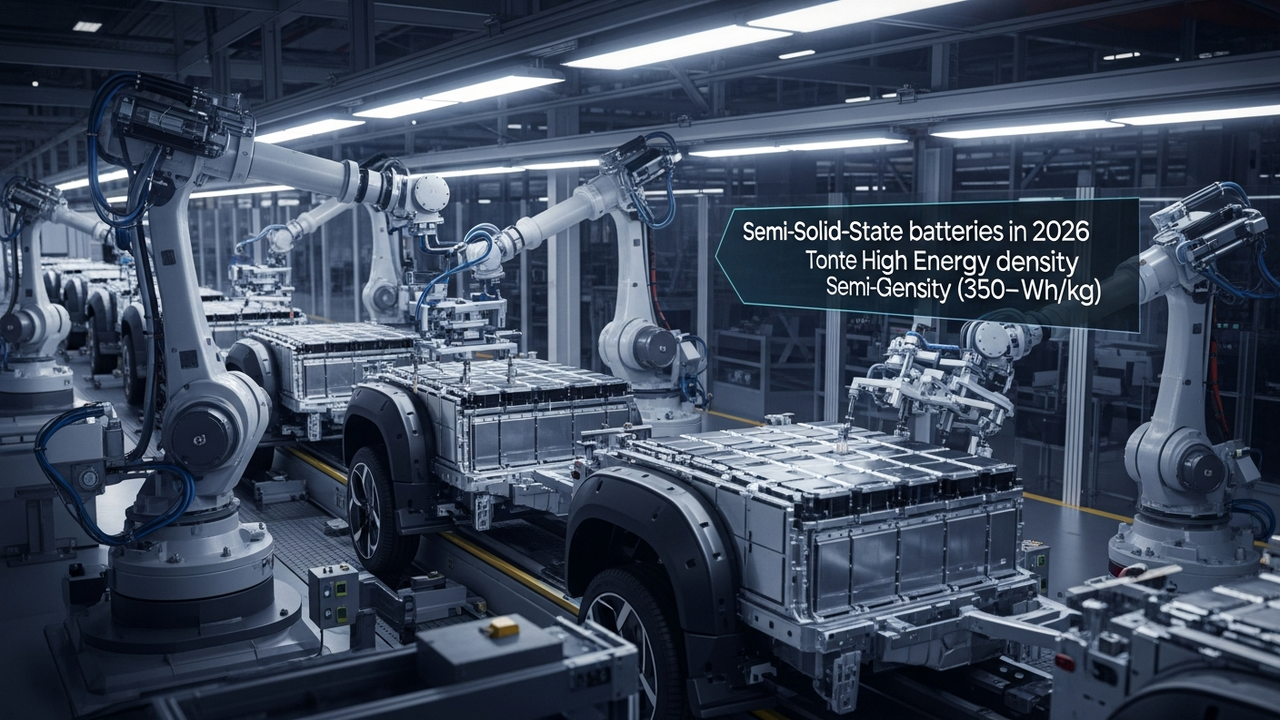
The year 2026 is a pivotal moment for the full-scale commercial deployment of semi-solid (hybrid liquid-solid) batteries within the EV sector. Major Chinese EV manufacturers, including NIO (with its ET9 model), MG (MG4), GAC (Hyper series), and Chery, are progressively introducing models equipped with these advanced battery packs. These semi-solid designs are achieving remarkable energy densities of 350–400 Wh/kg, comparable to or surpassing the performance of existing high-end lithium-ion batteries, which promises substantially extended driving ranges for electric vehicles.
Technically, semi-solid batteries incorporate gel-like or polymer-based solid electrolytes with a carefully controlled, small percentage of liquid electrolyte. This hybrid composition significantly enhances both safety and energy density compared to conventional liquid-electrolyte batteries. The inherent mechanical strength contributed by the solid electrolyte component improves overall battery structural stability, notably mitigating the risk of thermal runaway events. A crucial economic advantage of this semi-solid technology is its high compatibility, leveraging over 90% of existing liquid battery production lines. This allows for integration without extensive modifications to current manufacturing facilities, thus dramatically suppressing new capital investment, containing production cost increases, and accelerating time-to-market. This combination of enhanced performance, improved safety, and cost-effective, rapid deployment makes semi-solid batteries an exceptionally attractive option for a growing number of automakers and positions them as a critical ‘bridge’ technology until true all-solid-state batteries are ready for mass market adoption.
Source: https://www.tmtpost.com/8078054.html
Get our weekly technology intelligence — free
Receive an infographic that lets you judge at a glance whether each field’s analysis report is worth reading.
Subscribe Free — Weekly Tech Intelligence
By subscribing, you’ll receive Troy-Technical’s weekly technology intelligence newsletter.
- Your email and selected fields are used only to deliver the newsletter.
- We never share your information with third parties.
- You can unsubscribe anytime via the link in each email.
See our Privacy Policy for details.
Takes about a minute · Unsubscribe anytime





Comments