
Background: Scaling Challenges in High-Power AI Data Centers
The explosive growth of AI workloads has intensified the power and density challenges within data centers. High-bandwidth optical transceivers, essential for connecting GPUs and AI accelerators, require powerful laser arrays that consume significant energy and generate substantial heat. Traditionally placed on the network interface card (NIC) faceplate, these laser arrays create physical space and thermal dissipation bottlenecks, hindering rack density scaling. While liquid cooling is increasingly used for CPUs and GPUs, its application to optical interconnects has been a nascent but critical area of innovation.
Key Findings: Lightmatter’s Guide DR — A Liquid-Cooled Optical NIC
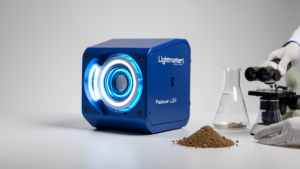
Lightmatter has introduced a groundbreaking solution to these challenges with Guide® DR, the industry’s first liquid-cooled Laser Network Interface Card (LNIC) in an OCP NIC 3.0 form factor. This innovation redefines how optical interconnects are integrated and managed in AI data centers:
- Laser Array Relocation: The most significant innovation in Guide DR is the relocation of the high-density laser array from the NIC faceplate to an internal position within the chassis. This strategic move liberates the faceplate, which is a key scaling bottleneck, allowing for more optical ports and higher overall density.
- Quadrupled Rack Density: By integrating the laser array internally and coupling it with existing liquid cooling infrastructure, Guide DR enables a fourfold increase in optical interconnect density per rack. This is crucial for maximizing the utilization of valuable data center space and supporting the expansion of AI superclusters.
- Leveraging Existing Liquid Cooling: Guide DR is designed to seamlessly integrate with standard liquid cooling systems already present in many modern data centers. Direct liquid cooling of the lasers offers significantly more efficient heat dissipation than air cooling, improving laser performance, reliability, and lifespan.
- Massive Bandwidth Support: The LNIC is capable of supporting up to 51.2 Tbps of aggregate scale-up bandwidth, facilitated through either Co-Packaged Optics (CPO) or Near-Packaged Optics (NPO). This immense capacity is vital for connecting thousands of XPUs (AI processors) within large-scale AI clusters, ensuring that data movement keeps pace with computational demands.
Technical Significance & Outlook: Enabling Next-Gen AI Scaling
Lightmatter’s Guide DR is a technically significant development that directly addresses fundamental scaling limitations in AI infrastructure. By innovating at the intersection of optics, packaging, and thermal management, it provides a powerful solution to overcome the ‘power wall’ and ‘density wall’ in AI data centers. The benefits are profound:
- Sustainable AI Growth: Improving power efficiency and physical density directly contributes to a lower Total Cost of Ownership (TCO) and a more sustainable environmental footprint for AI operations.
- Unlocking XPU Potential: By ensuring abundant and efficient interconnect bandwidth, Guide DR allows AI accelerators to operate at their peak performance, accelerating training times for complex models and enabling new AI capabilities.
- Setting a New Standard: This product sets a new benchmark for optical engine integration and thermal management in AI networking, likely influencing future designs and industry standards.
The integration of liquid cooling with advanced optical interconnects, as demonstrated by Guide DR, is a critical trend that will shape the future architecture of AI compute. It represents a bold step towards building the high-performance, energy-efficient foundations required for the next era of artificial intelligence.


Comments