Key Findings
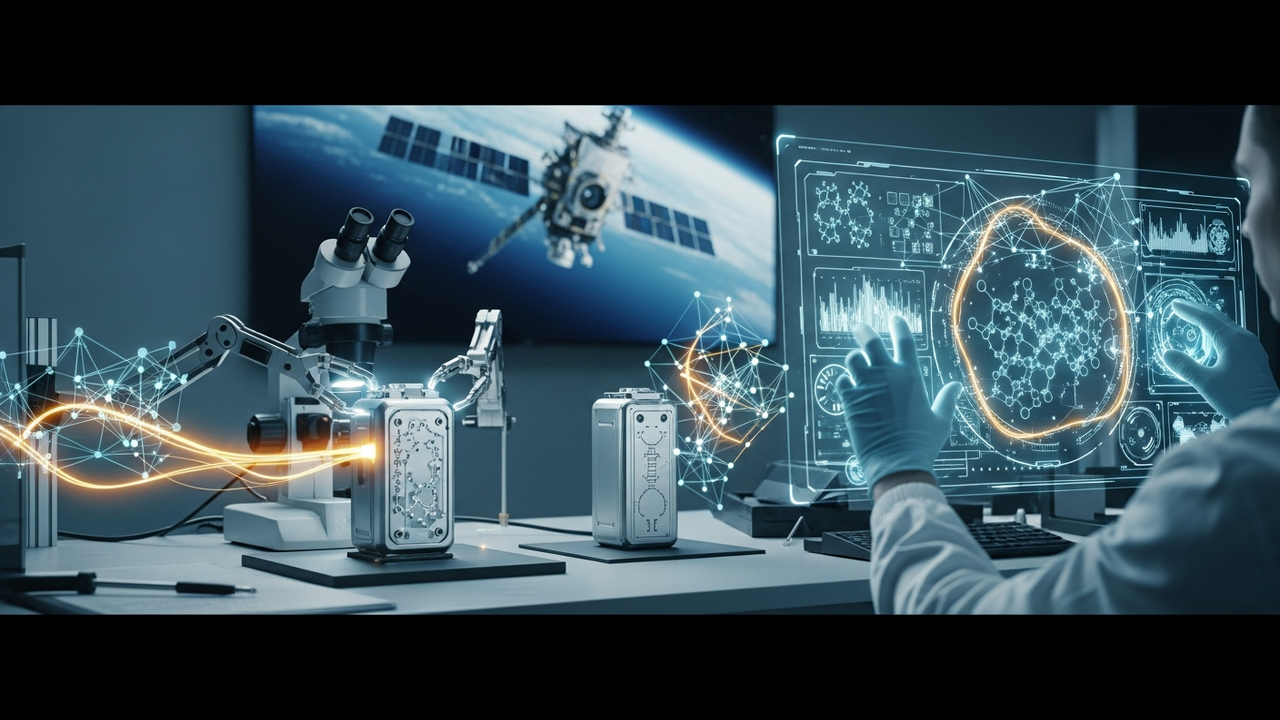
A paper published on July 17, 2026, in ACS Nano, titled ‘Unlocking the Chemical Space for Rechargeable Batteries with a Generative Solvent Design System,’ introduces a groundbreaking Generative Solvent Design System (GSDS) that could revolutionize electrolyte design for rechargeable batteries. By integrating a graph-based molecular generator with machine learning (ML) property predictors, this system enables efficient exploration of an unprecedentedly vast chemical space to identify high-performance battery solvent candidates. This technology is poised to significantly accelerate materials development, especially in fields demanding stringent performance criteria, such as space-grade batteries.
Technical Details
The GSDS comprises two main components. Firstly, the graph-based molecular generator learns from structural information of known solvent molecules and autonomously generates novel molecular structures. This enables the efficient creation of a much more diverse set of molecules than researchers could design manually. Secondly, the machine learning property predictor rapidly and accurately forecasts the physicochemical properties (e.g., dielectric constant, viscosity, electrochemical stability) of each generated molecule. These predictions are based on models trained with DFT calculations and experimental data. The system iteratively cycles through generation and prediction, searching for and optimizing solvent molecules that meet specific target performances. This enables rapid identification of solvents possessing properties crucial for space environments, such as excellent ion conductivity, a wide electrochemical window, and good low-temperature performance.
Background & Context
High-performance rechargeable batteries are indispensable across all facets of modern society, from electric vehicles and portable electronics to spacecraft and satellites. For space applications in particular, there is a demand for high-energy-density, highly stable batteries that can function under extreme conditions, including wide temperature fluctuations, radiation, and long-term reliability. However, conventional electrolyte development has been an inefficient trial-and-error process of searching for optimal candidates from a vast number of molecular possibilities. To overcome this bottleneck, data-driven approaches leveraging AI and machine learning have been strongly sought after, and GSDS stands at the forefront of this technological advancement.
Strategic Significance & Outlook
The introduction of GSDS is expected to bring about a paradigm shift in the research and development of next-generation battery materials. It will enable the rapid development of high-performance batteries optimized for various space applications, including spacecraft propulsion systems, satellite power supplies, and lunar base energy storage. Crucially, it offers the potential to achieve long-term operation in more extreme space environments, which has been challenging with conventional batteries. Future efforts will involve refining the GSDS algorithms to support the design of more complex electrolyte compositions (e.g., solvent mixtures, additives), thereby expanding its range of applications. This technology will accelerate innovation in space power systems and create new, attractive market opportunities for investors in the space industry.
Source: https://pubs.acs.org/doi/10.1021/acsnano.6c06255
Get our weekly technology intelligence — free
Receive an infographic that lets you judge at a glance whether each field’s analysis report is worth reading.
Subscribe Free — Weekly Tech Intelligence
By subscribing, you’ll receive Troy-Technical’s weekly technology intelligence newsletter.
- Your email and selected fields are used only to deliver the newsletter.
- We never share your information with third parties.
- You can unsubscribe anytime via the link in each email.
See our Privacy Policy for details.
Takes about a minute · Unsubscribe anytime




Comments