Key Findings
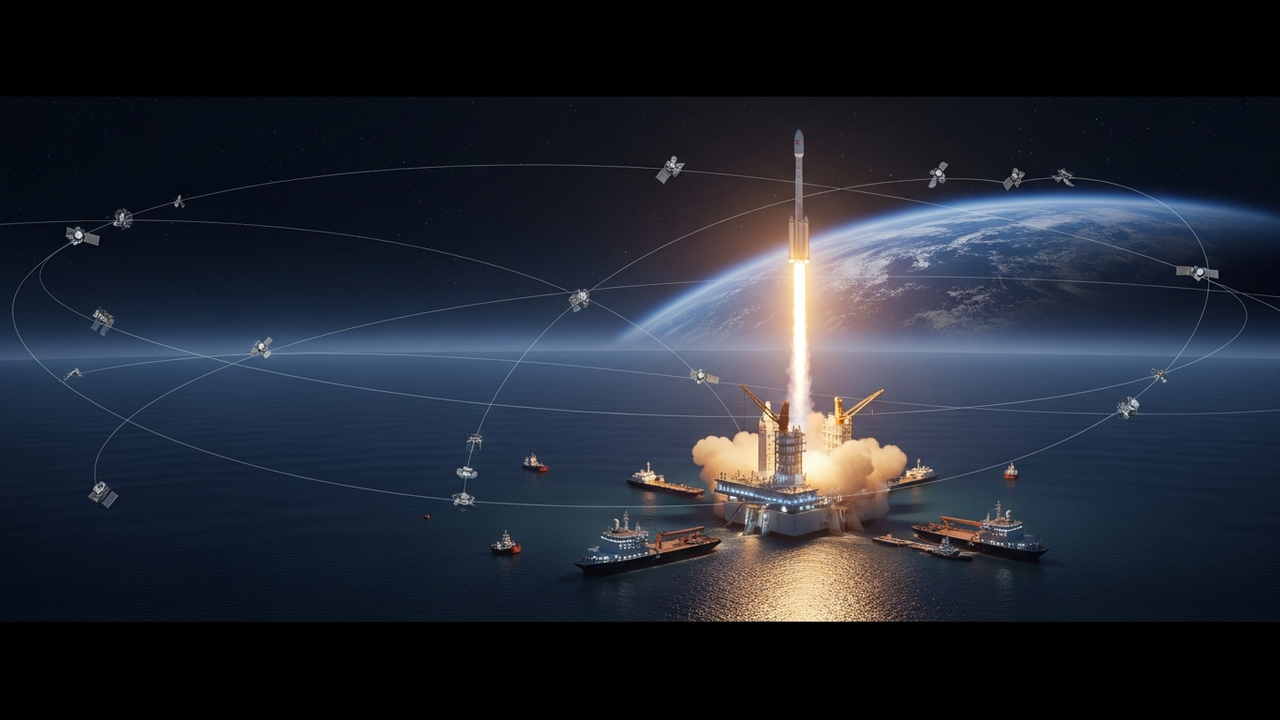
China’s Gravity-1 launch vehicle successfully completed a mission, deploying nine satellites into Sun-synchronous orbit (SSO) from an offshore platform in the East China Sea. This success not only re-affirms Gravity-1’s capability as the world’s most powerful solid-fuel rocket but also robustly demonstrates the significant operational advantages of solid-fuel rockets when utilized from sea-based launch platforms.
Technical & Mission Details
This mission marked the third successful launch for Gravity-1 since its commissioning in 2024. As a solid-fuel rocket, Gravity-1 possesses several key operational advantages compared to liquid-fueled rocket systems. Liquid-fueled rockets require complex propellant loading, cooling, and stringent temperature control, demanding extensive preparation time, a larger crew, and carrying inherent risks due to the flammability and explosiveness of their propellants. In contrast, solid-fuel rockets, with their solid propellant, feature simpler structures, eliminate the need for propellant loading, are easier to store and transport, and have shorter launch preparation times. These characteristics make them exceptionally well-suited for offshore launches, facilitating access to specific orbital inclinations and reducing dependency on inland launch facilities.
The nine satellites launched in this mission were placed into Sun-synchronous orbit. This orbit is ideal for Earth observation and remote sensing satellites, as it allows them to consistently pass over any given point on Earth at the same local solar time, enabling continuous collection of high-precision Earth observation data.
Background & Industry Context
In recent years, the global space industry has witnessed significant trends toward reducing launch costs, increasing launch frequency, and diversifying launch locations. Offshore launches offer strategic benefits, such as minimizing the risk of rocket debris falling over populated areas and leveraging Earth’s rotational speed for increased launch efficiency when launched near the equator. As China accelerates its national space program, it is also actively supporting commercial launch services by private companies, with offshore launch technology positioned as a crucial element for enhancing its competitiveness.
Strategic Significance & Outlook
The successful offshore satellite launch by Gravity-1 will contribute to the further development of China’s commercial space industry. The combination of solid-fuel rocket characteristics and offshore launch capabilities provides rapid and flexible launch options, strengthening its responsiveness for the small satellite market and urgent missions. This enables China to offer more competitive choices in the global launch market and is expected to expand its influence in data collection, communication services, and Earth observation in space. This technology reinforces a strategic foundation for China to solidify its position as a major space power.
Get our weekly technology intelligence — free
Receive an infographic that lets you judge at a glance whether each field’s analysis report is worth reading.
Subscribe Free — Weekly Tech Intelligence
By subscribing, you’ll receive Troy-Technical’s weekly technology intelligence newsletter.
- Your email and selected fields are used only to deliver the newsletter.
- We never share your information with third parties.
- You can unsubscribe anytime via the link in each email.
See our Privacy Policy for details.
Takes about a minute · Unsubscribe anytime






Comments