Key Findings
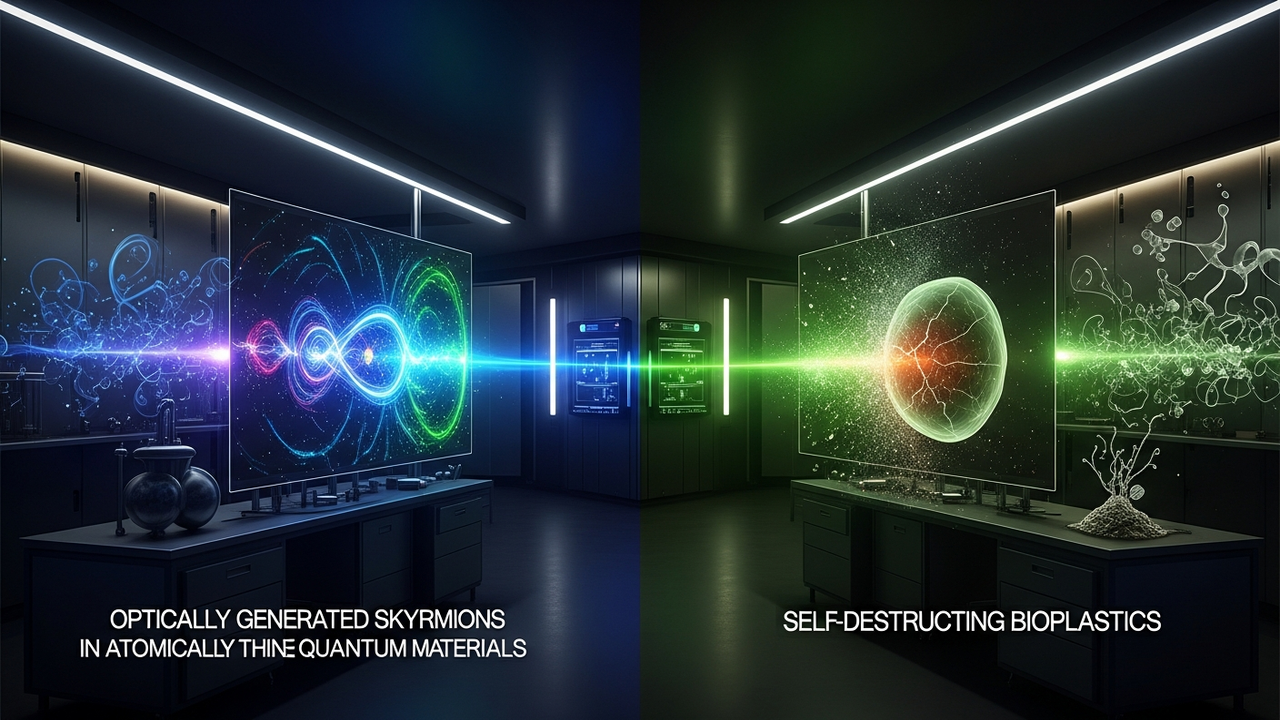
Breakthroughs across materials science include a surprisingly simple method for generating exotic optical skyrmions in atomically thin quantum materials, the laboratory creation of complex carbon-rich cosmic dust under simulated space conditions, and the development of self-destructing bioplastics engineered for complete biodegradation by specific bacteria.
Technical / Clinical Details
The generation of optical skyrmions in quantum materials utilizes the Poisson spot, a phenomenon where light diffracts around an opaque disc to form a bright central spot. Applying this principle to two-dimensional quantum materials offers a simplified pathway to forming these complex light structures, which could revolutionize fields like nonlinear optics and high-density data storage. Separately, researchers successfully simulated cosmic conditions in the lab to synthesize complex carbon-rich molecules, mimicking interstellar dust. This advancement provides critical insights into the formation of organic matter in space and the origins of life beyond Earth. The self-destructing bioplastic, designed to be fully broken down by engineered bacteria, represents a significant step towards tackling global plastic waste. This material offers a sustainable alternative to conventional plastics, minimizing environmental impact after disposal.
Background & Context
The interaction of light and magnetism in quantum materials is a cornerstone for future optoelectronic devices and quantum computing, attracting intense global research. Optical skyrmions, in particular, hold promise for ultra-high-density information processing and data transmission. Concurrently, the study of cosmic dust is central to astrobiology and planetary science, seeking to understand the origins of life. The development of self-destructing bioplastics is a crucial response to the escalating global plastic pollution crisis, aligning with circular economy initiatives. These innovations are poised to significantly impact various scientific and industrial sectors due to their inherent novelty and potential for transformative applications.
Strategic Significance & Outlook
The simplified optical skyrmion generation technique is expected to accelerate the development of ultra-fast, low-power optical information processing devices and novel quantum sensors. Advances in cosmic dust synthesis and analysis will contribute to future space exploration missions and the study of extraterrestrial materials, deepening our understanding of life’s potential in the universe. The self-destructing bioplastics, if widely adopted for single-use products and packaging, could fundamentally address plastic pollution, becoming indispensable for realizing a sustainable society. These research efforts not only enhance fundamental scientific understanding but also pave the way for practical, impactful applications.
Source: https://www.sciencedaily.com/news/matter_energy/materials_science/
Get our weekly technology intelligence — free
Receive an infographic that lets you judge at a glance whether each field’s analysis report is worth reading.
Subscribe Free — Weekly Tech Intelligence
By subscribing, you’ll receive Troy-Technical’s weekly technology intelligence newsletter.
- Your email and selected fields are used only to deliver the newsletter.
- We never share your information with third parties.
- You can unsubscribe anytime via the link in each email.
See our Privacy Policy for details.
Takes about a minute · Unsubscribe anytime








Comments