Key Findings
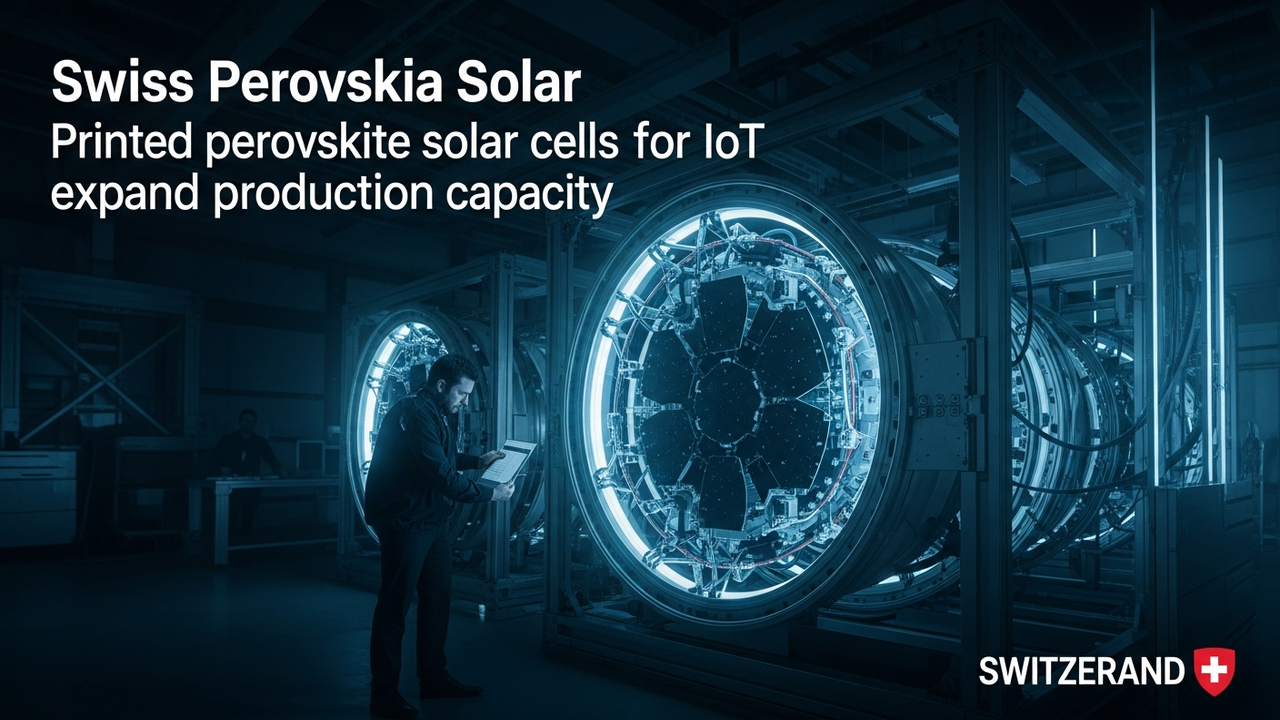
Perovskia Solar, an innovative Swiss startup, has successfully raised $2.4 million in seed funding for its printed perovskite solar cell technology, specifically designed for Internet of Things (IoT) devices. The company has already secured 10 customers and plans to significantly expand its production capacity to 1 million cells annually with this investment. This move clearly demonstrates the commercial potential of perovskite technology in delivering sustainable and autonomous power supply solutions for the burgeoning IoT market.
Technical / Clinical Details
Perovskia Solar’s core technology centers on printed perovskite solar cells that operate efficiently in low-light conditions. These cells possess the unique ability to generate high power conversion efficiency even under weak indoor lighting or artificial light, a challenge for traditional silicon solar cells. The company’s printing technology significantly reduces manufacturing costs and allows for the fabrication of solar cells on flexible substrates, making them easily integratable into a diverse range of IoT devices such as sensors, smart tags, electronic shelf labels, and wearable electronics, regardless of their shape or size. The raised capital will be used to expand production capacity from tens of thousands to 1 million cells per year. A particular focus will be on investing in back-end automation of the production process to ensure consistent quality and high yield. This will improve reliability and cost-efficiency in mass production, facilitating the widespread adoption of perovskite solar cells.
Background & Context
The rapid proliferation of IoT devices has highlighted challenges related to battery life and power supply. In an era where millions, if not billions, of devices are networked, the cost and environmental impact of battery replacement are considerable. Consequently, there is growing demand for indoor photovoltaics (IPVs) that can generate electricity from ambient light. Perovskite solar cells, with their high power conversion efficiency and tunable bandgaps, are considered the most promising candidates for IPVs in low-light environments. Perovskia Solar’s successful seed funding and early customer acquisition indicate that this market is reaching technological maturity and gaining commercial traction. As a spin-off from Empa (Swiss Federal Laboratories for Materials Science and Technology), the company benefits from a robust technological foundation.
Strategic Significance & Outlook
Perovskia Solar’s investment in expanding production capacity and back-end automation will accelerate the market entry of perovskite solar cells for IoT devices. The target of 1 million cells annually will promote the adoption of battery-less devices within the IoT ecosystem, contributing to the realization of maintenance-free smart devices. Future efforts will focus on further fundraising, expanding the product portfolio, and expanding into global markets. The company’s success demonstrates that perovskite technology can become a strong alternative to existing power solutions in niche, high-value markets, and is expected to play a crucial role in building a sustainable IoT future.
Source: #
Get our weekly technology intelligence — free
Receive an infographic that lets you judge at a glance whether each field’s analysis report is worth reading.
Subscribe Free — Weekly Tech Intelligence
By subscribing, you’ll receive Troy-Technical’s weekly technology intelligence newsletter.
- Your email and selected fields are used only to deliver the newsletter.
- We never share your information with third parties.
- You can unsubscribe anytime via the link in each email.
See our Privacy Policy for details.
Takes about a minute · Unsubscribe anytime