Key Findings
A research team at the University of Wisconsin-Madison has developed a pioneering new full-wave simulation framework for thoroughly analyzing Kerr frequency comb generation. The findings, published in the IEEE Journal of Selected Topics in Quantum Electronics, offer novel insights into the complex physical processes involved in Kerr comb generation and significantly simplify the design of next-generation photonic components.
Technical Details and Simulation Significance
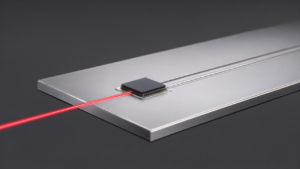
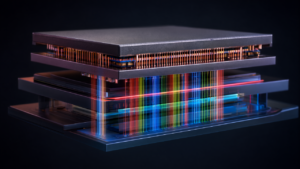
- Kerr Frequency Comb: A Kerr frequency comb is a collection of numerous discrete, equally spaced laser light frequencies generated through nonlinear optical effects (Kerr effect) within an optical resonator. It functions as an ultra-stable ‘optical ruler,’ with widespread applications expected in high-precision timing, precision spectroscopy, high-capacity optical communication, and quantum technologies (quantum computing, quantum sensing).
- Full-Wave Simulation Framework: Traditional modeling of Kerr combs often relied on simplified approaches (e.g., envelope equations). However, this new full-wave simulation framework more rigorously describes the interaction of light and matter based on Maxwell’s equations, enabling detailed analysis of the optical field’s behavior within the resonator in the time domain. This allows for accurate consideration of more complex resonator geometries and material properties.
- Simplified Design and New Insights: The framework makes it easier for researchers to virtually explore and optimize various design parameters (e.g., resonator shape, material, pump power) that affect Kerr comb performance. Visualizing the dynamic process of comb generation also provides deeper understanding of previously unclear physical mechanisms (e.g., inter-mode coupling, role of dispersion), leading to the design of higher-performance devices.
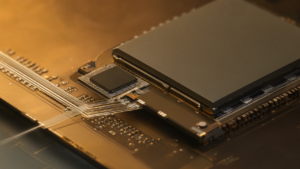
- Compact Integrated Frequency Comb Devices: This simulation technology is particularly effective for designing and optimizing chip-scale frequency comb devices. It serves as a crucial tool for developing compact, robust, and efficient Kerr combs on integrated photonics platforms.
Background and Industry Context
Optical frequency combs, celebrated as ’21st-century optical Nobel Prize-winning’ technology due to their innovative properties, are enabling breakthroughs across many scientific and technological fields. However, their generation process involves a complex interplay of nonlinear effects, requiring advanced expertise and computational power for theoretical understanding and practical design. Specifically, the development of Kerr combs on integrated photonics is key to device miniaturization and mass production, but a lack of high-precision simulation tools has been a challenge. This research addresses that gap.
Strategic Significance and Outlook
The research results from the University of Wisconsin are highly significant for accelerating the commercialization and broad application of Kerr frequency comb technology. The availability of more reliable simulation tools will shorten R&D cycles, fostering innovation in fields where Kerr combs are indispensable, such as high-precision measurement, terabit optical communication, quantum sensors, and optical atomic clocks. This framework also holds potential for future application in the design of other nonlinear photonic devices, further expanding the frontiers of optical technology. Investors should recognize the new market opportunities presented by the advancement of Kerr comb technology.
Get our weekly technology intelligence — free
Receive an infographic that lets you judge at a glance whether each field’s analysis report is worth reading.
Subscribe Free — Weekly Tech Intelligence
By subscribing, you’ll receive Troy-Technical’s weekly technology intelligence newsletter.
- Your email and selected fields are used only to deliver the newsletter.
- We never share your information with third parties.
- You can unsubscribe anytime via the link in each email.
See our Privacy Policy for details.
Takes about a minute · Unsubscribe anytime