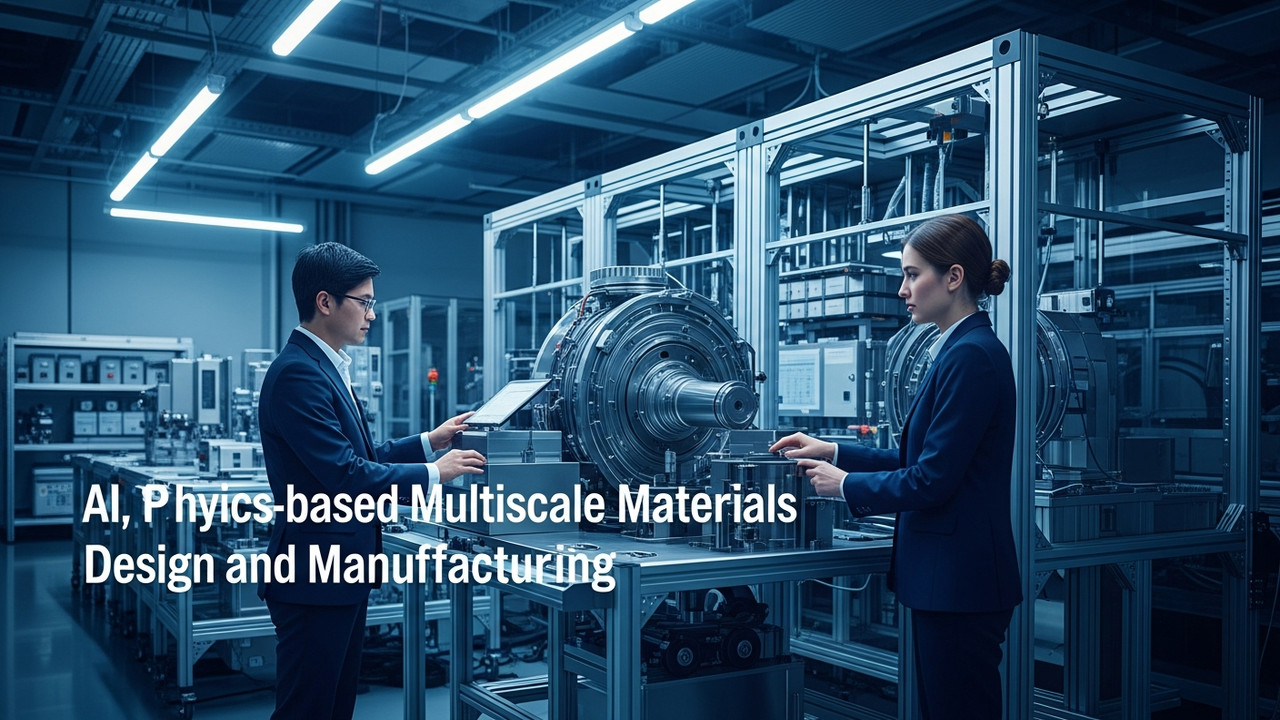
Background and Motivation
The development of novel functional materials is a critical driver for advancements across diverse industries, including electronics, energy, healthcare, and aerospace. Traditionally, materials discovery has been a labor-intensive, trial-and-error process, demanding significant time and resources. The advent of advanced computational methods and artificial intelligence (AI) has opened new avenues for revolutionizing this paradigm. Specifically, the integration of multiscale design, which considers material properties from the atomic to the macroscopic system level, with generative AI approaches holds immense promise for accelerating innovation.
Course Objectives and Key Curriculum
MIT Professional Education’s new course, “Generative Multiscale Materials Design: Physics, AI, Manufacturing,” addresses this emerging need by providing a comprehensive education in these cutting-edge methodologies. The program is designed to teach participants how to implement autonomous AI workflows for inventing transformative smart materials, by seamlessly integrating physics-based computational modeling with generative AI techniques. Key learning outcomes include:
- Fundamentals and advanced applications of AI in materials science.
- Principles and practical implementation of multiscale modeling.
- Leveraging generative AI for discovering and designing new materials.
- Predicting and optimizing material properties from atomic to system scales.
- Implementing an integrated approach from conceptualization to physical realization.
This curriculum enables participants to transcend conventional static materials design, fostering capabilities for autonomous reasoning, planning, and the invention of novel materials.
Technical Significance and Outlook
The skills acquired in this program are expected to dramatically enhance the efficiency and pace of new material development. For instance, AI-driven approaches can rapidly identify and design functional alloys, high-performance polymers, self-healing composites, or environmentally adaptive smart textiles, which are crucial for future technologies. Investing in the professional development of experts in this field is paramount for maintaining leadership in global materials innovation. Ultimately, this will lead to significantly shortened research and development cycles, enabling the quicker introduction of more sustainable and high-performance products into society. The ability to autonomously generate and optimize materials could unlock solutions for pressing global challenges, from efficient energy storage to advanced biomedical implants.







Comments