Key Findings: First-in-Class EGFR-HER3 Bispecific ADC Iza-Bren Achieves 48.1% ORR in Phase Ib for Extensive-Stage Small Cell Lung Cancer
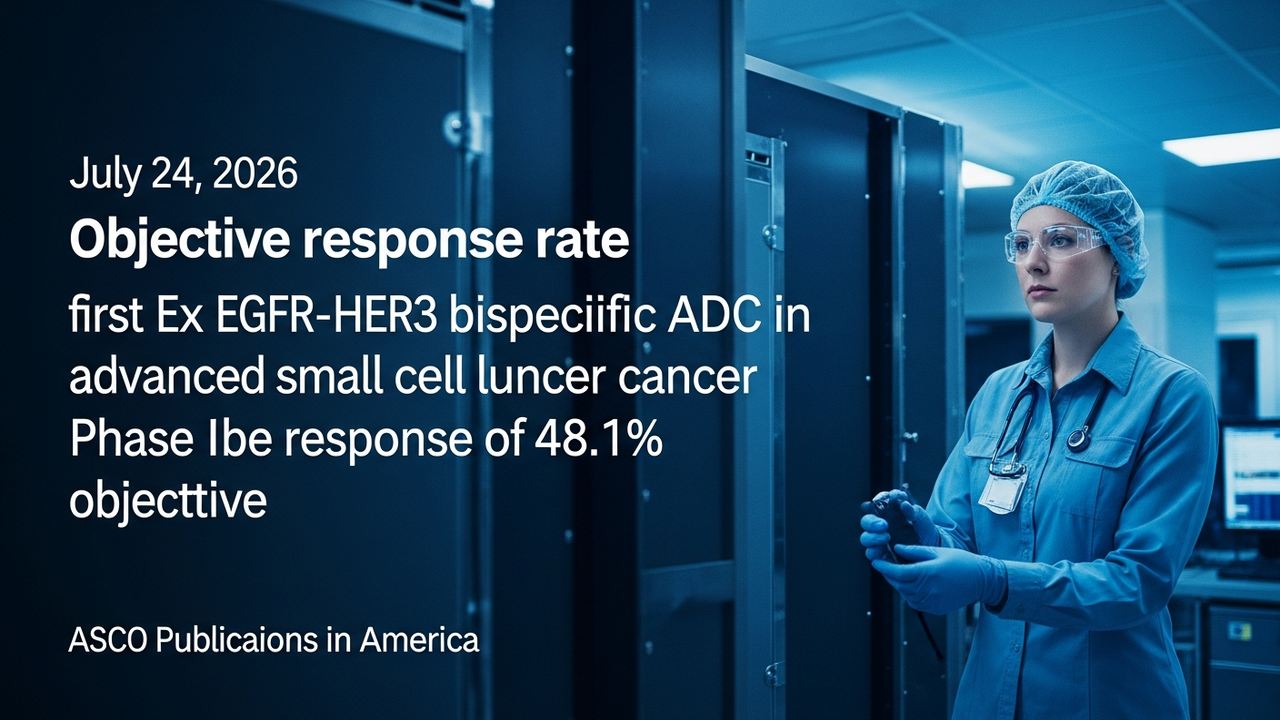
Results from a Phase Ib clinical study of Izalontamab Brengitecan (Iza-Bren), the first-in-class EGFR-HER3 bispecific antibody-drug conjugate (ADC) for patients with extensive-stage small cell lung cancer (SCLC), have been announced. This groundbreaking study demonstrated an impressive objective response rate (ORR) of 48.1% and a median progression-free survival (PFS) of 4.1 months in notoriously difficult-to-treat SCLC, strongly suggesting its potential to usher in a new therapeutic paradigm for SCLC treatment.
Technical and Clinical Details: Bispecific ADC Design and Efficacy in SCLC Patients
Iza-Bren is an intricately designed ADC with the following characteristics:
- Bispecific IgG1 Backbone: It is designed as a bispecific antibody to simultaneously target two receptors crucial for cancer cell proliferation and survival: Epidermal Growth Factor Receptor (EGFR) and HER3. Both EGFR and HER3 are often highly expressed on the cell surface of small cell lung cancer, and dual targeting is expected to lead to a more potent anti-tumor effect.
- Cleavable Linker: The topoisomerase I inhibitor payload (therapeutic drug) is conjugated to the antibody via a cleavable linker. This linker is designed to be cleaved under specific enzymatic or pH conditions once the ADC internalizes into the cancer cell, effectively releasing the therapeutic drug within the cell.
- Topoisomerase I Inhibitor Payload: By inhibiting topoisomerase I, an enzyme essential for DNA replication and repair, the drug induces DNA damage and promotes apoptosis (programmed cell death) in cancer cells.
In the Phase Ib study, a total of 52 patients with extensive-stage SCLC were enrolled and received Iza-Bren as a monotherapy. Key endpoints included safety, pharmacokinetics, and preliminary efficacy. The high ORR of 48.1% suggests that this treatment holds significant clinical relevance for SCLC patients who are resistant to existing therapies. A median PFS of 4.1 months is a promising result, considering the poor prognosis typically associated with extensive-stage SCLC after standard treatments. The safety profile was manageable, with commonly observed ADC-related hematological toxicities and gastrointestinal disorders reported but addressable with appropriate management.
Background and Industry Context: Unmet Medical Needs in Intractable SCLC
Small cell lung cancer (SCLC) is a highly aggressive form of lung cancer, accounting for about 15% of all lung cancers, characterized by rapid proliferation and early metastasis. Despite therapeutic advances, the prognosis for patients with extensive-stage SCLC remains very poor, leading to extremely high unmet medical needs for new treatment options. There is a strong demand for therapies that can improve response rates and extend survival, particularly for patient populations resistant to existing chemotherapy and immunotherapy. Bispecific ADCs like Iza-Bren hold the potential to deliver therapeutic effects unattainable by conventional treatments by simultaneously targeting multiple vulnerabilities of cancer cells.
Future Outlook: Transforming SCLC Treatment and New ADC Possibilities
The positive results from the Phase Ib study of Iza-Bren have the potential to transform the treatment paradigm for extensive-stage small cell lung cancer. It is expected that the efficacy and safety of Iza-Bren will be further validated through larger Phase II and Phase III clinical trials. If these trials show favorable results, Iza-Bren could become part of a new standard of care for SCLC patients. Furthermore, the success of this bispecific ADC could accelerate the development of other bispecific ADCs targeting multiple cancer-related antigens beyond EGFR and HER3, expanding the applicability of ADC technology. This represents a significant advancement towards personalized and precise cancer treatment, suggesting a future where patient prognosis is dramatically improved.
Source: #
Get our weekly technology intelligence — free
Receive an infographic that lets you judge at a glance whether each field’s analysis report is worth reading.
Subscribe Free — Weekly Tech Intelligence
By subscribing, you’ll receive Troy-Technical’s weekly technology intelligence newsletter.
- Your email and selected fields are used only to deliver the newsletter.
- We never share your information with third parties.
- You can unsubscribe anytime via the link in each email.
See our Privacy Policy for details.
Takes about a minute · Unsubscribe anytime