Key Findings
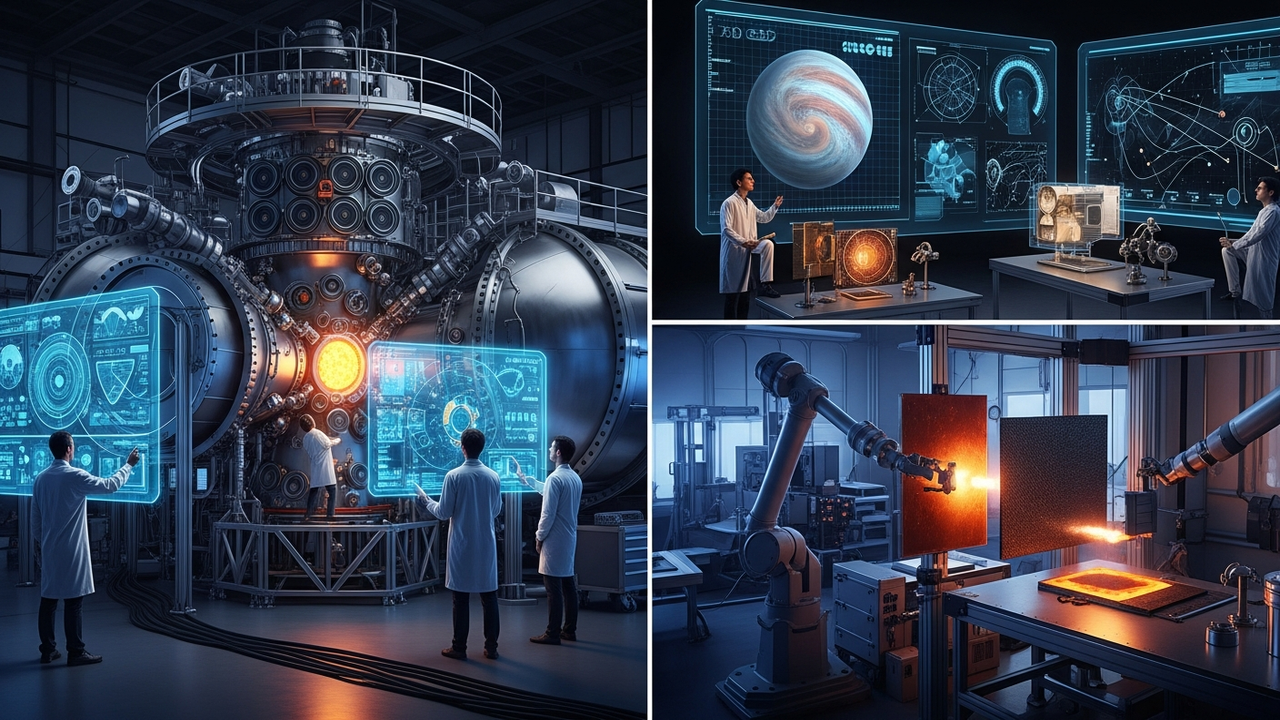
According to a recently published preprint on arXiv, groundbreaking research utilizing the DIII-D tokamak facility is meticulously investigating the mass loss rates and failure modes of spacecraft Thermal Protection System (TPS) materials. This study specifically aims to refine ablation models under high heat flux environments, addressing a long-standing challenge posed by discrepancies between predicted and actual mass loss rates observed during missions such as the Galileo probe’s entry into Jupiter’s atmosphere.
Technical Details
The DIII-D tokamak, primarily used for nuclear fusion research, has demonstrated a remarkable capability to replicate the extreme high heat flux environment experienced by spacecraft entering atmospheres at high speeds. The research team exposed TPS material samples to the DIII-D plasma, precisely measuring surface mass loss, erosion patterns, and failure mechanisms. This methodology allows for a more realistic simulation of material behavior under extreme atmospheric entry conditions, such as those faced by the Galileo probe, which were previously difficult to replicate on Earth. The data obtained will enhance the accuracy of ablation models, providing invaluable insights for designing safer and more efficient thermal protection systems for next-generation spacecraft.
Background & Context
Safe atmospheric entry for spacecraft is one of the most critical technical challenges for human missions and valuable sample return missions. Particularly, the atmospheres of gas giants like Jupiter generate incredibly high heat fluxes and pressures far exceeding those encountered on Earth. Traditional TPS design has heavily relied on laboratory testing and computational models, but the Galileo probe’s data indicated that these models still required significant improvement. The use of tokamak plasma for testing presents a novel method for extreme environment simulation, potentially having a profound impact on the field of aerospace engineering.
Strategic Significance & Outlook
This research utilizing the DIII-D tokamak holds the potential to fundamentally transform the design of thermal protection systems for future planetary probes and reusable space transportation systems. Improved accuracy in ablation models will enable the development of lighter yet more reliable TPS, contributing to enhanced spacecraft payload capacity and reduced mission costs. Furthermore, this methodology could potentially be applied to material development for supersonic and hypersonic vehicles. This innovative approach is expected to be a crucial key to enhancing the safety and efficiency of space exploration.
Source: https://arxiv.org/html/2607.23895v1
Get our weekly technology intelligence — free
Receive an infographic that lets you judge at a glance whether each field’s analysis report is worth reading.
Subscribe Free — Weekly Tech Intelligence
By subscribing, you’ll receive Troy-Technical’s weekly technology intelligence newsletter.
- Your email and selected fields are used only to deliver the newsletter.
- We never share your information with third parties.
- You can unsubscribe anytime via the link in each email.
See our Privacy Policy for details.
Takes about a minute · Unsubscribe anytime