Key Findings: Multifunctional Photonic Crystals Overcome Fundamental Trade-off in Light Control
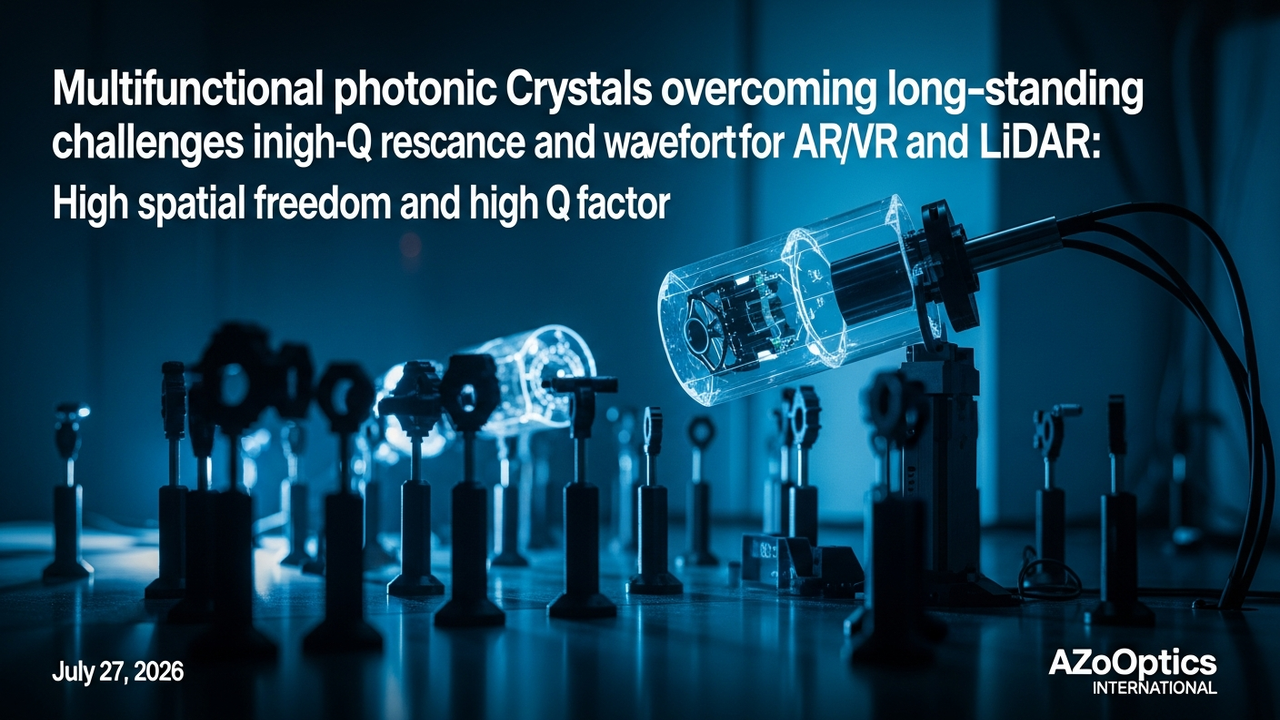
A team of researchers has successfully overcome a long-standing challenge in flat optics: the simultaneous realization of high spatial degrees of freedom (wavefront shaping) and high-Q factor resonances. By introducing specialized structures dubbed ‘metanotches’ into single-layer photonic crystal devices composed of titanium dioxide (TiO2) nanopillars, they experimentally demonstrated the coexistence of localized wavefront shaping capabilities and extremely high-Q factor quasi-Bound States in the Continuum (quasi-BIC) resonances. This breakthrough has significant implications for next-generation optical technologies, including AR/VR, LiDAR, and high-speed communication systems.
Technical and Device Details
- Challenges in Flat Optics: Traditional optical lenses and mirrors suffer from limitations in miniaturization and multifunctionality due to their bulk and complex shapes. Flat optics, such as metalenses, control light with thin films but typically face a trade-off where enhancing wavefront shaping capabilities leads to increased optical losses and reduced Q-factors.
- Multifunctional Photonic Crystal Composition: The newly developed device is based on a single-layer photonic crystal consisting of nanopillar structures fabricated from titanium dioxide (TiO2), a high-refractive-index material. This material exhibits high transparency across a broad spectrum from visible to near-infrared light and boasts high compatibility with CMOS manufacturing processes.
- Introduction of ‘Metanotches’: ‘Metanotches,’ specific geometric features, were introduced into the conventional photonic crystal structure. These metanotches precisely and locally control the light’s path and interactions within the device, while simultaneously enhancing light confinement. This enables the maintenance of high-Q factor quasi-BIC resonances. This unprecedented capability allows for highly efficient energy storage within specific frequency bands of optical signals, coupled with precise wavefront shaping.
- Coexistence of High-Q Quasi-BIC Resonance and Wavefront Shaping: Quasi-BIC resonances leverage the physical phenomenon of ‘bound states in the continuum,’ which theoretically possess infinite Q-factors, enabling very high Q-factors in practice. This high-Q resonance prolongs the interaction time between light and matter, facilitating high-sensitivity and high-efficiency applications like photodetectors and nonlinear optics. Concurrently, localized wavefront shaping via metanotches allows for flexible control over light’s focal position, polarization state, and phase.
Background and Industry Context
Next-generation optical devices demand miniaturization, lightweighting, multifunctionality, and low power consumption. There is a surging demand for innovative flat optics in diverse fields, including augmented reality/virtual reality (AR/VR) headsets, LiDAR systems crucial for autonomous vehicles, high-speed modulators in optical communication, and high-precision sensors. This breakthrough resolves fundamental design constraints faced by these technologies, enabling the development of higher-performance and more compact devices.
Future Outlook and Strategic Significance
This multifunctional photonic crystal is expected to find extensive applications in enhancing the visual experience of AR/VR devices, improving the ranging accuracy and efficiency of LiDAR systems, expanding data transmission speeds and capacities in optical communications, and advancing fields such as acoustic control, thermal management, and high-sensitivity sensors. Crucially, a technology capable of controlling light-matter interactions with such high degrees of freedom and efficiency also opens new avenues for light-based quantum computing and the development of novel optical sensing platforms. This research marks a significant step in shaping the future of flat optics, with profound implications for numerous advanced technological sectors.
Source: https://www.azooptics.com/news.aspx?newsID=32598
Get our weekly technology intelligence — free
Receive an infographic that lets you judge at a glance whether each field’s analysis report is worth reading.
Subscribe Free — Weekly Tech Intelligence
By subscribing, you’ll receive Troy-Technical’s weekly technology intelligence newsletter.
- Your email and selected fields are used only to deliver the newsletter.
- We never share your information with third parties.
- You can unsubscribe anytime via the link in each email.
See our Privacy Policy for details.
Takes about a minute · Unsubscribe anytime