Key Findings: Transparent Self-Healing Polyurethane Elastomer Developed with Near 100% Repair Efficiency via Hydrogen Bonding
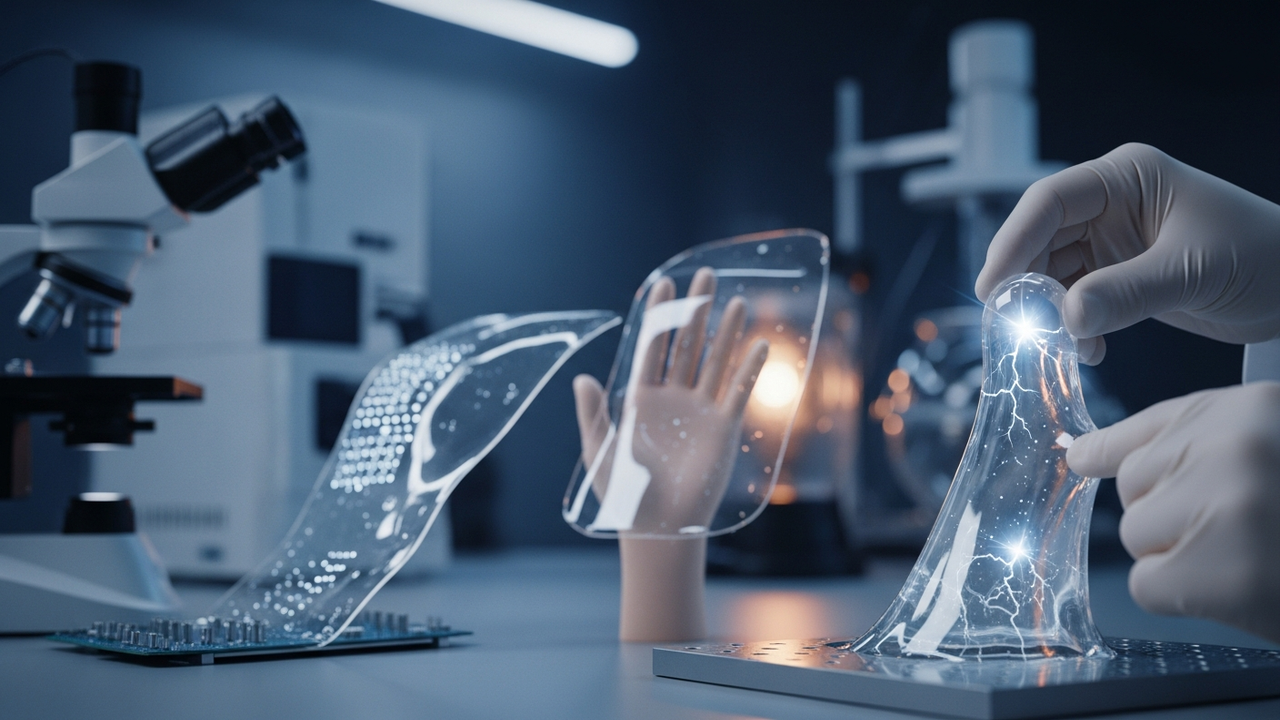
In research published in Chemistry of Materials by ACS Publications, researchers have developed a transparent polyurethane-isophorone-diisocyanate (PUI) elastomer film with exceptional self-healing capabilities by effectively crosslinking isophorone diisocyanate (IPDI) monomer with polyurethane (PU) precursors. This groundbreaking PUI film has been demonstrated to achieve rapid morphological recovery at moderate temperatures, mediated by hydrogen bond interactions, exhibiting a self-healing efficiency of nearly 100%. This achievement has significant implications for the field of flexible electronics.
Technical and Material Details
- Material Design and Synthesis: The research team designed a PUI polymer with an abundant hydrogen bonding network by mixing IPDI monomer and PU precursors in specific ratios and polymerizing them. These hydrogen bonds are key to the material’s mechanism of breaking upon damage and subsequently re-forming.
- Self-Healing Mechanism: When physical damage (e.g., cuts or cracks) occurs in the PUI film, hydrogen bonds are temporarily broken. Subsequently, by placing the material at a relatively low temperature (e.g., room temperature to a few tens of degrees Celsius), the broken hydrogen bonds autonomously re-form, restoring the damaged area to its original state. The study reports a self-healing efficiency of nearly 100%, suggesting that the material fully recovers its original functionality.
- Transparency and Flexibility: The developed PUI film combines high transparency with excellent flexibility. This makes it ideal for applications requiring both optical properties and mechanical flexibility, such as displays, optical sensors, and wearable devices.
- Durability and Reproducibility: The self-healing effect has been shown to be maintained over multiple repair cycles, ensuring the long-term durability and reliability of the material.
Background and Industry Context
Modern electronic devices are advancing in performance, miniaturization, and flexibility, yet they face the unavoidable challenge of damage from drops and everyday wear. Particularly in fields like flexible electronics, wearable sensors, and electronic skin, where materials are subjected to repeated deformation and external physical stress, self-healing capability is an indispensable property for extending product lifespan and improving reliability. Conventional materials often had limited self-healing functions or required high temperatures or specific chemicals, posing barriers to practical implementation.
Future Outlook and Strategic Significance
This transparent self-healing PUI elastomer, based on hydrogen bond interactions, is expected to find applications in a wide range of next-generation electronic devices. Specifically, it could be used in electronic skin that senses touch and self-heals like human skin, highly sensitive and durable sensor devices, self-healing coatings to protect smartphone and tablet displays, and even as a skin material for soft robots. This technology promises to dramatically improve the sustainability and user experience of electronic devices, opening new possibilities for the design of future smart devices.
Source: https://pubs.acs.org/doi/abs/10.1021/acs.chemmater.6c00123
Get our weekly technology intelligence — free
Receive an infographic that lets you judge at a glance whether each field’s analysis report is worth reading.
Subscribe Free — Weekly Tech Intelligence
By subscribing, you’ll receive Troy-Technical’s weekly technology intelligence newsletter.
- Your email and selected fields are used only to deliver the newsletter.
- We never share your information with third parties.
- You can unsubscribe anytime via the link in each email.
See our Privacy Policy for details.
Takes about a minute · Unsubscribe anytime