Background
Perovskite solar cells represent a highly anticipated next-generation photovoltaic technology, renowned for their theoretical high efficiency and potential for cost-effective manufacturing. However, their primary hurdle has historically been ensuring long-term stability and durability, particularly in outdoor environments susceptible to various stressors like extreme temperatures and humidity. For any solar product to gain market acceptance, secure consumer trust, and attract the necessary project financing from financial institutions, rigorous third-party certifications like IEC and UL are indispensable. These certifications serve as a critical prerequisite for validating product reliability and safety, essential for scaling from laboratory research to commercial deployment.
Key Findings
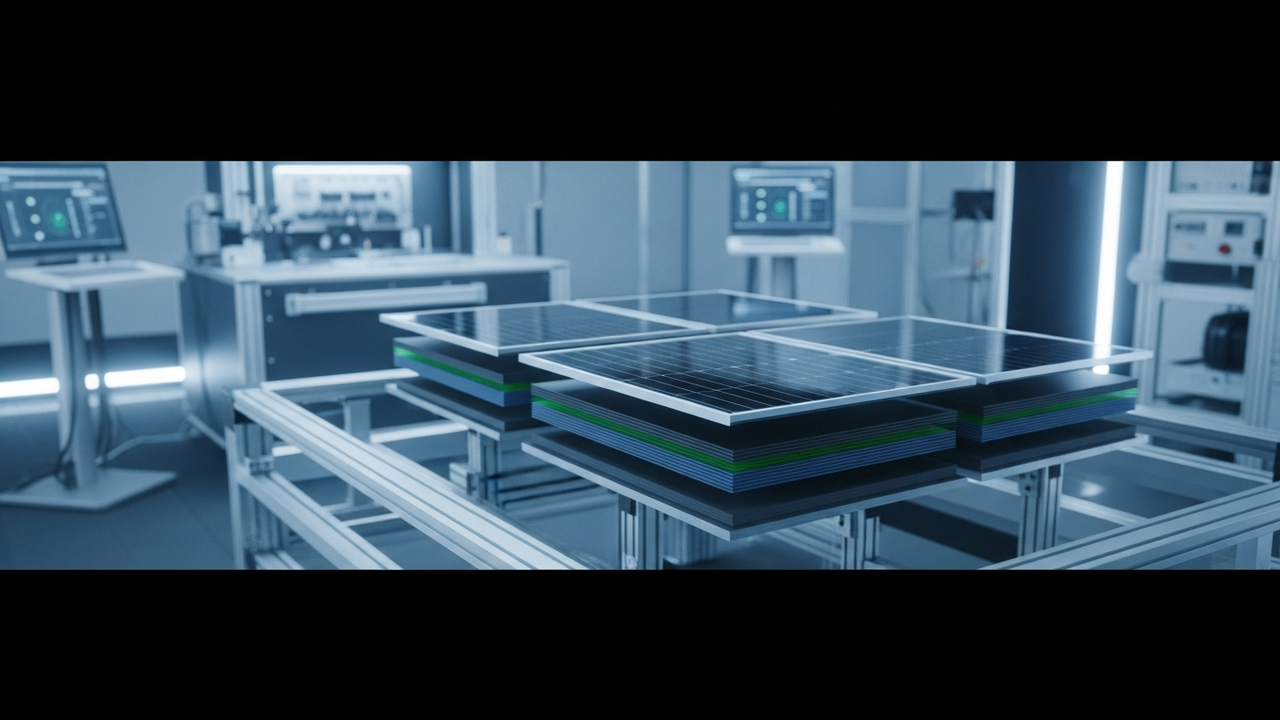
Qcells has achieved a pivotal breakthrough with its newly developed perovskite-silicon tandem solar panels, which have now received official certification from TÜV Rheinland, a globally recognized certification body. This certifies the panels’ compliance with international standards IEC 61215 for reliability and UL 61730 for safety. This landmark achievement is a critical milestone, unequivocally demonstrating that perovskite solar cell technology can maintain long-term reliability and safety even under harsh environmental conditions, moving beyond lab-scale limitations towards commercial mass production and market adoption.
The certification process involved comprehensive testing against key environmental stress factors designed to evaluate the panels’ long-term operational integrity. Qcells’ tandem panels exhibited superior performance in particularly demanding test categories:
- Thermal Cycling Test: The panels successfully endured 200 cycles of extreme temperature fluctuations, ranging from -40°C to 85°C. This rigorous evaluation confirms the material’s robust stress tolerance against the thermal expansion and contraction that occurs daily in real-world conditions.
- Damp Heat Test: The panels were subjected to continuous exposure for 1,000 hours in a high-temperature (85°C) and high-humidity (85% relative humidity) environment. This test specifically assesses the module’s resistance to degradation caused by moisture ingress, a historically significant challenge for perovskite materials.
Successfully passing these stringent tests underscores significant advancements in perovskite layer stability, encapsulation technology, and device architecture optimization. Overcoming the inherent vulnerability of perovskite materials to humidity and achieving compliance with international commercial standards is a groundbreaking accomplishment. This certification not only positions Qcells advantageously in the competitive solar market but also accelerates the adoption of high-efficiency, next-generation solar cell modules globally. It signals that perovskite-silicon tandem technology is nearing readiness for actual market deployment, promising to foster the standardization and widespread adoption of perovskite technology as a whole, thereby substantially enhancing solar power efficiency and ensuring reliability across the industry.
Source: https://www.autonocion.com/qcells-perovskite-solar-panel-iec-ul-certified-reliability/
Get our weekly technology intelligence — free
Receive an infographic that lets you judge at a glance whether each field’s analysis report is worth reading.
Subscribe Free — Weekly Tech Intelligence
By subscribing, you’ll receive Troy-Technical’s weekly technology intelligence newsletter.
- Your email and selected fields are used only to deliver the newsletter.
- We never share your information with third parties.
- You can unsubscribe anytime via the link in each email.
See our Privacy Policy for details.
Takes about a minute · Unsubscribe anytime