Background
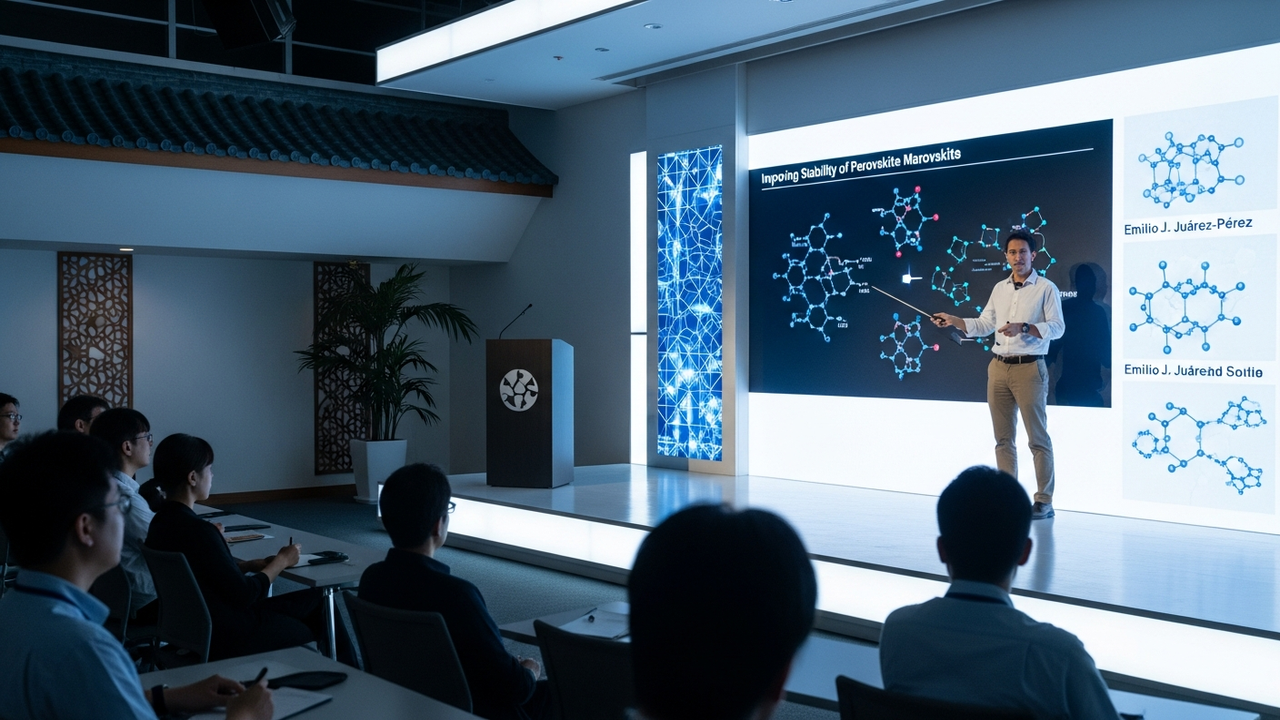
Perovskite solar cells are garnering significant global attention as a promising next-generation photovoltaic technology, primarily due to their high conversion efficiencies and potential for low-cost manufacturing. However, a critical hurdle for their widespread commercialization and large-scale market adoption remains: ensuring long-term reliability and durability that rivals or surpasses existing silicon solar cells. Addressing this challenge, Dr. Emilio J. Juárez-Pérez, a distinguished researcher from Spain’s Aragón Agency for Research and Development (ARAID), delivered a pivotal seminar in Okinawa, Japan, on July 27, 2026. This event served as an important platform for fostering knowledge sharing and joint research initiatives between European and Asian scientific communities, particularly significant given Japan’s world-leading position in fundamental perovskite technology research.
Key Findings & Technical Approaches
During his presentation, Dr. Juárez-Pérez outlined a multi-faceted approach to overcome the biggest challenge for perovskite solar cells: achieving long-term stability. The seminar provided critical insights into practical implementation strategies, emphasizing:
- Deep Understanding of Material Degradation Mechanisms: Comprehensive analysis of how environmental factors, including heat, humidity, and UV radiation, impact perovskite materials, leading to the formation of defects and undesired phase changes. This detailed understanding is crucial for designing more resilient devices.
- Real-World Monitoring Technologies: Introduction of novel methods for real-time observation and assessment of device performance under actual outdoor conditions. This approach moves beyond conventional lab-based accelerated degradation tests, enabling more realistic and accurate reliability evaluations for device deployment.
- Utilization of Open-Hardware Technologies: An innovative strategy that leverages open-source hardware and software throughout the design, manufacturing, and evaluation processes of solar energy devices. This not only significantly reduces research and development costs but also actively promotes broader international collaboration and faster innovation cycles.
These integrated approaches offer robust solutions to the stability challenges faced by perovskite solar cells, harmonizing advancements in materials science, device engineering, and data science.
Strategic Significance & Outlook
The novel approaches to stability enhancement presented by Dr. Juárez-Pérez are expected to provide critical guidance for resolving the long-term reliability challenges inherent in perovskite solar cells. Specifically, the synergistic integration of real-world performance monitoring with open-hardware technologies is anticipated to significantly accelerate the R&D cycle, facilitating the design and validation of more robust and durable devices. Moving forward, these insights are poised to be further developed through international collaborative research, ultimately leading to the market introduction of highly efficient and durable perovskite solar cells. Such advancements will play a vital role in accelerating the global adoption of renewable energy and making substantial contributions to the realization of a sustainable society.
Get our weekly technology intelligence — free
Receive an infographic that lets you judge at a glance whether each field’s analysis report is worth reading.
Subscribe Free — Weekly Tech Intelligence
By subscribing, you’ll receive Troy-Technical’s weekly technology intelligence newsletter.
- Your email and selected fields are used only to deliver the newsletter.
- We never share your information with third parties.
- You can unsubscribe anytime via the link in each email.
See our Privacy Policy for details.
Takes about a minute · Unsubscribe anytime