Background
Perovskite solar cells are widely regarded as ‘next-generation solar cells,’ garnering significant attention due to their high power conversion efficiency and low manufacturing costs. However, ensuring long-term reliability is paramount for their commercialization, and the degradation of electrode materials represents a primary challenge. Given that perovskite materials themselves are sensitive to moisture and oxygen, the stability of electrode materials is critically important in determining the overall device lifetime. Copper, while offering an excellent balance of performance and cost as an electrode material, has presented unresolved stability issues. This discovery bridges a significant gap from both materials science and device engineering perspectives.
Key Findings
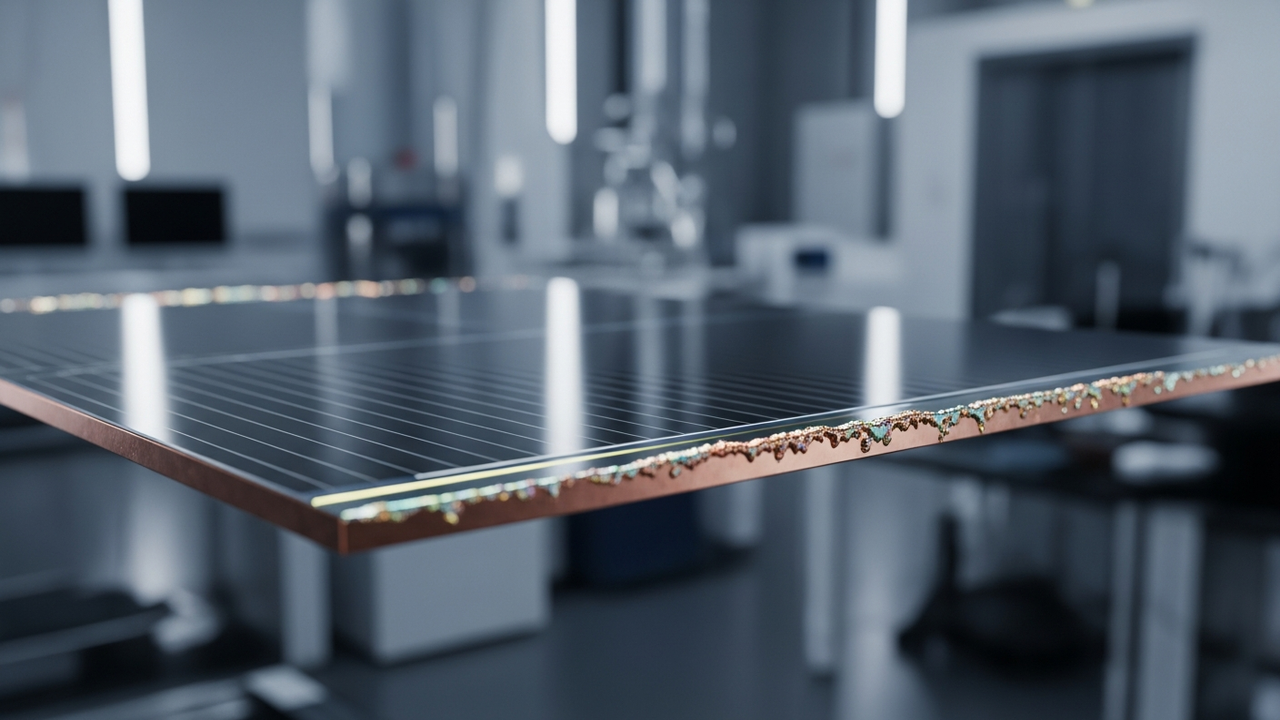
A research team at the Chinese Academy of Sciences (CAS) has uncovered an unexpected mode of degradation: edge corrosion in copper electrodes of perovskite solar cells during operation. This corrosion significantly compromises device performance by reducing charge collection efficiency at the interfaces with perovskite or charge transport layers, thereby increasing device resistance. This leads to a measurable decrease in fill factor (FF) and open-circuit voltage (Voc), posing a critical new challenge for the long-term stability essential for commercialization.
To address this, the CAS team devised a novel strategy: depositing a nanometer-scale thin layer of bismuth (Bi) onto the copper electrode. Bismuth, being less reactive with copper, forms a stable protective film that effectively blocks the chemical degradation process occurring specifically at the copper edges. The introduction of this bismuth protective layer resulted in significantly more stable device operation and substantially improved long-term stability compared to devices employing conventional copper electrodes.
This discovery of copper electrode edge corrosion and the successful establishment of an effective protection strategy using a thin bismuth layer provide indispensable insights for designing robust and reliable perovskite solar cells. This innovation is expected to enable the safe and long-term use of copper electrodes, thereby accelerating cost reduction and commercialization efforts for perovskite technology. Future research will focus on further optimizing the bismuth layer’s thickness and deposition methods, exploring combinations with other electrode materials, and integrating this solution into large-scale manufacturing processes. Ultimately, this work is poised to significantly enhance the reliability of perovskite solar cells, enabling them to play a crucial role in the global energy mix.
Get our weekly technology intelligence — free
Receive an infographic that lets you judge at a glance whether each field’s analysis report is worth reading.
Subscribe Free — Weekly Tech Intelligence
By subscribing, you’ll receive Troy-Technical’s weekly technology intelligence newsletter.
- Your email and selected fields are used only to deliver the newsletter.
- We never share your information with third parties.
- You can unsubscribe anytime via the link in each email.
See our Privacy Policy for details.
Takes about a minute · Unsubscribe anytime