Key Findings
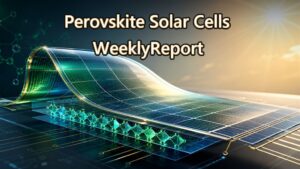
The U.S. Department of Energy’s (DOE) Integrated Energy Systems Office (IESO) is actively advancing research and development (R&D) in perovskite solar cells, with ambitious goals to improve device efficiency and lifespan, reduce manufacturing costs, and ultimately accelerate commercialization. Current data from the National Renewable Energy Laboratory (NREL) indicates efficiencies exceeding 26% for small-area perovskite devices and approximately 34% for perovskite-silicon tandem cells, underscoring the technology’s high potential.
Technical / Clinical Details
- Perovskite solar cells offer distinct advantages over traditional silicon cells, including easier manufacturing, applicability to diverse substrates, and the potential for thin-film and transparent designs. Tandem cell architectures, in particular, promise efficiencies beyond single-junction limits by absorbing different spectral ranges of sunlight more effectively.
- DOE-supported projects focus on enhancing perovskite material stability, developing robust encapsulation technologies, and establishing manufacturing processes suitable for large-scale production. The aim is to bridge the gap between laboratory achievements and commercial product scalability.
- Specific R&D areas include defect passivation, inhibition of ion migration, improvement of moisture and thermal stability, and the exploration of lead-free alternative materials to address environmental concerns.
Background & Context
As global energy demand grows and climate change concerns intensify, the role of renewable energy sources, particularly solar photovoltaics, becomes increasingly critical. Perovskite solar cells, with their innovative characteristics, have the potential to complement the existing silicon solar cell market and create new application domains. The DOE’s proactive funding and research support are integral to a strategic initiative to maintain U.S. leadership in clean energy technologies and bolster domestic manufacturing capabilities.
Strategic Significance & Outlook
The DOE’s sustained R&D support is crucial for overcoming key challenges facing perovskite solar cells: long-term stability, efficiency scaling, manufacturability, and technology validation. If these hurdles are successfully addressed, perovskite solar cells will become a competitive option across a wide range of markets, including residential, commercial, and utility-scale power generation, as well as flexible devices, building-integrated photovoltaics, and transportation applications. The DOE’s efforts are expected to accelerate the market entry of perovskite products in the U.S. and significantly advance the transition to a clean energy economy, positioning the nation at the forefront of solar innovation.
Source: https://www.energy.gov/cmei/systems/perovskite-solar-cells
Get our weekly technology intelligence — free
Receive an infographic that lets you judge at a glance whether each field’s analysis report is worth reading.
Subscribe Free — Weekly Tech Intelligence
By subscribing, you’ll receive Troy-Technical’s weekly technology intelligence newsletter.
- Your email and selected fields are used only to deliver the newsletter.
- We never share your information with third parties.
- You can unsubscribe anytime via the link in each email.
See our Privacy Policy for details.
Takes about a minute · Unsubscribe anytime