Key Findings
All-Photonics Networks (APN) are poised to initiate a paradigm shift in AI data center siting, potentially reducing the industry’s dependence on traditional, concentrated urban data center hubs with their inherent power and space limitations. This technological advancement will enable more distributed and flexible data center deployments, allowing for locations optimized by energy supply availability and specific regional demands. The anticipated outcome is a dramatic improvement in AI computational efficiency coupled with enhanced environmental sustainability for its operations. The Fiber Broadband Association has positioned fiber as the “fourth pillar” of AI, citing current AI chip architectures approaching 30 Tbps/chip and exceeding electrical interconnect capabilities.
Technical & Business Details
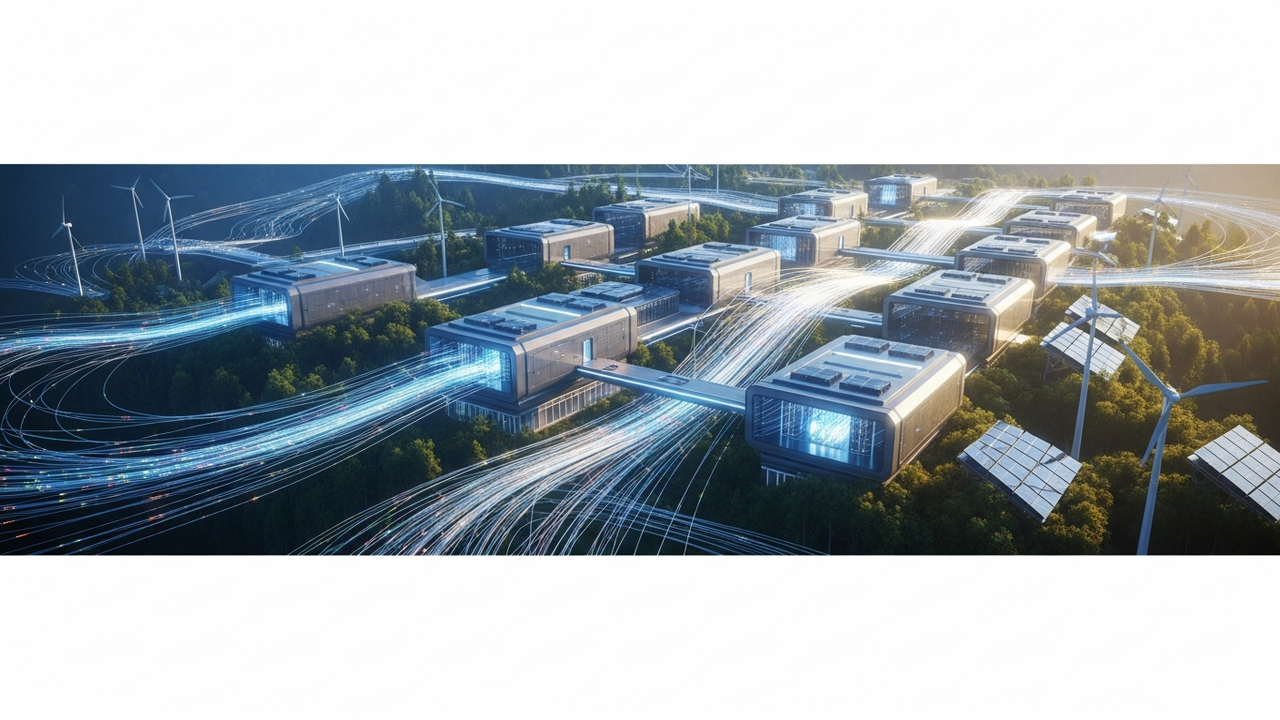
- Driving a Distributed Data Center Model: APN transmits data entirely as optical signals, minimizing signal degradation and enabling long-distance, ultra-low-latency communication. This effectively neutralizes the challenge of physical distances between data centers, facilitating distributed deployments in regions with abundant power, high cooling efficiency, or proximity to specific data generation sources—locations previously considered impractical.
- Enhancing Energy Efficiency and Sustainability: AI data centers consume vast amounts of electricity, and their cooling represents a significant challenge. Optical communication technologies like APN reduce the number of electrical-to-optical conversions, minimizing power loss and improving overall energy efficiency. This is expected to lower operational costs and reduce carbon footprints, contributing to the development of sustainable AI infrastructure.
- Fundamental Improvement in AI Efficiency: In large-scale “AI factories,” high-speed, efficient data movement between chips, servers, and data centers often bottlenecks AI processing performance. Photonics is key to resolving this bottleneck, enabling dramatic increases in data transfer speeds while maintaining power efficiency. This accelerates the training and inference of AI models, facilitating the realization of more complex AI applications.
Background & Context
The evolution of AI demands unprecedented computational and data processing capabilities, pushing existing data center infrastructures to their limits. Specifically, the “siloed” nature of data centers often leads to inefficient resource utilization and increased power consumption. Optical communication technology is recognized as a promising solution to these challenges, serving to strengthen the “brain” and “nervous system” of AI infrastructure. This has fostered a consensus within the industry that to improve AI efficiency, data center connectivity methods must be fundamentally transformed.
Strategic Significance & Outlook
Further advancements in APN and optical communication technologies will accelerate the shift of AI data centers from high-cost, power-constrained urban areas to more optimized, distributed locations. This could also stimulate regional economic development and foster the creation of new industrial clusters. By positioning fiber as an indispensable element of AI, investment in optical infrastructure will intensify, fortifying the foundation to unleash the full potential of AI technology. Future AI will operate on distributed, highly efficient infrastructures powered by advanced optical connectivity.
Source: https://www.photonics.com/Articles/To_Improve_the_Efficiency_of_AI_Lets_Improve/p5/a72338
Get our weekly technology intelligence — free
Receive an infographic that lets you judge at a glance whether each field’s analysis report is worth reading.
Subscribe Free — Weekly Tech Intelligence
By subscribing, you’ll receive Troy-Technical’s weekly technology intelligence newsletter.
- Your email and selected fields are used only to deliver the newsletter.
- We never share your information with third parties.
- You can unsubscribe anytime via the link in each email.
See our Privacy Policy for details.
Takes about a minute · Unsubscribe anytime