Key Findings
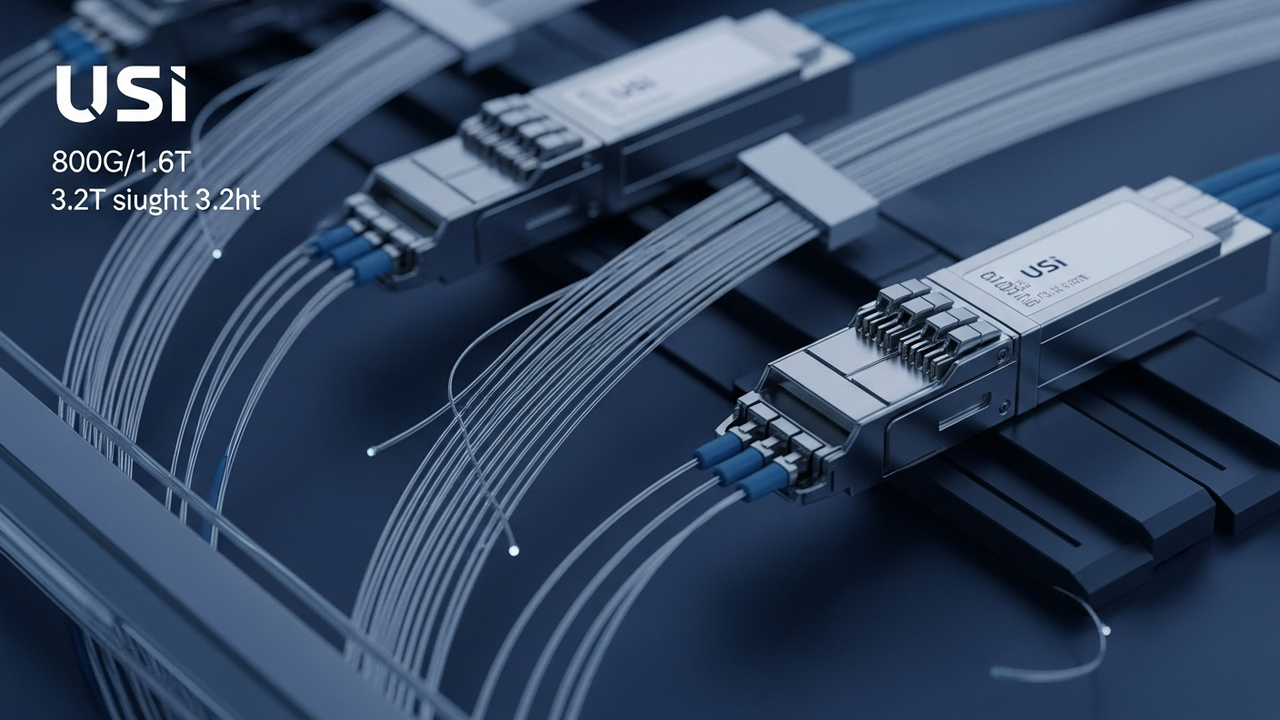
Optical transceiver technology is undergoing rapid evolution to address critical data transfer bottlenecks within AI clusters, with current solutions at 100G and 400G quickly advancing to 800G and 1.6T. Universal Scientific Industrial (USI) highlights that this accelerated progress is directly driven by AI demand, with an eye towards achieving ultra-high-speed 3.2T optical transceivers in the near future.
Technical Details
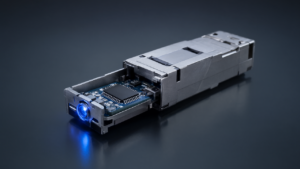
This remarkable progress is underpinned by the maturation of silicon photonics technology and the adoption of advanced integration techniques like Co-Packaged Optics (CPO). Optical transceivers convert electrical signals into optical signals for data transmission over fiber optic cables. In AI clusters, where thousands to tens of thousands of GPUs must be interconnected to exchange vast amounts of data in real-time, high-speed, low-latency, and low-power optical interconnects are indispensable. 800G and 1.6T transceivers achieve high bandwidth by utilizing multiple optical lanes (channels), offering performance that far exceeds the limitations of traditional copper cables, particularly for short-reach data center interconnections.
Background & Context
The evolution of AI is profoundly reshaping data center architectures. While traditional data centers primarily supported internet services and enterprise applications, AI workloads demand much higher computational density and commensurate data movement capabilities. Consequently, optical communication has expanded its role from being the backbone of traditional telecom networks to becoming the primary connectivity technology within data centers (datacom). The current AI boom is a significant growth driver for the optical communications industry, fueling its largest expansion cycle in decades by providing the essential infrastructure for AI’s performance enhancement and widespread deployment.
Strategic Significance & Outlook
The acceleration of optical transceiver speeds is set to continue, with the transition to 3.2T promising to further scale AI clusters and boost their performance. This technological advancement will significantly improve data center power efficiency and contribute to reducing operational costs. Moreover, ultra-high-speed, high-capacity optical interconnects will enable the development of new AI applications and facilitate the training of even more complex AI models. Companies like USI are playing a pivotal role in supporting digital transformation in the AI era by providing these high-performance optical devices, thus becoming integral to the development of next-generation computing infrastructure. For investors, this trend highlights significant business opportunities in the optical component market, extending beyond just semiconductor manufacturers within the broader AI ecosystem.
Source: https://www.usiglobal.com/en/blog/the-rise-of-silicon-photonics-optical-transceiver
Get our weekly technology intelligence — free
Receive an infographic that lets you judge at a glance whether each field’s analysis report is worth reading.
Subscribe Free — Weekly Tech Intelligence
By subscribing, you’ll receive Troy-Technical’s weekly technology intelligence newsletter.
- Your email and selected fields are used only to deliver the newsletter.
- We never share your information with third parties.
- You can unsubscribe anytime via the link in each email.
See our Privacy Policy for details.
Takes about a minute · Unsubscribe anytime