Key Findings
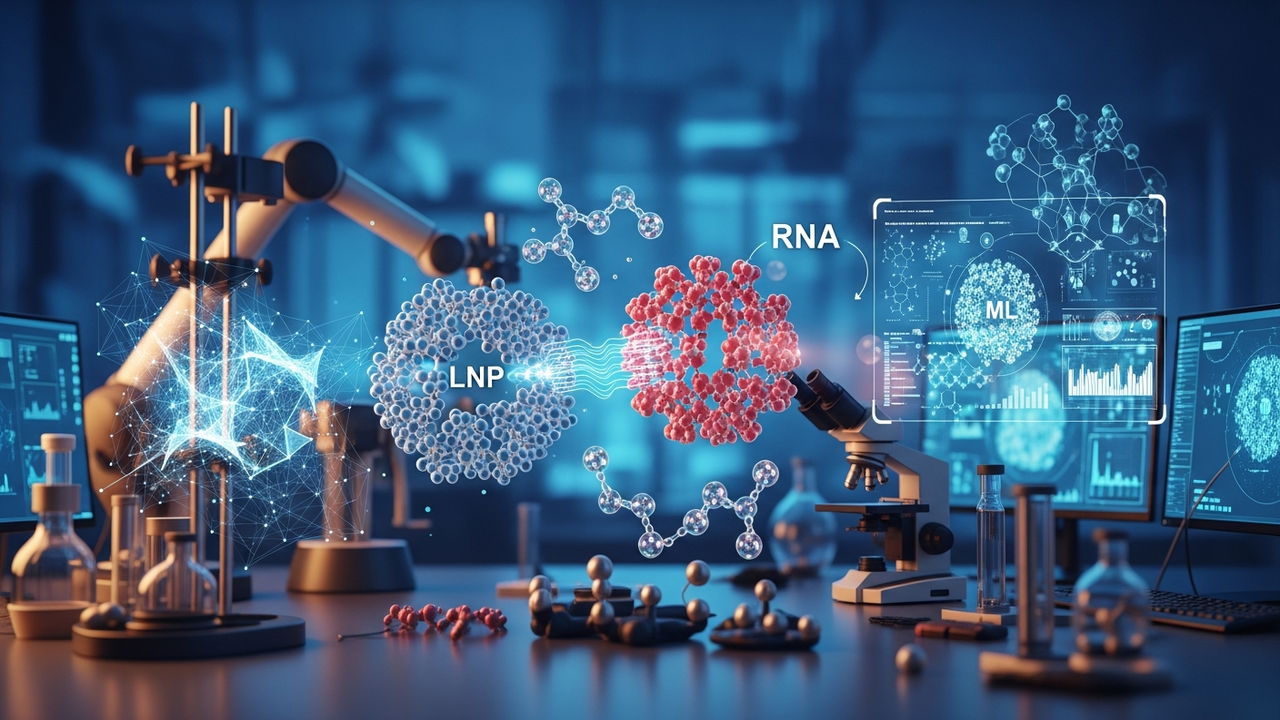
The application of machine learning (ML) to lipid nanoparticle (LNP) design is significantly accelerating the formulation development of critical new modalities, including RNA therapeutics, gene-editing systems, and protein replacement therapies. This ML-driven approach is poised to enhance delivery performance while substantially reducing the experimental burden traditionally associated with LNP optimization, leading to more efficient and rapid development of advanced medicines.
Technical / Clinical Details
ML algorithms analyze vast datasets of experimental LNP formulations to uncover intricate relationships between lipid composition (e.g., ratios of ionizable lipids, phospholipids, cholesterol, and PEG-lipids) and critical performance metrics. These metrics include physicochemical properties like particle size, zeta potential, and nucleic acid encapsulation efficiency, as well as biological outcomes such as cellular uptake, endosomal escape, in vivo tissue distribution, and therapeutic efficacy. While traditional formulation development relies heavily on iterative wet-lab experiments, ML models can learn from these past data to predict optimal LNP compositions in silico, dramatically reducing the number of experiments required. For instance, ML can quickly propose optimal LNP formulations for specific mRNA or siRNA cargoes, tailored for particular disease targets. However, rigorous laboratory validation remains paramount, establishing a crucial feedback loop between in silico predictions and in vitro/in vivo experimental confirmation. LNPs are essential carriers for fragile therapeutic molecules like nucleic acids that are otherwise susceptible to rapid degradation and poor cellular uptake in biological environments.
Background & Context
RNA therapeutics and gene-editing technologies hold immense promise for addressing a wide range of diseases, but their clinical translation has been bottlenecked by the challenge of safe and efficient delivery. LNPs have proven their value as a delivery platform, notably in the success of mRNA vaccines and siRNA therapies. Nevertheless, optimizing LNP compositions for specific nucleic acid cargoes or disease targets remains a time-consuming and resource-intensive process. The integration of ML into LNP design transforms this optimization into a data-driven process, enabling faster and more efficient development. This advancement is critical for overcoming drug development bottlenecks, ultimately shortening the time it takes for novel therapies to reach patients.
Strategic Significance & Outlook
The convergence of ML and LNP design is expected to intensify, with future ML models learning from even larger and more diverse datasets to expand their roles beyond design to include optimization of manufacturing processes, quality control, and even prediction of safety profiles. ML is also anticipated to contribute to the development of ‘smart LNPs’ that allow for more precise targeting to specific tissues or cell types, potentially by designing more sophisticated ligands or responsive materials. This capability could lead to lower dosing, minimized off-target effects, and maximal therapeutic benefits. Furthermore, this technology holds promise for personalized medicine, enabling the rapid design of LNP formulations tailored to individual patient genetic backgrounds and disease characteristics. The ongoing evolution of ML combined with LNP technology will be a powerful driving force behind the advancement of next-generation nucleic acid medicines and gene therapies, fundamentally impacting global healthcare.
Source: https://pharmatica.io/insights/machine-learning-lipid-nanoparticles
Get our weekly technology intelligence — free
Receive an infographic that lets you judge at a glance whether each field’s analysis report is worth reading.
Subscribe Free — Weekly Tech Intelligence
By subscribing, you’ll receive Troy-Technical’s weekly technology intelligence newsletter.
- Your email and selected fields are used only to deliver the newsletter.
- We never share your information with third parties.
- You can unsubscribe anytime via the link in each email.
See our Privacy Policy for details.
Takes about a minute · Unsubscribe anytime