Key Findings
In a groundbreaking advance for materials science, researchers have employed a universal computational strategy to achieve the massive discovery of 9,139 novel low-dimensional materials. This achievement stems from the synergistic integration of universal machine-learning interatomic potentials (UMLIPs) with an interatomic force constant-based method. The newly identified materials encompass a wide array of structures previously overlooked by conventional geometric descriptors, significantly expanding the landscape for 2D materials exploration.
Technical / Clinical Details
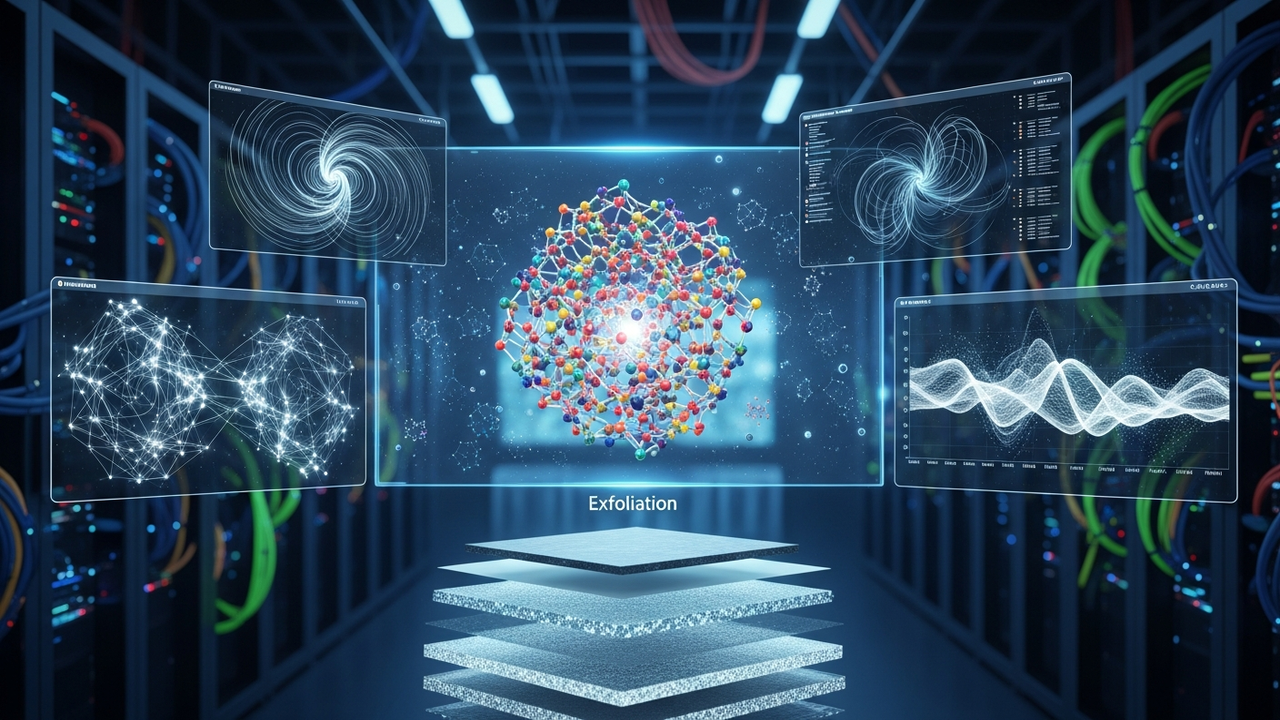
The methodology employed in this research aims to balance precision and efficiency in materials simulation. UMLIPs provide flexible interatomic potentials capable of adapting to diverse atomic environments, thereby enabling large-scale material screening. This is coupled with an interatomic force constant-based stability evaluation, allowing for rapid identification of thermodynamically and dynamically stable materials. As a result, 9,139 novel materials, including clusters, chains, sheets, and ‘mixed-dimensional’ materials that combine these forms, were identified, many of which were absent from existing material databases. A particularly notable finding is that 887 of these 2D materials are deemed easily or potentially exfoliable, akin to graphene. These exfoliable 2D materials hold immense potential to manifest new functionalities in fields such as electronics, catalysis, and energy storage.
Background & Context
Low-dimensional materials, especially 2D materials, have garnered significant attention as cornerstones for next-generation technologies due to their unique electronic, mechanical, and optical properties. While many 2D materials have been discovered since graphene, their exploration has remained a time-consuming and costly process. The computational strategy demonstrated in this study is transformative, enabling comprehensive exploration of regions previously intractable by experimental or purely theoretical approaches. This breakthrough addresses a critical bottleneck in the development of new functional materials, promising an acceleration of innovation.
Strategic Significance & Outlook
The discovery of thousands of new low-dimensional materials provides a vast landscape for materials science research. Particularly, the exfoliable 2D materials are poised to drive breakthroughs in diverse application areas, including ultra-thin devices, high-efficiency catalysts, and next-generation batteries. This universal computational strategy serves as a crucial foundation for further advancements in ‘inverse design of materials,’ where materials are designed on-demand to meet specific functional requirements. It represents a significant step towards the full automation of the materials development process, opening up unprecedented possibilities for technological progress.
Source: https://pubs.acs.org/doi/10.1021/acs.chemmater.5c03151?ref=PDF
Get our weekly technology intelligence — free
Receive an infographic that lets you judge at a glance whether each field’s analysis report is worth reading.
Subscribe Free — Weekly Tech Intelligence
By subscribing, you’ll receive Troy-Technical’s weekly technology intelligence newsletter.
- Your email and selected fields are used only to deliver the newsletter.
- We never share your information with third parties.
- You can unsubscribe anytime via the link in each email.
See our Privacy Policy for details.
Takes about a minute · Unsubscribe anytime