The Race for Next-Gen Memory: Why Traditional Storage Falls Short
Modern data-intensive applications, spanning data centers, IoT devices, industrial automation, and demanding AI/ML workloads, frequently push the limits of conventional storage technologies. These sectors require not only high-speed data processing but also extreme durability and ultra-low latency, areas where traditional NAND flash memory often encounters bottlenecks. While flash has achieved widespread adoption, its inherent limitations in write endurance and performance degradation under continuous writes can hinder the performance of high-demand systems. For years, phase-change memory (PCM) has been a subject of extensive research, envisioned as a ‘universal memory’ capable of bridging the critical performance and persistence gap between dynamic random-access memory (DRAM) and flash storage. Major semiconductor players, including IBM, Micron, Samsung, STMicroelectronics, and Western Digital, have significantly invested in this promising technology, signaling its potential shift from research curiosity to mainstream solution.
Transcend’s Strategic Shift: Integrating PCM into Industrial Solutions
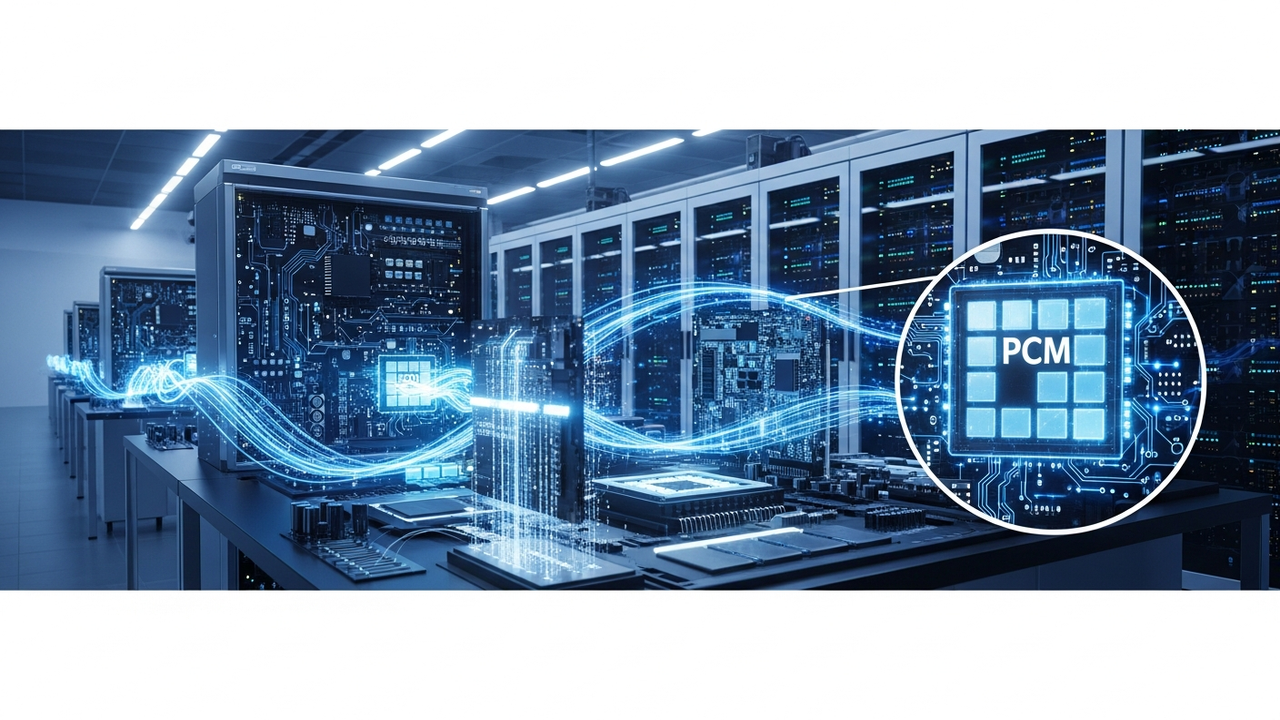
Transcend, a global leader in memory and storage products, is now accelerating the integration of phase-change memory (PCM) technology into its industrial-grade SSDs and DRAM modules. This strategic move is particularly aimed at enhancing mission-critical energy automation systems, where reliability and performance are paramount. Transcend’s initiative underscores the transformative potential of PCM to reshape the industrial storage market by offering a compelling alternative to flash memory. This proactive adoption by Transcend further signifies the maturation and expanding commercial viability of PCM in demanding industrial environments.
Unpacking Phase-Change Memory: A Technical Deep Dive
Phase-change memory (PCM) stands as a non-volatile memory technology that leverages the reversible physical transition of certain materials, typically chalcogenide glass alloys, between an amorphous (high electrical resistance) and a crystalline (low electrical resistance) phase. This phase change is precisely controlled through localized thermal manipulation, unlike flash memory which relies on electron movement through an oxide layer that inevitably leads to wear-out and degradation. PCM’s mechanism, based on atomic rearrangement, fundamentally offers dramatically improved write/erase cycle endurance.
Key Advantages Over Flash Memory
- Superior Write Performance: PCM achieves significantly faster data write speeds, crucial for real-time data logging and high-frequency updates.
- Exceptional Endurance: Capable of hundreds of millions of write/erase cycles, vastly surpassing NAND flash and making it ideal for industrial applications demanding long-term reliability and intensive writes.
- Lower Power Consumption: Consumes less power, particularly during write operations, contributing to energy efficiency in high-density deployments.
- Faster Access Times: Provides high-speed data read and write access, leading to improved overall system responsiveness and reduced latency.
- Byte Addressability: Unlike block-addressable flash, PCM allows for finer, byte-level manipulation of data structures, facilitating more complex and efficient data processing.
Transcend is strategically capitalizing on these inherent characteristics to deliver high-performance PCM-equipped SSDs and DRAM modules designed for industrial applications requiring 24/7 stable operation. A critical advantage for these demanding environments is the guaranteed data integrity and stable performance, even under continuous, high-load conditions.
Broader Strategic Implications and Future Outlook
The widespread adoption of PCM technology, spearheaded by industrial solution providers like Transcend, is poised to profoundly impact the future landscape of data-intensive computing. Its unique advantages make it particularly well-suited for:
- Industrial IoT/Edge Computing: Empowering devices that require real-time data processing, high-endurance storage, and robust performance in challenging environments.
- Autonomous Driving Systems: Enabling high-speed, reliable data logging and critical system operation for vehicle autonomy.
- AI/ML Inference at the Edge: Facilitating rapid data access and low-latency processing essential for edge artificial intelligence applications.
- Next-Generation Data Centers: Contributing to lower power consumption and enabling highly durable storage layers for hyperscale infrastructure.
While challenges remain in optimizing PCM manufacturing costs, achieving even higher densities, and ensuring seamless compatibility with existing system architectures, the compelling performance advantages are expected to drive substantial demand. This demand will be particularly acute in mission-critical applications and areas bottlenecked by current storage limitations. As such, PCM technology is set to establish a new competitive axis within the global storage market, forming a foundational pillar for the next generation of digital infrastructure.
Source: #
Get our weekly technology intelligence — free
Receive an infographic that lets you judge at a glance whether each field’s analysis report is worth reading.
Subscribe Free — Weekly Tech Intelligence
By subscribing, you’ll receive Troy-Technical’s weekly technology intelligence newsletter.
- Your email and selected fields are used only to deliver the newsletter.
- We never share your information with third parties.
- You can unsubscribe anytime via the link in each email.
See our Privacy Policy for details.
Takes about a minute · Unsubscribe anytime