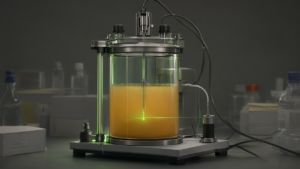
Key Finding: Raman Spectroscopy Advances Real-Time Bioreactor Monitoring, Enhancing Cell Culture Precision and Efficiency
Process Raman Spectroscopy, leveraging fiber-optic probes, enables real-time, in-line chemical monitoring in bioreactors and process streams. This non-invasive and cost-effective technology can track reaction conversion and cell-culture metabolite concentrations without the need for sampling, positioning it as a pivotal tool for Process Analytical Technology (PAT) in biopharmaceutical manufacturing. Raman spectroscopy is also applicable for rapid identification of cell culture media and detection of contaminants by distinguishing between microbes and mammalian cells, playing a crucial role in ensuring product quality and safety.
Technical & Clinical Details: Applications and Challenges
Raman spectroscopy’s ability to provide direct molecular vibrational information allows for continuous monitoring of critical parameters (e.g., glucose, lactate, ammonia, cell density) throughout the culture process. This facilitates faster decision-making and process control compared to traditional off-line analytical methods. Specifically, in fed-batch bioreactors, it can provide continuous indicators of cellular state, such as viability inflection points, especially when combined with capacitance-based biomass probes. This enables earlier detection and precise timing of interventions to manage cell death pathways like apoptosis, ferroptosis, and parthanatos, thereby improving cell culture outcomes. Integration with osmolality tracking further helps mitigate oxidative stress.
However, challenges persist. While effective for identifying high mass percent Raman active components, its sensitivity for low mass percent raw materials and polymorphic detection in complex chemically defined dry powder media is limited. Companies like Merck Millipore are actively researching ways to enhance Raman spectroscopy’s capabilities for complex media identification. Furthermore, a poster presented at ACS Fall 2026 highlights the ongoing research to optimize and refine the sensitivity of Raman spectroscopy for accurate, real-time measurements of viral particles in flow conditions.
Background & Industry Context: Driving PAT and Continuous Manufacturing
The push for PAT in biopharmaceutical manufacturing is a major industry trend aimed at improving quality, efficiency, and enabling real-time release testing. Raman spectroscopy plays a critical role in realizing this PAT strategy, particularly in continuous manufacturing processes, by providing a foundation for ensuring consistent product quality and process robustness. Real-time monitoring is also essential for visualizing polymorph distribution and rapid contaminant detection, contributing to reduced downtime and lower production risks.
Strategic Significance & Outlook: Advanced Integration and Widespread Adoption
Raman spectroscopy represents a significant step towards deepening process understanding and enabling a more controlled and automated manufacturing environment in biopharmaceutical production. As integration with AI and machine learning advances, more complex data analysis will become possible, further enhancing predictive accuracy. It is anticipated that this technology will be widely adopted as a standard monitoring tool across bioprocesses, becoming an indispensable component for efficient and high-quality biopharmaceutical production. This will ultimately contribute to faster development and broader availability of life-saving biologics.
Source: https://www.spectroscopyonline.com/view/measuring-matters-mysteries-with-light-and-plasma
Get our weekly technology intelligence — free
Receive an infographic that lets you judge at a glance whether each field’s analysis report is worth reading.
Subscribe Free — Weekly Tech Intelligence
By subscribing, you’ll receive Troy-Technical’s weekly technology intelligence newsletter.
- Your email and selected fields are used only to deliver the newsletter.
- We never share your information with third parties.
- You can unsubscribe anytime via the link in each email.
See our Privacy Policy for details.
Takes about a minute · Unsubscribe anytime