Background
Perovskite materials have garnered immense attention for their exceptional optoelectronic properties and rapidly advancing power conversion efficiencies, rivaling traditional silicon-based photovoltaics. However, the inherent presence of defects within these materials has been a significant challenge, often leading to reduced device performance and considerable stability issues that hinder their commercialization. Prior research has predominantly focused on external chemical passivation strategies to mitigate these detrimental defects. This study, by contrast, uncovers an intrinsic self-passivation mechanism, revealing that perovskites possess an inherent resilience to defects—a paradigm shift in understanding their fundamental properties and potential.
Key Findings
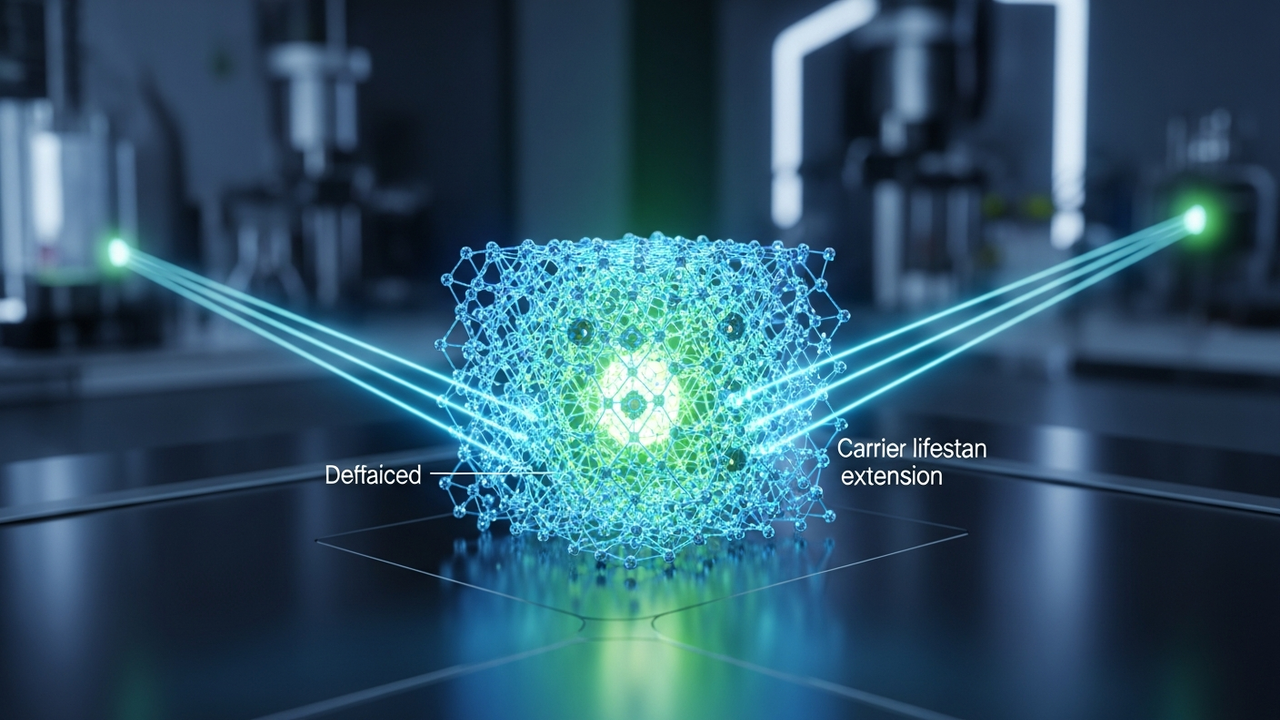
Groundbreaking research has revealed that defect coupling within perovskite materials can instigate advantageous structural and electronic reconstructions, leading to the intrinsic self-passivation of deep traps and the suppression of ion migration. This synergistic self-passivation mechanism has been shown to extend charge carrier lifetimes by an astonishing three orders of magnitude (1000-fold). This discovery offers profound new insights into the inherent defect tolerance of halide perovskite photovoltaics, suggesting that the material itself possesses a powerful self-healing capability crucial for enhancing device performance and long-term stability.
Technical and Experimental Details
- Defect Coupling and Structural Reconstruction: The study elucidates how specific defects, when in close proximity, can induce localized structural rearrangements. These reconstructions alter the electronic states of the defects, effectively transforming them into benign, electrically inactive sites. For instance, the formation of vacancy complexes (clusters of atomic vacancies) was observed to optimize the surrounding lattice structure, leading to a more energetically stable configuration, thereby minimizing their detrimental impact.
- Passivation of Deep Traps: A direct consequence of this structural reconstruction is that deep traps, which typically capture charge carriers and lead to non-radiative recombination losses, are rendered electrically inert. This enables more efficient collection of photogenerated carriers, thereby preventing a reduction in power conversion efficiency.
- Suppression of Ion Migration: Ion migration, a primary degradation pathway in perovskite solar cells, is also shown to be significantly mitigated by these localized structural changes induced by defect coupling. By restricting the movement of mobile ions, the long-term operational stability of the device is substantially enhanced.
- Dramatic Extension of Carrier Lifetime: The cumulative effect of these mechanisms is a phenomenal extension of the charge carrier lifetime. This is a critical parameter for high-efficiency solar cells, as longer carrier lifetimes ensure that more photogenerated charges reach the electrodes before recombining, thus directly improving both power conversion efficiency and long-term device stability.
Strategic Significance and Outlook
The discovery of this synergistic self-passivation mechanism provides a novel guiding principle for the rational design of more robust and high-performing perovskite solar cells. Future research can now leverage this insight to develop novel material compositions or optimized processing techniques that inherently enhance these intrinsic defect tolerance capabilities. Critically, reducing reliance on external passivating agents could significantly simplify manufacturing processes and potentially lower production costs, making perovskite technology more economically viable. Ultimately, this fundamental understanding is expected to significantly accelerate the practical deployment and commercialization of highly efficient and exceptionally stable perovskite solar cell technology, solidifying its crucial role in the global renewable energy landscape.
Get our weekly technology intelligence — free
Receive an infographic that lets you judge at a glance whether each field’s analysis report is worth reading.
Subscribe Free — Weekly Tech Intelligence
By subscribing, you’ll receive Troy-Technical’s weekly technology intelligence newsletter.
- Your email and selected fields are used only to deliver the newsletter.
- We never share your information with third parties.
- You can unsubscribe anytime via the link in each email.
See our Privacy Policy for details.
Takes about a minute · Unsubscribe anytime