Key Findings
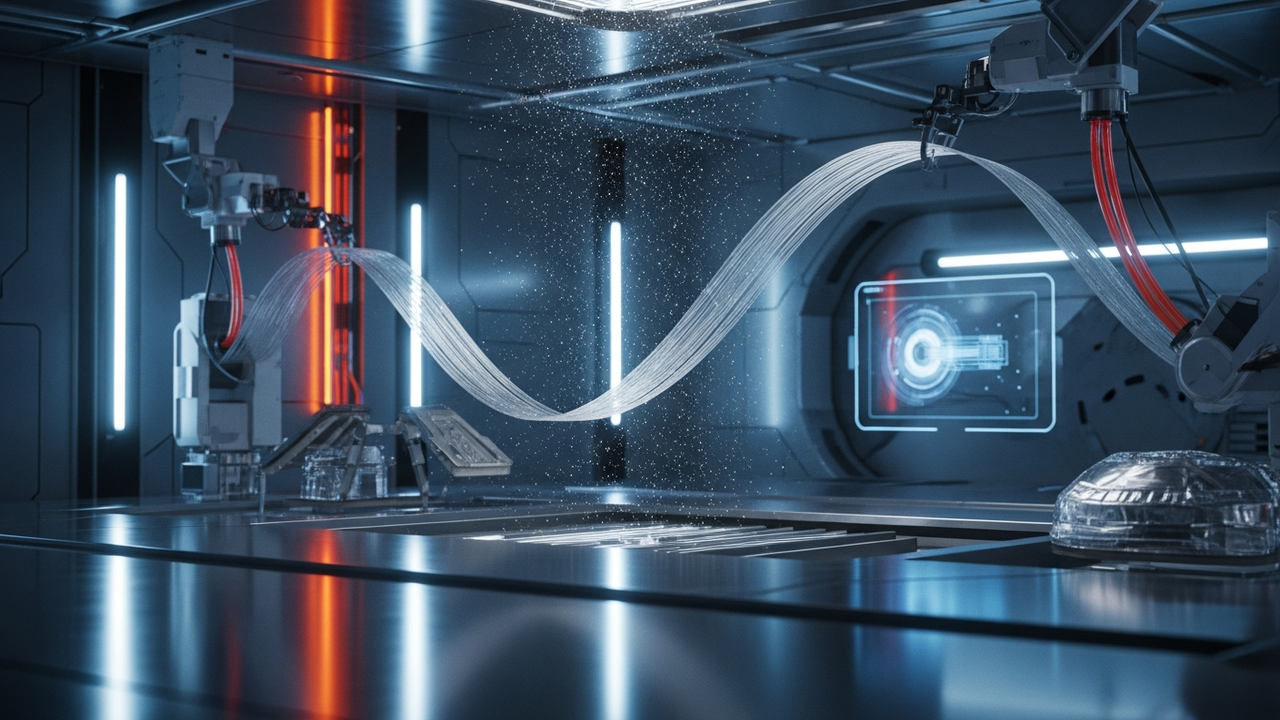
Recent research underscores that microgravity and vacuum environments fundamentally alter the physical processes involved in the in-space manufacturing of carbon-fiber-reinforced structures (CFRC), presenting challenges distinct from terrestrial production. This finding points to a critical need for new design guidelines and manufacturing protocols for successful orbital fabrication of large structures.
Technical / Clinical Details
The study meticulously analyzed the impact of microgravity on buoyancy and the influence of vacuum on internal pressure during composite material manufacturing. On Earth, gas bubbles within materials tend to rise due to buoyancy and are easily expelled. However, in microgravity, this buoyancy is severely diminished, making it much easier for gas bubbles to become trapped within the composite matrix, which significantly degrades the mechanical properties of the final product. Furthermore, the low-pressure (vacuum) environment of space can cause dissolved gas components within resin materials to readily expand, also contributing to bubble formation. Manufacturing processes that fail to account for these dual effects risk compromising structural integrity and reliability. Researchers conclude that developing new material processing techniques optimized for microgravity and low-pressure conditions, coupled with real-time sensor monitoring systems, is indispensable for overcoming these challenges. This approach is vital for producing high-quality large structures in space and ensuring their structural integrity.
Background & Context
The construction of advanced space infrastructure, such as large orbital telescopes, space solar power stations, and expanded space stations, requires massive structures that are impractical to launch fully assembled from Earth. In-space manufacturing (ISM) is therefore gaining traction as a key enabler for enhancing the sustainability and economic viability of space activities. Carbon-fiber composites, due to their lightweight and high strength, are ideal materials for space structures, but adapting their manufacturing processes to the space environment demands fundamental physical understanding and technological innovation. This research provides crucial insights into the basic material science of ISM, which is essential for the success of future space manufacturing missions.
Strategic Significance & Outlook
These research findings mark a significant step in the evolution of in-space manufacturing technologies. Going forward, advanced simulation models to accurately predict and control material behavior in microgravity, alongside validating in-orbit experiments, will be increasingly necessary. The development of autonomous quality control systems utilizing real-time sensor data and new composite forming technologies tailored for low-gravity environments is expected to accelerate. This will open up possibilities for efficiently and reliably fabricating large structures required for lunar bases and Mars exploration without reliance on Earth-based launches, thereby dramatically enhancing the flexibility and sustainability of space development.
Get our weekly technology intelligence — free
Receive an infographic that lets you judge at a glance whether each field’s analysis report is worth reading.
Subscribe Free — Weekly Tech Intelligence
By subscribing, you’ll receive Troy-Technical’s weekly technology intelligence newsletter.
- Your email and selected fields are used only to deliver the newsletter.
- We never share your information with third parties.
- You can unsubscribe anytime via the link in each email.
See our Privacy Policy for details.
Takes about a minute · Unsubscribe anytime