Key Findings
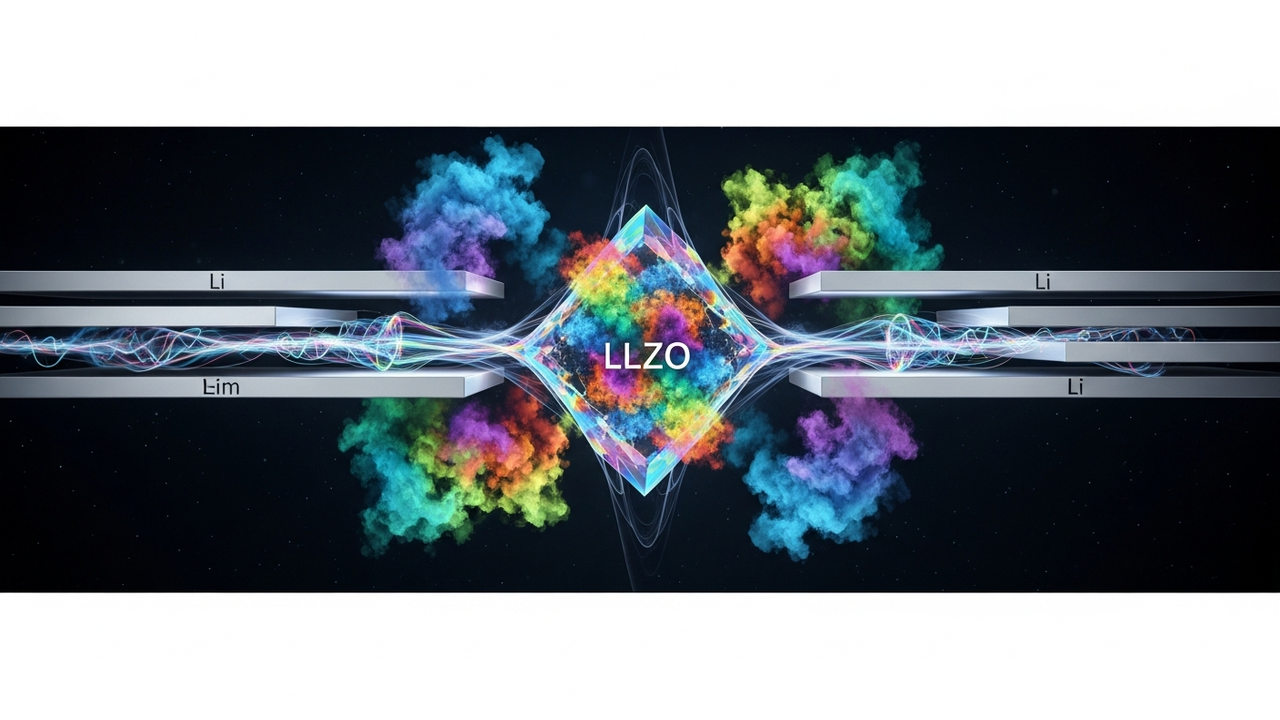
This preprint delves into the potential of entropy-driven multi-dopant synergy to robustly enhance the interfaces between lithium (Li) and Li7La3Zr2O12 (LLZO) solid electrolytes in all-solid-state batteries. The research provides crucial insights for realizing high-performance solid-state batteries by elucidating the impact of introducing high-entropy garnet materials on the stability of lithium metal interfaces and critical current density.
Technical / Clinical Details
One of the primary challenges in all-solid-state batteries is dendrite formation and high interfacial resistance at the interface between the lithium metal anode and the solid electrolyte. In this study, molecular dynamics (MD) simulations were extensively used to analyze how the synergistic action of multiple dopant elements in high-entropy garnet materials improves the stability of the Li|LLZO interface and lithium ion transport. The coexistence of multiple dopants increases the overall entropy of the material, stabilizing its crystal structure and optimizing lithium ion diffusion pathways. This suppresses the growth of lithium dendrites at the interface, enabling stable battery operation at higher critical current densities (CCD). MD simulations served as a powerful tool to understand the interfacial structure, ion migration mechanisms, and defect behavior at the atomic level.
Background & Context
All-solid-state batteries are highly anticipated as a next-generation battery technology, offering high energy density, enhanced safety, and longer lifespan compared to current lithium-ion batteries. However, challenges such as high interfacial resistance between solid electrolytes and electrodes, and stability issues with lithium metal anodes, remain major barriers to commercialization. LLZO garnet-based solid electrolytes, in particular, have garnered attention for their high ionic conductivity, but improving their interfacial properties has been essential. Multi-dopant strategies and high-entropy designs are actively being researched as new approaches to simultaneously enhance material stability and performance.
Strategic Significance & Outlook
This entropy-driven multi-dopant strategy is highly promising for accelerating the development of high-performance all-solid-state batteries. Stabilizing the Li|LLZO interface and increasing the critical current density directly impact the cycle life and safety of all-solid-state batteries, promoting their adoption across a wide range of applications including electric vehicles, portable electronic devices, and stationary energy storage systems. Future research will focus on experimental validation of simulation results, development of large-scale manufacturing processes, and long-term performance evaluation in actual battery cells. This technology holds the potential to be a fundamental building block for next-generation battery technology, essential for achieving a sustainable energy society.
Source: https://chemrxiv.org/doi/abs/10.26434/chemrxiv.15007100/v1
Get our weekly technology intelligence — free
Receive an infographic that lets you judge at a glance whether each field’s analysis report is worth reading.
Subscribe Free — Weekly Tech Intelligence
By subscribing, you’ll receive Troy-Technical’s weekly technology intelligence newsletter.
- Your email and selected fields are used only to deliver the newsletter.
- We never share your information with third parties.
- You can unsubscribe anytime via the link in each email.
See our Privacy Policy for details.
Takes about a minute · Unsubscribe anytime