Key Findings
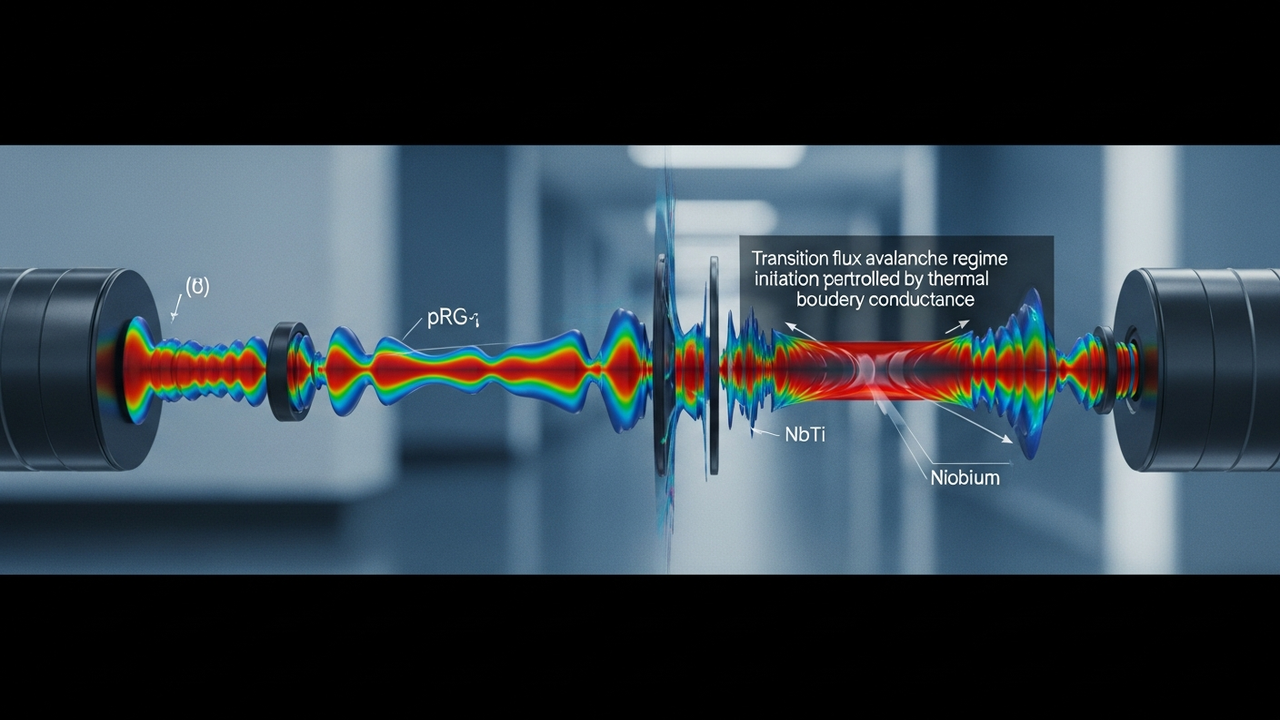
In bulk NbTi (niobium-titanium) superconductors, the onset of the transitional flux-avalanche regime—an instability characterized by rapid flux penetration—has been experimentally and theoretically demonstrated to be precisely controlled by the thermal boundary conductance between the material and its surrounding environment. This discovery is critically important for understanding the magnetic stability of superconducting materials, offering new guidelines for the design and safe operation of superconducting devices.
Technical / Clinical Details
NbTi is widely used in various high-field superconducting applications, including MRI machines, magnets for high-energy physics experiments, and fusion reactor coils. However, under high current densities and magnetic fields, rapid flux penetration (flux avalanche) can lead to partial resistive states, ultimately resulting in a quench (loss of superconductivity). This study revealed that thermal boundary conductance—the efficiency of heat transfer between the superconductor surface and the coolant (e.g., liquid helium)—plays a decisive role in determining the onset conditions of these flux avalanches. When thermal boundary conductance is high, generated Joule heat is efficiently transferred to the coolant, thereby suppressing the initiation of flux avalanches. Conversely, low conductance leads to heat accumulation, making instabilities more likely to occur at lower magnetic fields or currents. The research demonstrated that by adjusting different surface treatments or cooling environments to vary thermal boundary conductance, the threshold for flux avalanche onset shifts. This quantitative understanding provides design guidelines for enhancing the operating limits of NbTi superconductors.
Background & Context
Superconducting magnets are indispensable in many frontier areas of modern science and technology, but their stability has always been a significant challenge. Thermal and electromagnetic instabilities (of which flux avalanches are an example) occurring within or on the surface of superconductors can limit device performance and sometimes cause severe damage. Flux avalanches are a crucial design consideration, especially in large-scale magnets and applications requiring high current densities. The findings of this study emphasize the importance of integrating thermal management strategies into superconductor design and provide specific methodologies for improving the reliability of existing NbTi-based devices. This knowledge is critically important for large-scale projects like the International Thermonuclear Experimental Reactor (ITER) and the design of next-generation accelerators.
Strategic Significance & Outlook
Elucidating the mechanism of flux avalanche control by thermal boundary conductance enables the development of more stable and reliable superconducting devices. This knowledge will be directly applied in surface modification of superconducting magnets, optimization of cooling system designs, and selection of operating parameters. In the future, it is expected to lead to the exploration of thermal boundary effects on magnetic instabilities in other superconducting materials (e.g., MgB2 and high-temperature superconductors) and the development of more advanced thermal management technologies (e.g., microchannel cooling). This will further broaden the application range of superconducting technology, accelerating its societal implementation in various fields such as energy, medicine, and transportation.
Source: #
Get our weekly technology intelligence — free
Receive an infographic that lets you judge at a glance whether each field’s analysis report is worth reading.
Subscribe Free — Weekly Tech Intelligence
By subscribing, you’ll receive Troy-Technical’s weekly technology intelligence newsletter.
- Your email and selected fields are used only to deliver the newsletter.
- We never share your information with third parties.
- You can unsubscribe anytime via the link in each email.
See our Privacy Policy for details.
Takes about a minute · Unsubscribe anytime