Key Findings
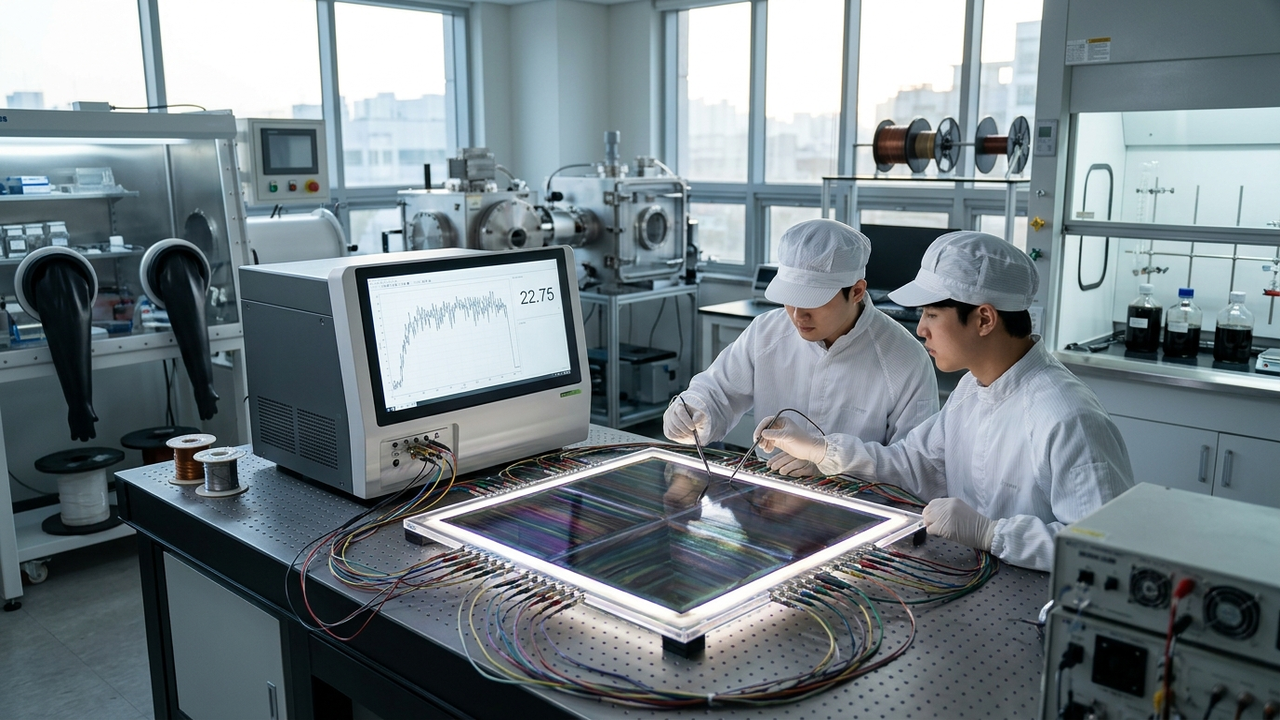
A South Korean research team has achieved a remarkable certified power conversion efficiency of 22.75% for a large-area perovskite solar cell measuring 100 cm². This breakthrough demonstrates the superior capability of the dynamic spin casting (DSC) method, which continuously supplies raw materials, to form higher quality thin films compared to conventional static processes, thereby advancing both high efficiency and scalability in larger cells.
Technical / Clinical Details
The research team confirmed that the DSC method, characterized by its continuous supply of raw materials, forms more uniform and higher-quality perovskite thin films than traditional static spin coating. This improved film quality directly translates to enhanced efficiency in large-area cells.
- Certified Efficiency: 22.75% power conversion efficiency for a 100 cm² large-area perovskite solar cell, independently verified by a third-party organization.
- Fabrication Method: The dynamic spin casting (DSC) method, which ensures a continuous supply of precursor materials, was employed. This technique significantly improved film uniformity and quality compared to conventional static spin coating methods.
- Stability: The cells exhibited excellent long-term stability, maintaining over 80% of their initial efficiency after 1,000 hours of continuous light soaking. This robust performance is crucial for addressing durability, one of the primary challenges for the commercialization of perovskite solar cells.
Background & Context
Perovskite solar cells are widely regarded as a promising next-generation photovoltaic technology due to their high potential for photoelectric conversion efficiency. However, while high efficiencies have been reported for small-area cells, efficiency degradation upon scaling up and ensuring long-term stability have been significant barriers to commercialization. This study presents an effective approach to overcome these challenges by optimizing a scalable manufacturing technique like DSC, holding substantial implications for the development of cost-effective, large-scale production methods.
Strategic Significance & Outlook
This research offers a practical pathway to simultaneously improve the efficiency and stability of large-area perovskite solar cells. Scalable processes like DSC have the potential to accelerate the adoption of perovskite solar cells in diverse applications, including flexible solar panels and Building Integrated Photovoltaics (BIPV). Further optimization and advancements in cost reduction and mass production based on this technology are expected to introduce new competitiveness into the renewable energy market.
Source: https://en.sedaily.com/technology/2026/08/19/korean-team-hits-2275-percent-efficiency-in-large
Get our weekly technology intelligence — free
Receive an infographic that lets you judge at a glance whether each field’s analysis report is worth reading.
Subscribe Free — Weekly Tech Intelligence
By subscribing, you’ll receive Troy-Technical’s weekly technology intelligence newsletter.
- Your email and selected fields are used only to deliver the newsletter.
- We never share your information with third parties.
- You can unsubscribe anytime via the link in each email.
See our Privacy Policy for details.
Takes about a minute · Unsubscribe anytime