Key Findings
The All-Photonics Network (APN), central to NTT Group’s IOWN (Innovative Optical and Wireless Network) concept, aims to entirely eliminate power consumption and latency bottlenecks arising from optical-to-electrical signal conversions. This strategy focuses on maintaining end-to-end data transmission as pure optical signals, with NTT adopting a phased miniaturization approach to physically bring photonic connectivity closer to where computations occur.
Technical / Clinical Details
- Elimination of Optical-Electrical Conversion: In traditional networks, data transmission involves multiple conversions between optical and electrical signals, which are primary sources of power consumption and latency. APN dramatically improves overall network efficiency by minimizing or entirely eliminating these optical-to-electrical conversions.
- Phased Miniaturization Approach: NTT’s APN strategy is characterized by ‘phased miniaturization,’ physically bringing photonic connections closer to data processing sites.
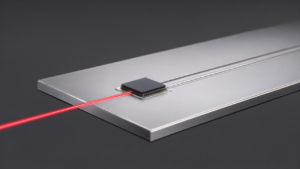
- Current Achievement (Switch-Level): The current APN achieves optical fiber connectivity at the data center switch level. This enables high-speed, low-latency communication between server racks.
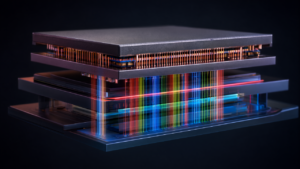
- Next Step (Board-Level: PEC-2): Development of PEC-2 (Photonic Electronics Convergence) devices is underway for the next evolutionary stage. PEC-2 integrates optical and electrical components at the board level, bringing optical fiber connections directly to the board to achieve even lower latency and higher bandwidth.
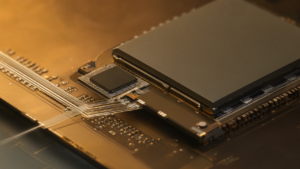
- Ultimate Goal (Chip-Level): The ultimate goal is ‘chip-level photonics,’ where optical engines are integrated directly onto processing chips like CPUs and GPUs, aiming to achieve ultimate performance and efficiency.
- High Capacity, Low Latency, Low Power Consumption: Through these technological advancements, APN delivers terabit-class high-capacity communication, microsecond-level ultra-low latency, and significantly reduced power consumption compared to conventional networks.
Background & Context
The advancements in AI, IoT, 5G, and other technologies are imposing unprecedented data volume and speed demands on data centers and network infrastructure. Relying solely on existing electrical communication technologies makes it challenging to meet these demands and achieve sustainable growth. NTT’s IOWN concept, envisioning the future of such a digital society, aims to innovate the entire digital infrastructure by maximizing the utilization of optical technology. Specifically, end-to-end optical transmission via APN holds crucial significance for addressing data center power consumption issues and enabling real-time applications.
Strategic Significance & Outlook
NTT’s APN strategy will play a significant role in shaping the future of digital infrastructure. The board-level integration of PEC-2 devices, and ultimately the realization of chip-level photonics, will enable new breakthroughs in various fields such as AI computing, quantum communication, and smart cities. The evolution of this technology demonstrates Japan’s potential to lead global communication technology, and further acceleration is expected through international standardization and collaborations with other companies. Improved energy efficiency will also contribute to realizing a sustainable society.
Get our weekly technology intelligence — free
Receive an infographic that lets you judge at a glance whether each field’s analysis report is worth reading.
Subscribe Free — Weekly Tech Intelligence
By subscribing, you’ll receive Troy-Technical’s weekly technology intelligence newsletter.
- Your email and selected fields are used only to deliver the newsletter.
- We never share your information with third parties.
- You can unsubscribe anytime via the link in each email.
See our Privacy Policy for details.
Takes about a minute · Unsubscribe anytime