Key Findings
Microgravity crystallization technology, traditionally used for growing high-quality single crystals for structural research, is rapidly expanding its relevance towards the production of high-value materials in low Earth orbit (LEO) and for future in-space manufacturing (ISM). A comprehensive review analyzes the current state of progress, identifies key technological challenges, and outlines future directions, signaling a potential revolution in the manufacturing of pharmaceuticals, semiconductors, and advanced alloys.
Technical and Clinical Details
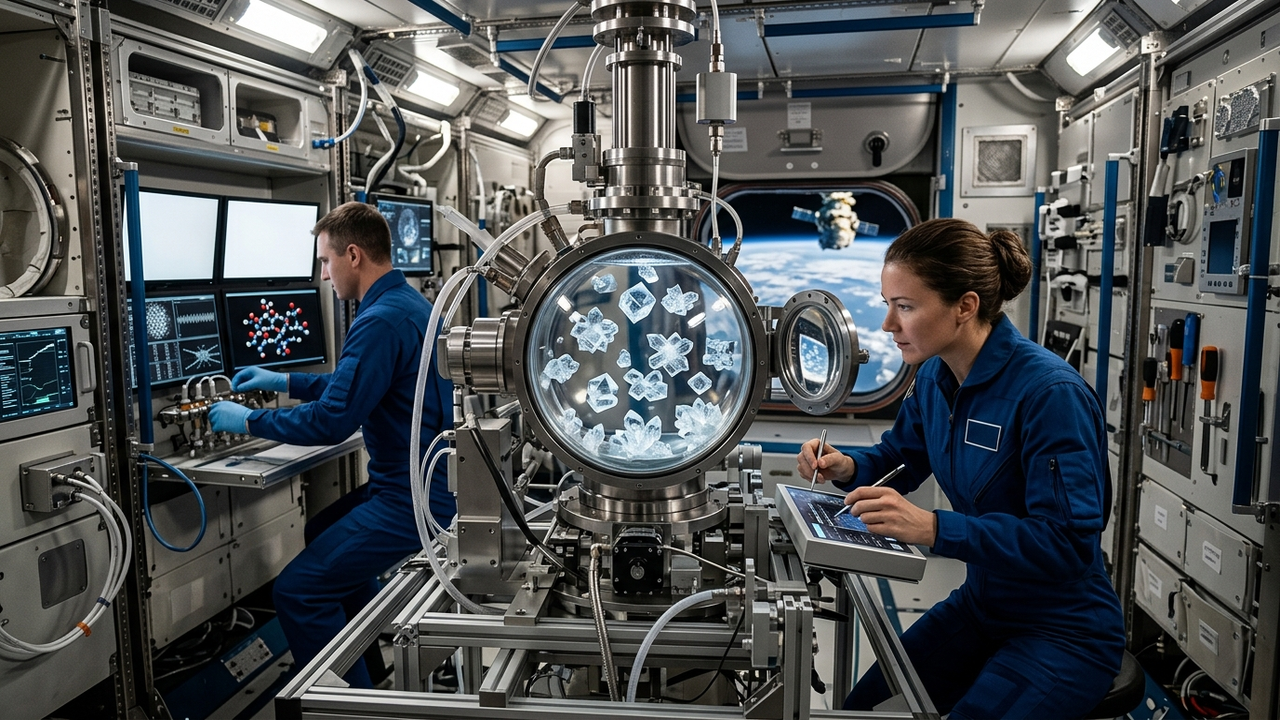
The absence of gravity-driven convection and sedimentation in microgravity offers a unique advantage for producing materials with more uniform and defect-free crystal structures compared to Earth-based methods. This capability could lead to new drugs with improved solubility and stability, higher-performance electronic devices, and more durable new materials for aerospace applications. The review details experimental methods for investigating crystallization kinetics and optimal regimes (single-crystal versus bulk-crystal) for various material types, including simulations of crystal growth under different temperature gradients and pressures, as well as experiments using microgravity furnaces in space. For example, specific protein crystals grown on the International Space Station (ISS) have demonstrated superior quality to their terrestrial counterparts, providing critical structural data for drug design.
Background and Industry Context
The space industry is undergoing a significant shift from government-led exploration to commercialization, with in-space manufacturing (ISM) emerging as a crucial pillar. The business model of producing high-value materials in space for return to Earth or for direct use in space is creating new market opportunities. There is a high demand for ultra-high-purity and novel functional materials that are difficult to produce terrestrially, positioning microgravity crystallization as a core technology to meet this need. Previous experiments on the ISS have successfully demonstrated the production of superior protein and zeolite crystals, confirming the technological feasibility.
Future Outlook
The primary challenge ahead is to advance microgravity crystallization from a research-stage endeavor to a scalable, controlled manufacturing process. This requires developing automation technologies for large-scale production, real-time monitoring and control systems for crystal growth, and efficient energy utilization and recycling technologies to reduce manufacturing costs in space. Furthermore, establishing quality assessment standards for space-manufactured products and developing regulatory frameworks for their return and utilization on Earth are critical. Overcoming these hurdles will transform space into a ‘new factory’ for high-value materials, bringing innovation and competitive advantages to Earth-based industries. This technology not only enhances the sustainability of space exploration but also holds the potential to deliver groundbreaking solutions in terrestrial medicine, electronics, and energy sectors.
Get our weekly technology intelligence — free
Receive an infographic that lets you judge at a glance whether each field’s analysis report is worth reading.
Subscribe Free — Weekly Tech Intelligence
By subscribing, you’ll receive Troy-Technical’s weekly technology intelligence newsletter.
- Your email and selected fields are used only to deliver the newsletter.
- We never share your information with third parties.
- You can unsubscribe anytime via the link in each email.
See our Privacy Policy for details.
Takes about a minute · Unsubscribe anytime