Key Findings
The integration of AI in materials science is dramatically accelerating the pace of new material discovery and synthesis. Google’s AI model, GNoME (Graph Networks for Materials Exploration), has identified over 2.2 million computational candidates for new materials, with 381,000 confirmed as novel stable crystal structures. In a parallel breakthrough, the autonomous research laboratory known as ‘A-Lab’ successfully synthesized 36 target materials physically within an astonishingly short period of just 17 days. These accomplishments strongly underscore AI’s potential to expedite the entire materials development lifecycle.
Technical / Clinical Details
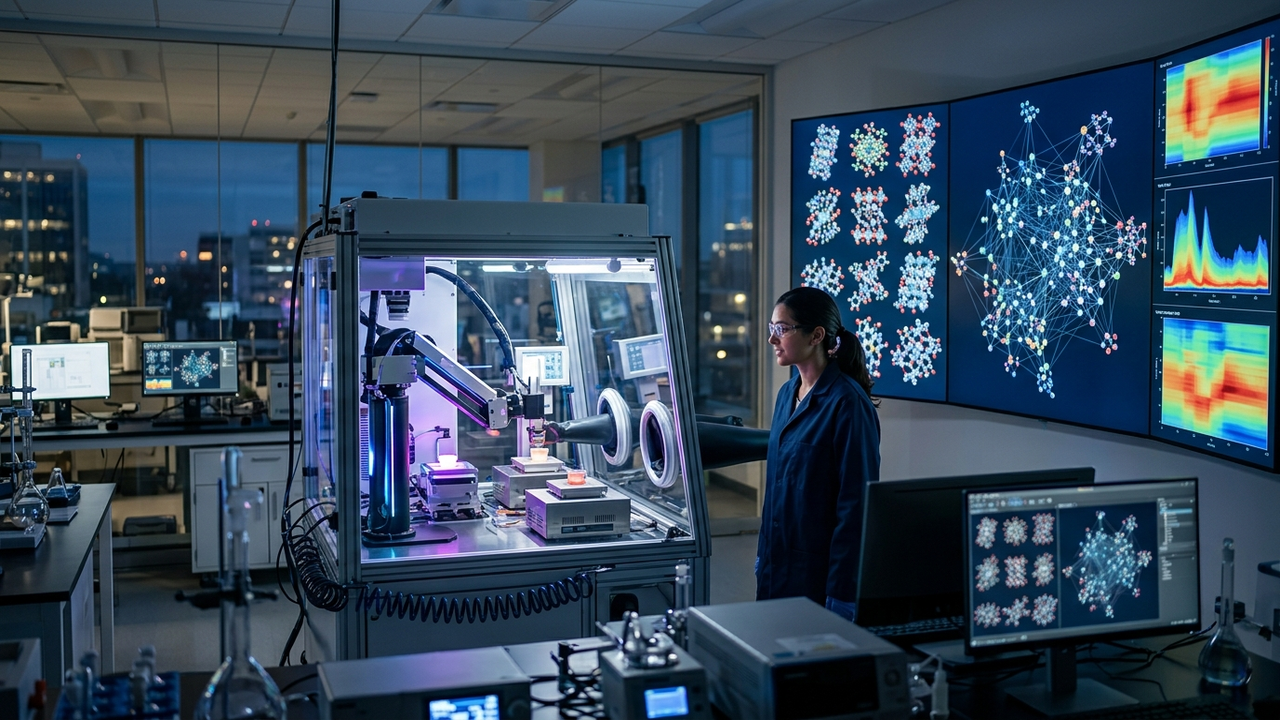
Google’s GNoME leverages deep learning and graph neural networks to predict the stability of new compositions and structures from existing materials data. This capability allows for efficient high-throughput screening of a vast number of material candidates prior to experimental validation, significantly improving discovery efficiency compared to traditional trial-and-error approaches. A-Lab, on the other hand, is an autonomous research laboratory that integrates AI-driven robotic systems with automated experimental apparatus. It operates on a closed-loop system where AI proposes material designs, robots perform synthesis, characterization, and data analysis, and the AI then learns from these results to plan subsequent experiments. This system enables the high-speed execution of material synthesis processes without human intervention, reducing tasks that traditionally took months or years into mere days or weeks.
Background & Context
The discovery and development of new materials are fundamental to advancements across all industries, including energy, medicine, electronics, and aerospace. However, this process has traditionally been costly, time-consuming, labor-intensive, and fraught with low success rates. The advent of autonomous materials discovery, powered by AI and robotics, is poised to alleviate these bottlenecks, positioning itself as a ‘game-changer’ in material development. The discovery of novel stable crystal structures, in particular, provides clear pathways for practical applications, proving the reliability and effectiveness of AI in materials science.
Strategic Significance & Outlook
AI’s role in materials science is expected to expand even further. Computational tools like GNoME will provide vast libraries of virtual materials, while autonomous laboratories like A-Lab will accelerate the physical validation of these candidates. This integrated approach has the potential to dramatically speed up the discovery of new functional materials, such as superconductors, high-performance battery materials, novel catalysts, and pharmaceutical candidates. Consequently, this could lead to faster product development and market entry, generating significant economic impact across materials-related industries. In the future, AI, in collaboration with human expertise, is anticipated to play a central role in the design and synthesis of even more complex and challenging material systems, ushering in an era of unprecedented material innovation.
Source: https://agentmira.io/blog/ai-for-materials-science
Get our weekly technology intelligence — free
Receive an infographic that lets you judge at a glance whether each field’s analysis report is worth reading.
Subscribe Free — Weekly Tech Intelligence
By subscribing, you’ll receive Troy-Technical’s weekly technology intelligence newsletter.
- Your email and selected fields are used only to deliver the newsletter.
- We never share your information with third parties.
- You can unsubscribe anytime via the link in each email.
See our Privacy Policy for details.
Takes about a minute · Unsubscribe anytime