Key Findings
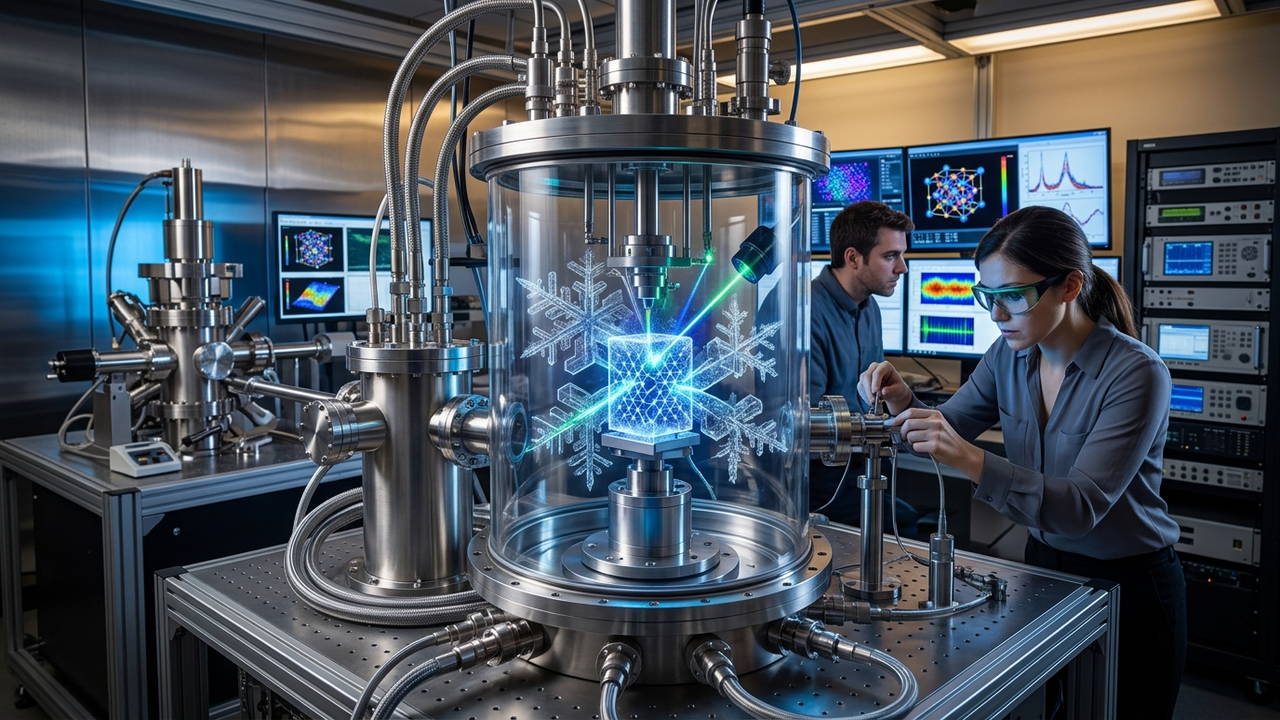
A team of physicists at the Massachusetts Institute of Technology (MIT) has made a significant discovery regarding the highly unique electron reconfiguration phenomena within the quantum material ErTe3 (Erbium Tritelluride). Their research reveals that two distinct electronic phases present within the material form through remarkably different mechanisms: one spreading continuously and smoothly, while the other emerges as localized ‘pockets,’ akin to the growth of ice crystals. This insight represents a critical breakthrough in the fundamental science of quantum materials.
Technical / Clinical Details
The researchers utilized advanced experimental techniques, including scanning tunneling microscopy (STM) and angle-resolved photoemission spectroscopy (ARPES), to analyze the electronic states within ErTe3 at an atomic level of detail. ErTe3 is known to exhibit charge density waves (CDW), where electrons form periodic patterns. In this discovery, instead of a uniform distribution, the electrons displayed a dual behavior during CDW formation: in some regions, they continuously reconfigured like a liquid, while in others, they aggregated into discrete pockets, analogous to ice nucleation and growth. This ‘ice-like reconfiguration’ mechanism suggests a complex interplay between electron-lattice interactions, electron-electron interactions, and local inhomogeneities, pointing to intricate quantum phenomena previously unobserved.
Background & Context
Quantum phenomena such as superconductivity and magnetism are paramount for the development of next-generation energy-efficient electronics, ultra-fast computing, and quantum computers. These phenomena are determined by how electrons behave within materials, yet their underlying mechanisms remain largely mysterious. Research into charge density wave materials like ErTe3 provides a crucial platform for deepening our fundamental understanding of electronic phase transitions. MIT’s current research suggests that the collective behavior of electrons is far more diverse than anticipated, revealing complex phenomena not captured by conventional models, thus pointing towards new research directions in quantum materials science.
Strategic Significance & Outlook
This groundbreaking discovery offers new insights into the control and design of superconductivity, magnetism, and other exotic quantum phases. The ability to understand and control electron reconfiguration mechanisms is particularly essential for developing quantum materials with innovative functionalities, such as room-temperature superconductors and new types of spintronic devices. In the future, this knowledge is expected to be leveraged to construct more predictable and robust quantum devices, shaping the future of information and energy technologies. This research is profoundly significant for pushing the physical limits of quantum materials and exploring new frontiers in scientific and technological innovation, potentially unlocking solutions for some of the grand challenges in materials physics.
Source: https://www.sciencedaily.com/releases/2026/08/260819041231.htm
Get our weekly technology intelligence — free
Receive an infographic that lets you judge at a glance whether each field’s analysis report is worth reading.
Subscribe Free — Weekly Tech Intelligence
By subscribing, you’ll receive Troy-Technical’s weekly technology intelligence newsletter.
- Your email and selected fields are used only to deliver the newsletter.
- We never share your information with third parties.
- You can unsubscribe anytime via the link in each email.
See our Privacy Policy for details.
Takes about a minute · Unsubscribe anytime