Key Findings
By 2026, the field of self-healing materials has evolved beyond laboratory demonstrations to possess practical engineering properties. A significant advancement comes from North Carolina State University, which developed a fiber-reinforced composite capable of enduring over 1000 damage-repair cycles, a technology now patented and licensed to Structeryx Inc. Furthermore, New York University discovered organic crystals capable of self-healing at an extreme -196°C, and Sungkyunkwan University engineered self-healing polymer-based transistor stacks that maintained functionality for a week under in-vivo conditions. These breakthroughs are supported by funding from defense agencies, highlighting their strategic importance.
Technical / Clinical Details
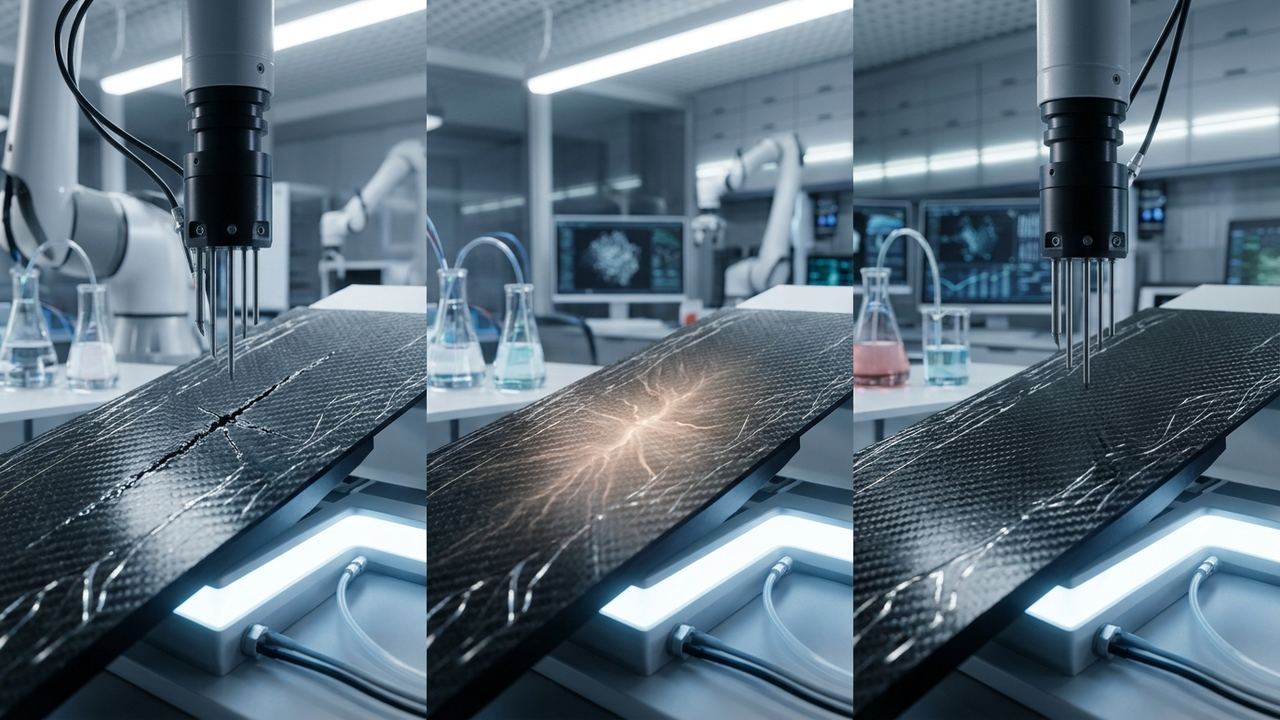
The fiber-reinforced composite developed by North Carolina State University exhibits an unprecedented ability to repeatedly restore its structural integrity and function after damage. This material leverages specific polymer bonding mechanisms to initiate self-repair upon the formation of cuts or cracks. Demonstrating over 1000 damage-repair cycles is a monumental achievement in terms of durability and reliability, with potential applications in aerospace, automotive, and infrastructure sectors. The technology has already been patented and licensed to Structeryx Inc., signaling concrete steps towards commercialization.
Researchers at New York University discovered that a unique organic crystal possesses self-healing capabilities even at cryogenic temperatures, equivalent to liquid nitrogen at -196°C. This breakthrough is critical for applications in extreme environments such as space exploration and cryogenic electronics, where conventional materials fail. The self-healing mechanism in this crystal is believed to be based on reversible molecular interactions at a fundamental level.
Additionally, Sungkyunkwan University successfully developed transistor stacks built with self-healing polymers. These devices are designed to be biocompatible and have demonstrated stable functionality for over a week under in-vivo (within living organisms) conditions. This opens up significant possibilities for applications in wearable medical devices, implantable sensors, and soft robotics, where durability and repair capabilities in biological environments are paramount.
Background & Context
Research into self-healing materials has been ongoing for decades, but practical implementation has been hindered by challenges in durability, repair efficiency, and environmental adaptability. These latest breakthroughs, driven by advancements in materials science and engineering, indicate that these hurdles are being overcome. Funding from defense agencies underscores the potential for these materials to enhance durability and reduce maintenance costs in military applications. Moreover, in consumer products, there’s growing interest in self-healing materials from a sustainability perspective, aiming to extend product lifespan and reduce waste.
Strategic Significance & Outlook
These diverse advancements in self-healing materials are poised to have a broad impact on future industries and society. North Carolina State University’s composite material will promote maintenance-free structural materials, contributing to long-term cost savings and enhanced safety. New York University’s cryogenic self-healing material opens new design possibilities for devices in extreme environments like space and deep-sea. Sungkyunkwan University’s biocompatible transistors will accelerate the development of next-generation medical devices and bioelectronics. Self-healing technology is expected to fundamentally alter product lifecycles and become an indispensable component in building a more resilient and sustainable society. Researchers, engineers, and investors are keenly observing commercialization opportunities in this rapidly evolving field.
Get our weekly technology intelligence — free
Receive an infographic that lets you judge at a glance whether each field’s analysis report is worth reading.
Subscribe Free — Weekly Tech Intelligence
By subscribing, you’ll receive Troy-Technical’s weekly technology intelligence newsletter.
- Your email and selected fields are used only to deliver the newsletter.
- We never share your information with third parties.
- You can unsubscribe anytime via the link in each email.
See our Privacy Policy for details.
Takes about a minute · Unsubscribe anytime