Key Findings
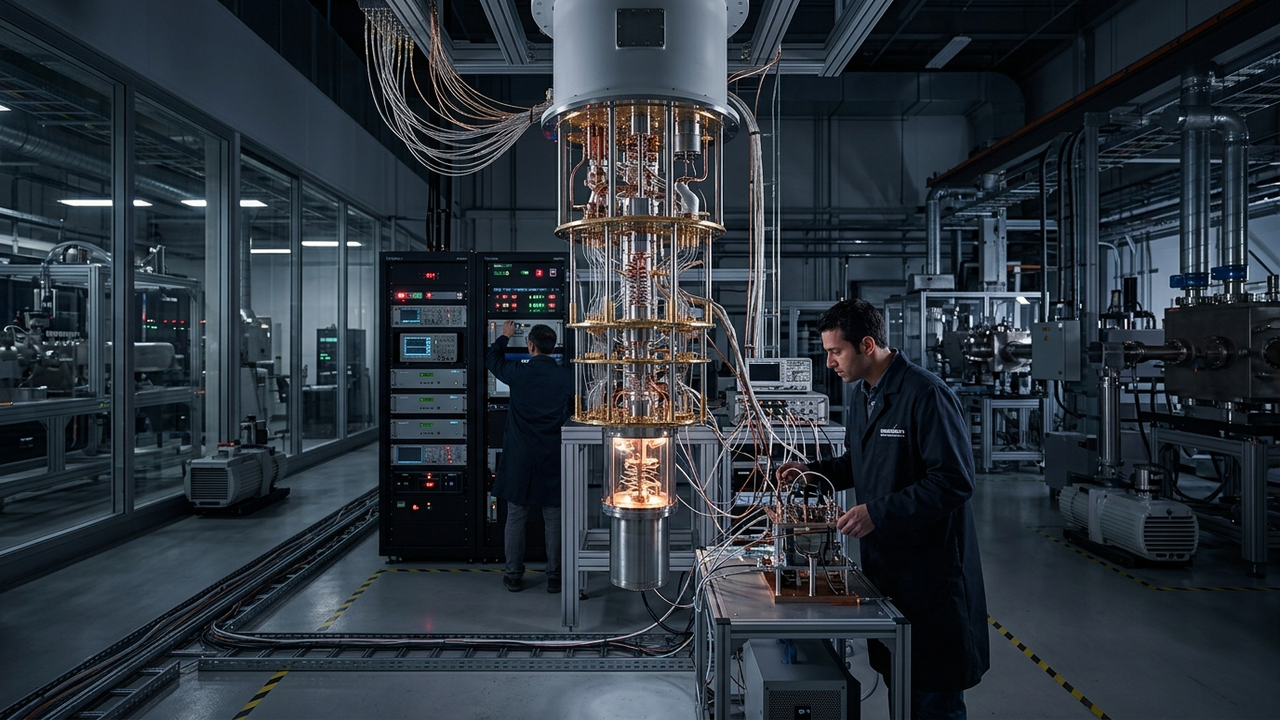
Researchers at the Co-design Center for Quantum Advantage (C2QA), spearheaded by Brookhaven National Laboratory, have achieved a breakthrough in superconducting qubit technology, extending coherence times to over 1 millisecond. This accomplishment signifies a crucial advancement towards realizing practical fault-tolerant quantum computers by enhancing qubit stability and reliability.
Technical / Clinical Details
This development in superconducting qubits was achieved through a novel materials approach, specifically focusing on a combination of tantalum and silicon. The performance of superconducting qubits is largely determined by their coherence time—the duration for which a quantum state can be maintained. Longer coherence times allow qubits to perform more computational steps and are less susceptible to errors. The research team succeeded in minimizing interactions between the qubits and their surrounding environment by optimizing material purity and surface quality. This significantly suppressed decoherence in standard transmon qubits, enabling the attainment of coherence times exceeding 1 millisecond, a feat previously difficult to achieve. This advancement forms a foundational technology for improving the efficiency of quantum error correction and enabling the construction of larger-scale quantum computers.
Background & Context
Quantum computing holds the potential to revolutionize various fields, including drug discovery, materials science, and financial modeling. However, current quantum computers are limited by rapid qubit decoherence, which restricts their computational power. Extending coherence time is an indispensable factor for quantum computing to execute more complex algorithms and achieve true quantum advantage. Collaborative research centers like C2QA are addressing fundamental challenges in quantum hardware through interdisciplinary approaches. Brookhaven National Laboratory’s achievement pushes the frontier of qubit materials science and illuminates a new path for enhancing quantum computer performance.
Strategic Significance & Outlook
The development of superconducting qubits with coherence times exceeding 1 millisecond will have a profound impact on the field of quantum computing. This technology is expected to accelerate the design and construction of future fault-tolerant quantum computers, enabling approaches to problems previously deemed intractable. The research team plans to build upon this achievement by developing qubits with even longer coherence times and exploring techniques for integrating a greater number of qubits. This progression is anticipated to evolve quantum computing from a mere laboratory phenomenon into a practical tool, bringing widespread benefits to society.
Source: https://www.bnl.gov/newsroom/news.php?a=223093
Get our weekly technology intelligence — free
Receive an infographic that lets you judge at a glance whether each field’s analysis report is worth reading.
Subscribe Free — Weekly Tech Intelligence
By subscribing, you’ll receive Troy-Technical’s weekly technology intelligence newsletter.
- Your email and selected fields are used only to deliver the newsletter.
- We never share your information with third parties.
- You can unsubscribe anytime via the link in each email.
See our Privacy Policy for details.
Takes about a minute · Unsubscribe anytime