Key Findings
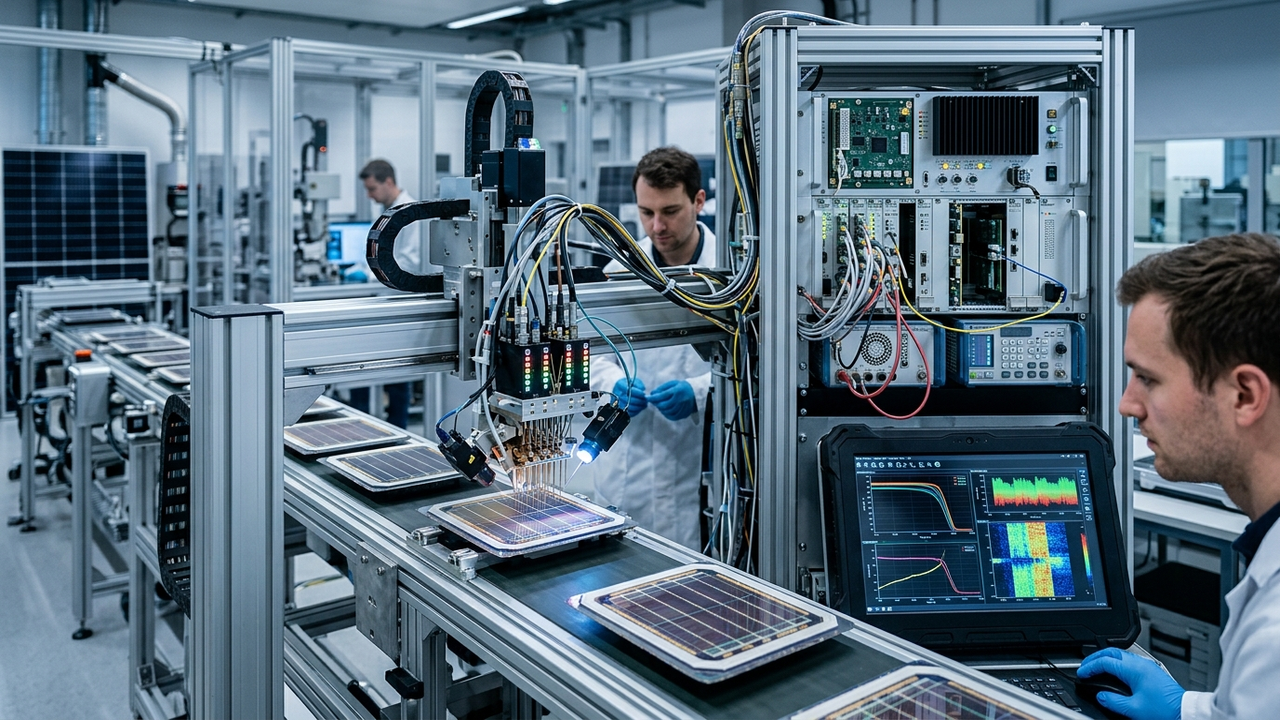
As perovskite-silicon tandem solar cells continue to achieve higher performance, quality control in their mass production remains a critical challenge. To address this, researchers at Germany’s Fraunhofer Institute for Solar Energy Systems (Fraunhofer ISE) have developed a groundbreaking purely electrical method capable of individually measuring the current of each subcell within a tandem solar cell at millisecond resolution. This innovative metrology can be directly integrated into standard current-voltage (j-V) tests, eliminating the need for additional external hardware. This enables real-time, in-line subcell current monitoring in manufacturing lines, substantially enhancing product uniformity and reliability.
Technical Details
Tandem solar cells achieve higher conversion efficiencies than single-junction cells by stacking multiple solar cells with different bandgaps, efficiently utilizing a broader range of the solar spectrum. However, in tandem structures, it is crucial that the currents generated by each subcell are matched; current mismatch leads to a reduction in overall performance. Conventional measurement methods have struggled to accurately and rapidly evaluate the current of each subcell independently.
Key features of the new method developed by Fraunhofer ISE include:
- Pure Electrical Measurement: It measures and separates the current of each subcell using only electrical signals, without requiring additional optical filters or spectrometers.
- Millisecond-Level High-Speed Response: Capable of capturing current fluctuations on very short timescales, allowing for real-time detection of subtle changes during the manufacturing process.
- Integration into Existing j-V Tests: Easily incorporated into standard current-voltage (j-V) measurement systems, facilitating relatively straightforward implementation into manufacturing lines.
- In-line Monitoring: Real-time monitoring of individual module subcell currents on the production line helps in early detection of manufacturing defects and optimization of processes.
This technology is expected to improve yields and tighten quality control in tandem solar cell manufacturing, contributing to the stable supply of high-performance products.
Background & Context
Perovskite-silicon tandem solar cells are regarded as a prime candidate for next-generation photovoltaic technology due to their potential for achieving over 30% conversion efficiency. However, replicating laboratory results in mass production and maintaining quality requires sophisticated manufacturing process control and accurate diagnostic tools. The subcell current metrology developed by Fraunhofer ISE addresses a critical bottleneck in the commercialization of tandem solar cells, and is expected to have a significant impact on stabilizing manufacturing quality and ensuring reliability across the industry.
Strategic Significance & Outlook
This new subcell current metrology will be an indispensable tool for accelerating the mass production of perovskite-silicon tandem solar cells. Reductions in manufacturing costs and improvements in product reliability directly contribute to the wider adoption of solar power. In the future, this technology is also expected to be utilized in optimizing tandem solar cell designs, further promoting the development of more efficient and stable products. This represents a crucial step towards expanding the use of clean energy and realizing a sustainable society.
Get our weekly technology intelligence — free
Receive an infographic that lets you judge at a glance whether each field’s analysis report is worth reading.
Subscribe Free — Weekly Tech Intelligence
By subscribing, you’ll receive Troy-Technical’s weekly technology intelligence newsletter.
- Your email and selected fields are used only to deliver the newsletter.
- We never share your information with third parties.
- You can unsubscribe anytime via the link in each email.
See our Privacy Policy for details.
Takes about a minute · Unsubscribe anytime






Comments