Key Findings
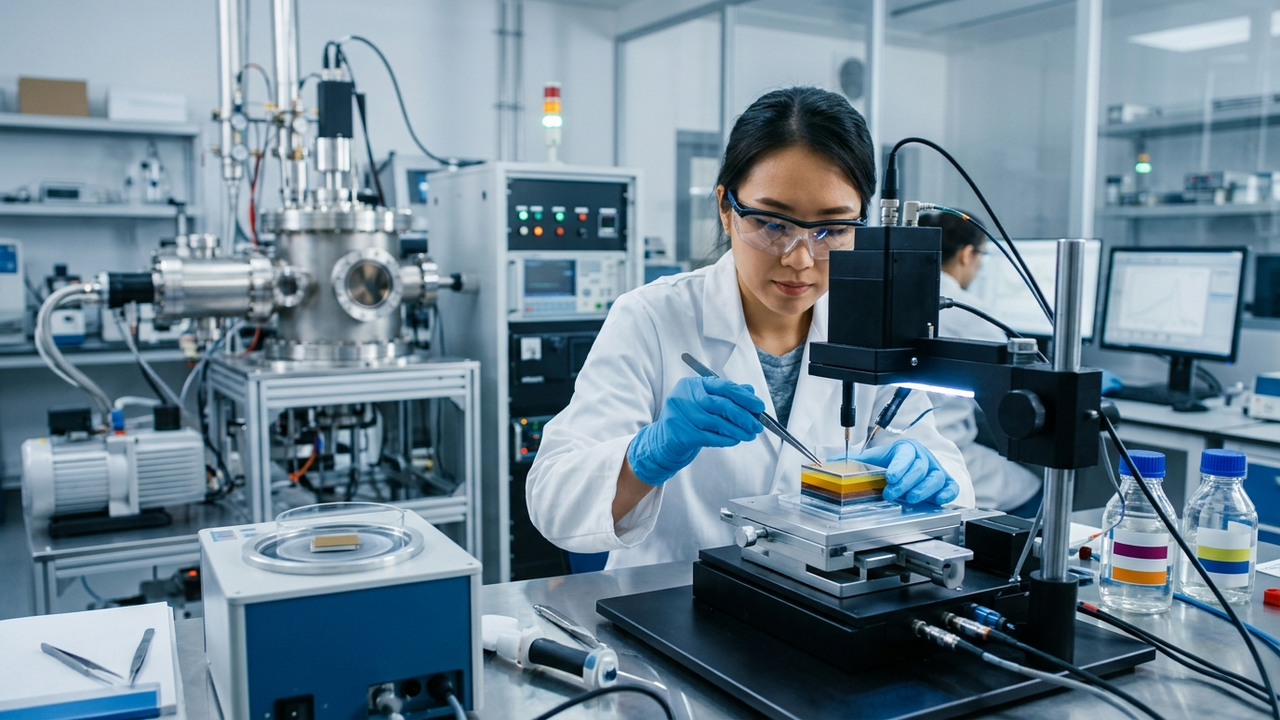
To enhance the performance of perovskite solar cells (PSCs), precise control over not only material composition but also the interface properties between different layers is essential. A recent study published in ACS Applied Energy Materials demonstrates that engineering the interface between NiOx (nickel oxide) and perovskite bifunctionally contributes to improving the performance of wide-bandgap PSCs that can be efficiently processed in ambient air. This breakthrough presents a new pathway for simultaneously increasing the efficiency and stability of PSCs under practical manufacturing conditions.
Technical Details
The ‘bifunctional’ nature of NiOx/perovskite interface engineering in this study refers to two key aspects:
- Optimizing Charge Transport: The NiOx layer functions as a hole transport layer, efficiently collecting and transporting holes generated in the perovskite layer. When the interface is appropriately designed, recombination losses of charge carriers are minimized, leading to improvements in the device’s photocurrent density and open-circuit voltage.
- Interface Passivation and Stability Enhancement: The NiOx layer also effectively passivates (deactivates) defects on the surface of the perovskite layer. This suppresses non-radiative recombination and enhances the environmental stability of the perovskite material, particularly its resistance to degradation in ambient air.
This interface engineering is particularly important for PSCs utilizing ‘wide-bandgap’ perovskite materials. Wide-bandgap materials efficiently absorb light in the blue region of the visible spectrum and are suitable for the top cells in tandem solar cells, transparent solar cells, and high-intensity light applications. However, optimizing their stability and charge transport properties has been a challenge. A notable aspect of this research is enabling ‘air processing’ for PSC manufacturing, which reduces production costs and increases manufacturing scalability.
Background & Context
Perovskite solar cells are anticipated as a next-generation technology with the potential to exceed the theoretical efficiency of silicon solar cells. However, long-term stability and the development of low-cost manufacturing processes that do not require cleanroom environments have been significant barriers to commercialization. Interface engineering is a crucial research area for maximizing material performance and improving stability. NiOx, known for its stability and hole transport capability, is one of the materials widely used to enhance PSC performance, and this study further unlocks its potential.
Strategic Significance & Outlook
Advancements in NiOx/perovskite interface engineering will significantly contribute to realizing high-efficiency and stable wide-bandgap PSCs that can be manufactured in ambient air. This will accelerate the commercialization of a wide range of next-generation PV applications, including tandem solar cells, transparent solar cells, and flexible solar cells. Specifically, if air processing becomes practical, manufacturing costs will be substantially reduced, dramatically improving the market competitiveness of perovskite solar cells and strongly supporting the global transition to clean energy.
Source: https://pubs.acs.org/aaemcq/issue/9/16
Get our weekly technology intelligence — free
Receive an infographic that lets you judge at a glance whether each field’s analysis report is worth reading.
Subscribe Free — Weekly Tech Intelligence
By subscribing, you’ll receive Troy-Technical’s weekly technology intelligence newsletter.
- Your email and selected fields are used only to deliver the newsletter.
- We never share your information with third parties.
- You can unsubscribe anytime via the link in each email.
See our Privacy Policy for details.
Takes about a minute · Unsubscribe anytime




Comments