Key Findings
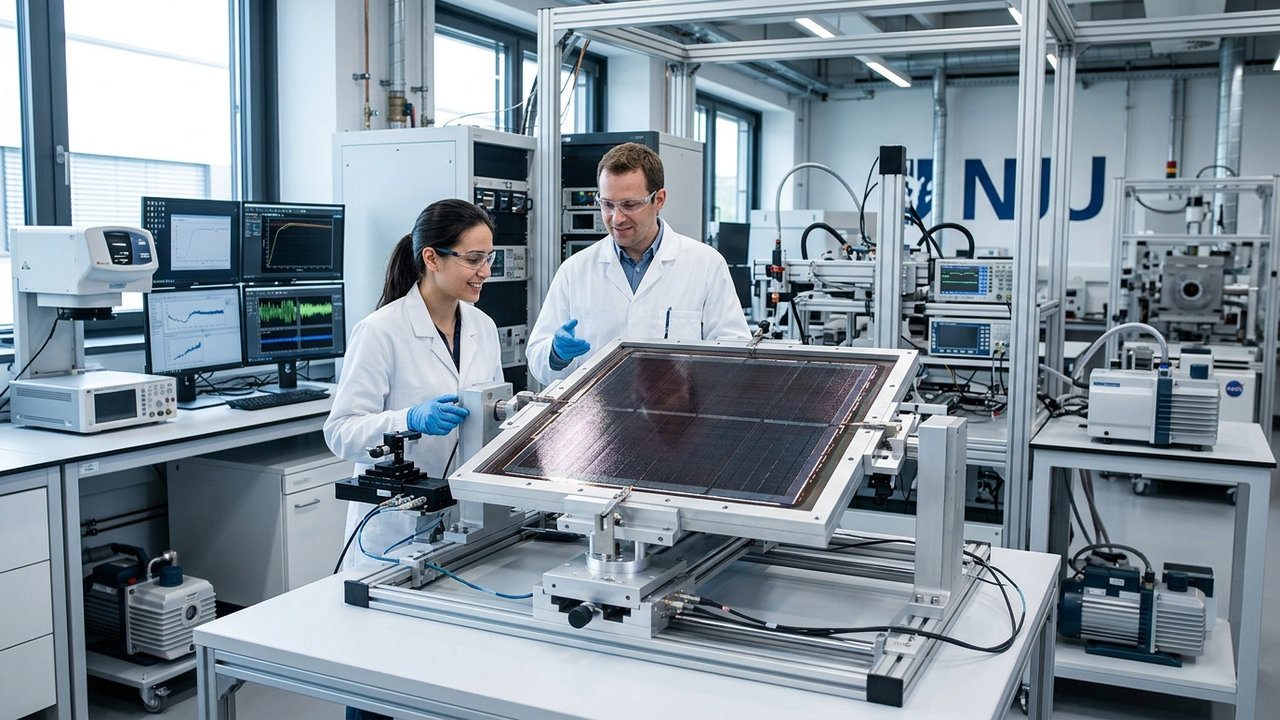
A research team led by Professor Hairen Tan at Nanjing University has announced a breakthrough that simultaneously addresses two major challenges in all-perovskite tandem solar modules: scaling up and achieving high efficiency. By introducing a novel strategy called ‘nano-crystal regulated recombination,’ they suppressed efficiency degradation typically observed in large-area devices. This led to a JET (Japan Electrical Safety & Environment Technology Laboratories) certified power conversion efficiency of 26.2% on a practical 65 cm² module, setting a new world record for all-perovskite tandem modules and marking a crucial milestone for the commercialization of next-generation solar cells.
Technical Details
All-perovskite tandem solar cells use perovskite materials in both the top and bottom layers. This structure can efficiently utilize a broader solar spectrum than single-junction perovskite cells, with expectations of achieving efficiencies over 30%. However, challenges such as perovskite layer uniformity, interface defects, and charge transport optimization have hindered their manufacturing process, particularly when scaling to large areas.
Key technical features of the ‘nano-crystal regulated recombination’ strategy developed by Professor Hairen Tan’s team include:
- Nanocrystal Control: Precise control over the crystalline structure within the perovskite layer at the nanoscale enhances charge carrier lifetime and mobility. This enables efficient charge collection even in large-area modules.
- Suppression of Recombination Losses: The strategy effectively suppresses non-radiative recombination of charge carriers at interfaces and in the bulk, which is a primary cause of efficiency loss and a key factor in their success.
- Large-Area Uniformity: The new strategy facilitates the formation of high-quality, uniform perovskite layers even on large substrates, stabilizing the overall module performance.
Achieving 26.2% efficiency on a 65 cm² module demonstrates that perovskite technology is overcoming challenges in scaling up from small lab cells to practical large-area modules.
Background & Context
As the demand for renewable energy grows, improving solar power efficiency is an urgent global priority. Perovskite solar cells are seen as a promising next-generation technology, potentially replacing or complementing existing silicon solar cells due to their high efficiency and low-cost manufacturing potential. All-perovskite tandem solar cells, being silicon-free, can further reduce manufacturing costs and offer advantages in specific applications (e.g., flexible, lightweight). This achievement from Nanjing University reconfirms China’s leading position in perovskite solar cell research and development.
Strategic Significance & Outlook
The world record achieved by Professor Hairen Tan’s team with a 65 cm² all-perovskite tandem module significantly advances the commercialization of this technology. High efficiency on large areas enhances product competitiveness and will accelerate adoption in a wide range of applications, including Building-Integrated Photovoltaics (BIPV), portable devices, and large-scale solar farms. As this nano-crystal regulated recombination strategy is further refined and manufacturing costs are reduced, all-perovskite tandem solar cells are increasingly likely to play a central role in the global energy transition.
Source: https://www.nsfc.gov.cn/english/site_1/news/A2/2026/08-25/573.html
Get our weekly technology intelligence — free
Receive an infographic that lets you judge at a glance whether each field’s analysis report is worth reading.
Subscribe Free — Weekly Tech Intelligence
By subscribing, you’ll receive Troy-Technical’s weekly technology intelligence newsletter.
- Your email and selected fields are used only to deliver the newsletter.
- We never share your information with third parties.
- You can unsubscribe anytime via the link in each email.
See our Privacy Policy for details.
Takes about a minute · Unsubscribe anytime









Comments