Key Findings
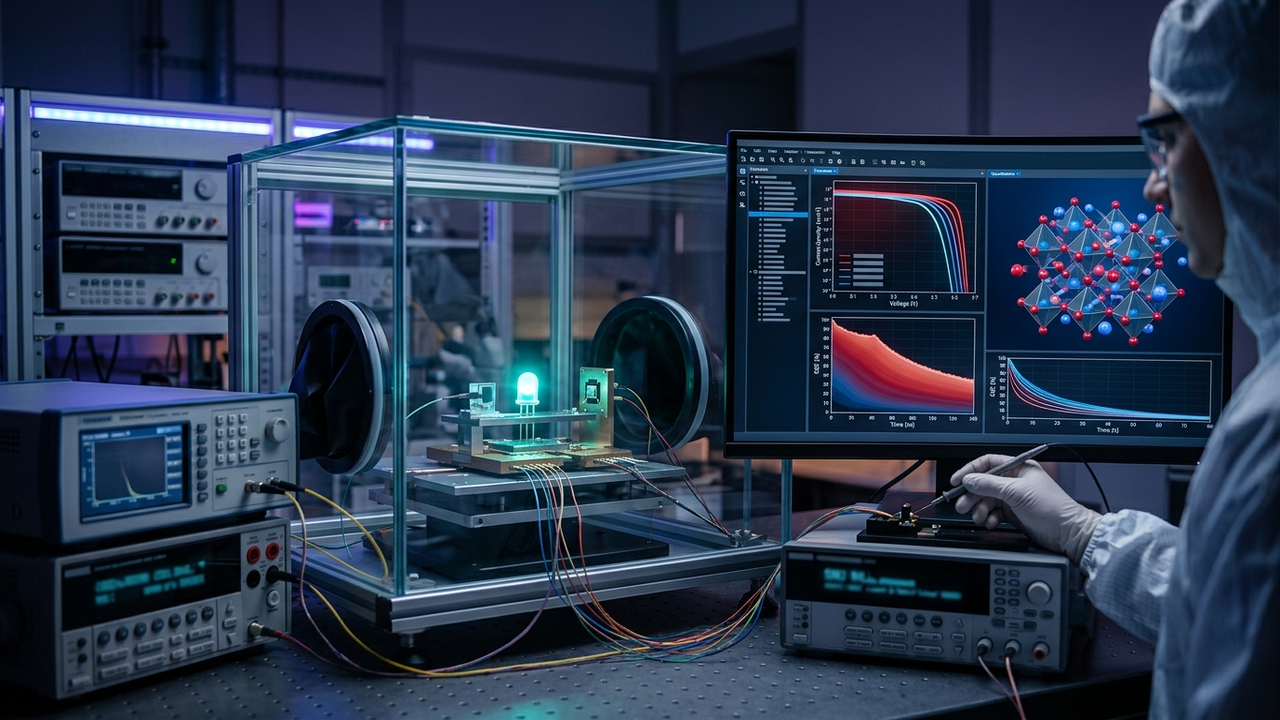
A recent study published in ACS Energy Letters has meticulously unraveled the complex mechanisms of electro-ionic interplay driving degradation in perovskite light-emitting diodes (PeLEDs). While the research reported PeLED devices achieving a remarkably high initial external quantum efficiency (EQEmax) of 20.0%, it simultaneously highlighted a significant operational instability that is highly dependent on the current injection level, with observed half-lives ranging from mere minutes to several hours.
Technical / Clinical Details
The study demonstrated that PeLED degradation is driven by a complex interplay of electrical stress and ion migration. Despite their excellent emissive properties, making PeLEDs promising for next-generation displays and lighting, long-term stability remains a major challenge. The reported devices exhibited high initial performance, with an EQEmax of 20.0% for blue emission, but suffered from rapid performance decline under continuous current injection. Specifically, bias-dependent operational instability was observed; for example, at low current densities, the half-life was several hours, whereas at high current densities, it shortened to just a few minutes. This instability is attributed to the interaction between charge carriers and ions, particularly the migration of halide ions within the perovskite layer, which is accelerated by the electric field. This migration leads to changes in the material structure and an increase in non-radiative recombination pathways. The research provides a deep analysis of how these ion movements contribute to device degradation, offering critical design guidelines for improving PeLED stability.
Background & Context
Perovskite LEDs are gaining significant attention as a potential next-generation light source to replace or complement organic LEDs (OLEDs), thanks to their advantages such as high color purity, wide color gamut, and low-cost manufacturing potential. However, the greatest barrier to commercialization has been achieving both high luminous efficiency and long-term stability. Understanding the degradation mechanisms during operation is essential for optimizing device design. Previous studies primarily focused on external factors like moisture, oxygen, and heat, but this research delves into the fundamental mechanism of internal electro-ionic interplay, shedding light on its complex role. This represents a crucial advancement in deepening the fundamental scientific understanding essential for the progress of PeLED technology.
Strategic Significance & Outlook
The elucidated relationship between electro-ionic interplay and PeLED degradation will guide new design strategies for enhancing device stability. Researchers and engineers will now focus on exploring materials that suppress ion migration, refining device architectures, or optimizing operating conditions to significantly improve the long-term stability of PeLEDs. This is expected to enable high-performance, high-stability PeLEDs that are comparable to or even surpass currently commercialized OLEDs, accelerating their commercial deployment across a wide range of applications, including displays, lighting, and even optical communications. Investors are keenly watching whether this technology can establish long-term reliability and ultimately gain market competitiveness.
Get our weekly technology intelligence — free
Receive an infographic that lets you judge at a glance whether each field’s analysis report is worth reading.
Subscribe Free — Weekly Tech Intelligence
By subscribing, you’ll receive Troy-Technical’s weekly technology intelligence newsletter.
- Your email and selected fields are used only to deliver the newsletter.
- We never share your information with third parties.
- You can unsubscribe anytime via the link in each email.
See our Privacy Policy for details.
Takes about a minute · Unsubscribe anytime

Comments