Key Findings
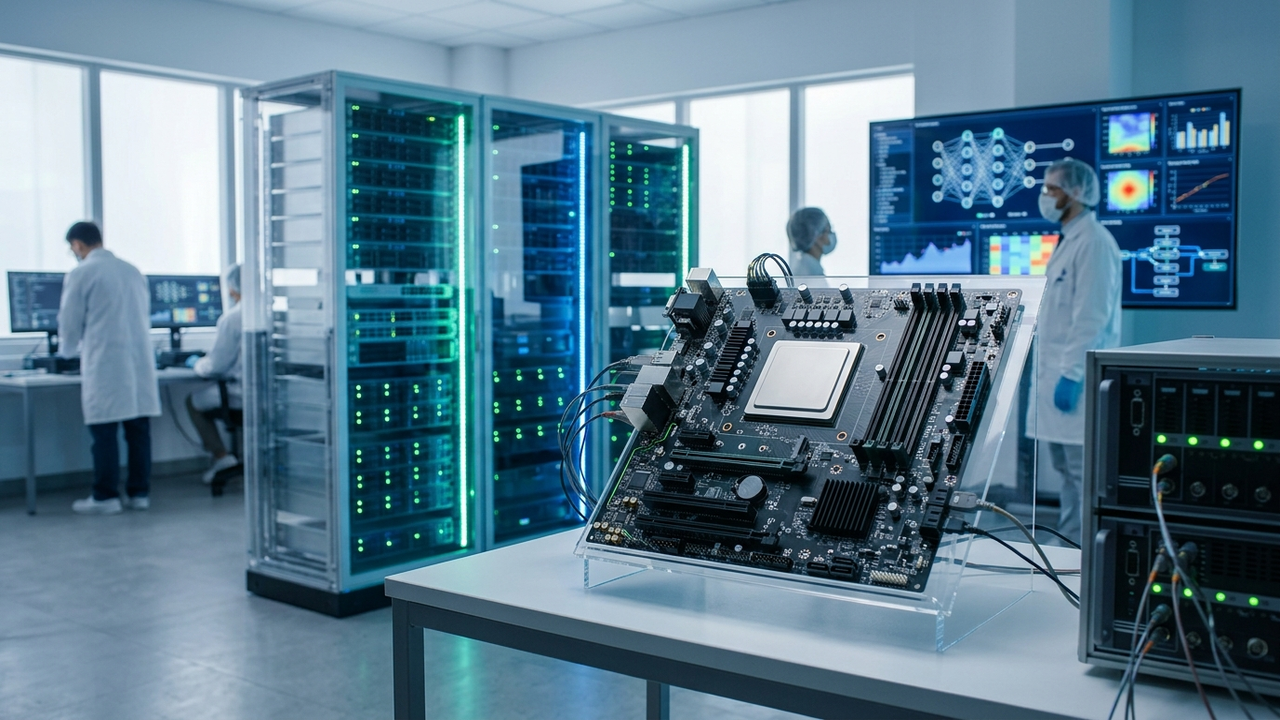
Alibaba has announced the development of a groundbreaking RISC-V-based chip capable of running a 27 billion parameter AI model without the need for a traditional Graphics Processing Unit (GPU). This innovation marks a substantial advancement in specialized hardware for AI workloads, promising enhanced efficiency and potentially lower operational costs for large-scale AI deployment.
Technical / Clinical Details
- RISC-V Architecture Leveraging: The chip is built upon the open-source RISC-V instruction set architecture, which provides inherent flexibility for custom hardware acceleration tailored to specific AI computational patterns. This open standard allows for greater customization compared to proprietary architectures.
- GPU-Independent AI Model Execution: Historically, large AI models have been heavily dependent on GPUs due to their parallel processing capabilities. Alibaba’s chip demonstrates the ability to handle a massive 27 billion parameter model autonomously, indicating a highly optimized design for AI inference that reduces reliance on general-purpose accelerators.
- Specialized AI Workload Design: It is inferred that the chip integrates dedicated hardware components optimized for common AI operations such as matrix multiplication and convolution, enabling it to perform these tasks with greater efficiency and lower power consumption than more generalized computing platforms.
Background & Context
The escalating scale of AI models has led to an exponential increase in computational resource and energy demands. While GPUs have been instrumental in fueling the AI revolution, their general-purpose nature can sometimes lead to inefficiencies for highly specific AI tasks. Consequently, there is a global push towards developing more specialized AI hardware, often leveraging open instruction sets like RISC-V, to improve power efficiency in data centers and enable AI at the edge. Alibaba’s achievement also aligns with China’s strategic initiatives to foster indigenous technological capabilities in the critical AI semiconductor sector.
Strategic Significance & Outlook
Alibaba’s RISC-V chip introduces a compelling alternative in the AI accelerator market, with the potential to transform the cost and efficiency landscape of AI infrastructure, particularly for cloud-based AI services and data centers. Furthermore, the evolution of such dedicated AI hardware has indirect implications for the development of silicon photonics and optical computing. As optical interconnects become essential for addressing data movement bottlenecks in next-generation AI systems, the synergy between specialized electronic AI chips and optical accelerators could lead to even faster and more energy-efficient AI computing solutions. This development by Alibaba is expected to spur further diversification and optimization in AI hardware, driving broader innovation across the industry.
Source: #
Get our weekly technology intelligence — free
Receive an infographic that lets you judge at a glance whether each field’s analysis report is worth reading.
Subscribe Free — Weekly Tech Intelligence
By subscribing, you’ll receive Troy-Technical’s weekly technology intelligence newsletter.
- Your email and selected fields are used only to deliver the newsletter.
- We never share your information with third parties.
- You can unsubscribe anytime via the link in each email.
See our Privacy Policy for details.
Takes about a minute · Unsubscribe anytime








Comments