Key Findings
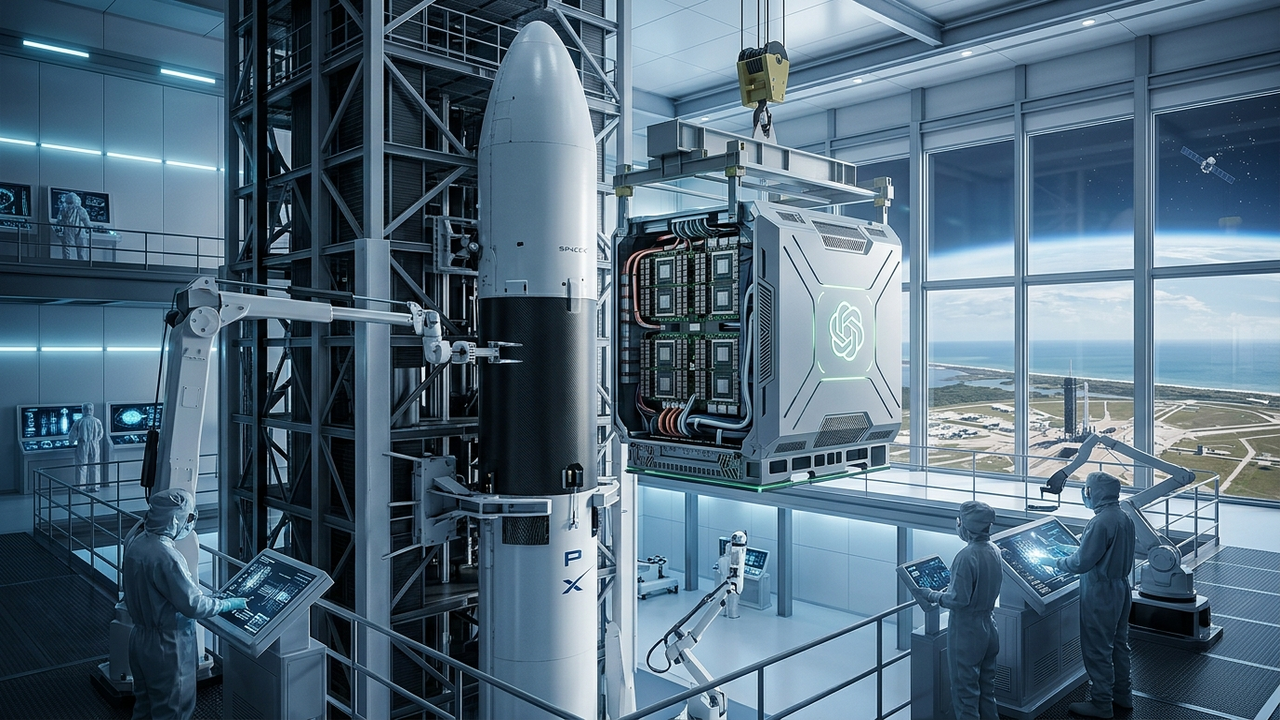
SpaceX and Nvidia have unveiled ambitious plans to launch ‘Starmind AI1,’ an orbital AI supercomputer, in the fourth quarter of 2027. This collaborative project will leverage Nvidia’s advanced Vera Rubin NVL72 AI system, adapted for the rigorous demands of space. The primary objective of Starmind AI1 is to dramatically enhance AI workload processing capabilities in orbit and substantially reduce the volume of data transmitted back to Earth, heralding a new paradigm in satellite data analysis and real-time decision-making from space.
Technical Details and Challenges
Starmind AI1 integrates Nvidia’s high-performance Vera Rubin NVL72 AI system into a space-hardened platform. This system is expected to deliver petaflop-scale computing power, enabling complex AI algorithms to run on orbital platforms. Its core function is to pre-process and analyze the vast amounts of raw data continuously collected by Earth observation satellites, communication satellites, and space science missions, directly in orbit. This on-orbit processing significantly reduces the data volume that needs to be downlinked to Earth, optimizing the use of limited communication bandwidth and accelerating insights. However, the extreme conditions of space, particularly the challenge of thermal management for high-performance computing in a vacuum, pose critical engineering hurdles. Developing advanced cooling systems and selecting/designing radiation-tolerant components are paramount to ensuring the system’s reliability and longevity.
Background and Industry Context
The volume of data collected by satellites in fields such as Earth observation, telecommunications, and defense has surged dramatically in recent years. This exponential growth has led to escalating costs and time for data transfer to Earth, alongside persistent communication bandwidth bottlenecks. On-orbit data processing is recognized as one of the most promising solutions to this challenge. The successful deployment of operational orbital data center nodes by Axiom Space and Kepler Communications demonstrates the accelerating industry momentum towards space-based computing. The convergence of SpaceX’s unparalleled launch capabilities and Nvidia’s cutting-edge AI technology is set to be a powerful driving force in this emerging sector, opening new possibilities for autonomous space systems, deep space exploration, and a wide array of AI applications on Earth.
Strategic Significance and Outlook
The success of Starmind AI1 is poised to have a profound impact on future space missions and commercial ventures. Enhanced on-orbit AI processing capabilities will enable the development of more autonomous satellites, real-time global environmental monitoring, rapid decision-making in space resource exploration, and improved space debris tracking and avoidance. In the long term, this project foreshadows a future where space becomes not just a site for data collection but a new hub for high-performance computing and intelligence. Overcoming technical challenges like thermal management will be crucial in determining how quickly and widely this innovation permeates the space economy and transforms humanity’s interaction with the cosmic frontier.
Get our weekly technology intelligence — free
Receive an infographic that lets you judge at a glance whether each field’s analysis report is worth reading.
Subscribe Free — Weekly Tech Intelligence
By subscribing, you’ll receive Troy-Technical’s weekly technology intelligence newsletter.
- Your email and selected fields are used only to deliver the newsletter.
- We never share your information with third parties.
- You can unsubscribe anytime via the link in each email.
See our Privacy Policy for details.
Takes about a minute · Unsubscribe anytime






Comments