Key Findings
The successful maiden flight of SpaceX’s new cargo transport spacecraft, ‘Starfall,’ in June 2026 has significantly heightened interest within the pharmaceutical industry regarding the potential for drug manufacturing in microgravity environments. Pharmaceuticals crystallized in space are anticipated to form exceptionally uniform and high-purity crystalline structures, a feat difficult to achieve on Earth. This breakthrough is particularly promising for high-molecular-weight drugs, such as cancer therapeutics, as it could enable the development of patient-friendly subcutaneous injection formulations, substantially improving drug delivery efficiency and patient quality of life.
Technical and Clinical Details
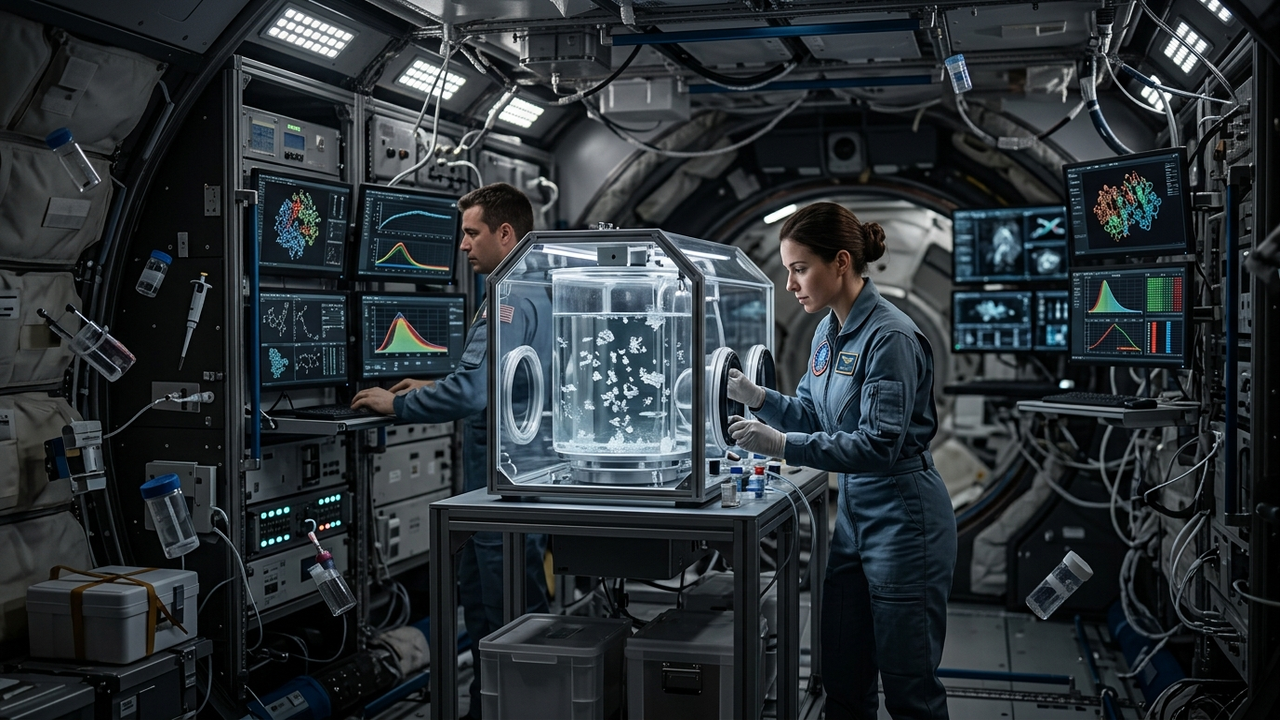
The primary advantage microgravity offers to pharmaceutical manufacturing lies in the elimination of gravitational effects on crystal growth. On Earth, gravity-induced sedimentation and convection often lead to non-uniform crystal formation. In space, however, these influences are absent, allowing for the growth of larger and more perfect crystals. These ‘more uniform crystals’ carry significant clinical and business implications:
- Enhanced Formulation Stability: High-purity, uniform crystals improve drug stability, enabling longer shelf lives.
- Improved Administration Convenience: Especially for protein-based drugs, the ability to produce highly concentrated and stable liquid formulations facilitates a shift from predominantly intravenous infusions to subcutaneous injections. This dramatically enhances patient convenience, freeing them from lengthy hospital administrations and enabling self-injection at home. For example, many current antibody therapies for cancer require several hours of IV infusion, and subcutaneous options would significantly reduce patient burden.
- Accelerated Drug Discovery: More accurate analysis of protein crystal structures enhances the precision of drug target identification, contributing to more efficient and faster new drug development.
- Reduced Side Effects: Higher purity drugs also inherently carry the potential for reduced side effects caused by impurities.
Commercial cargo spacecraft like Starfall are dramatically expanding opportunities for pharmaceutical companies to access microgravity environments for experimentation and manufacturing.
Background and Industry Context
The concept of drug manufacturing in space has existed since the Apollo era, but high costs and limited access methods were persistent barriers. However, the dramatic reduction in launch costs driven by the rise of private space companies like SpaceX, coupled with the availability of commercially accessible platforms such as the ‘Kibo’ module on the ISS, has accelerated the practical application of this field. The pharmaceutical industry is showing keen interest in new market opportunities and the potential for innovative formulation development that is challenging on Earth. Research into drug discovery in microgravity is also being supported by the development of related infrastructure, such as JAXA’s fully operational integrated biobank, ibSLS. This trend indicates that space is establishing itself not merely as a site for scientific exploration but as a frontier of ‘space industry’ that delivers direct value to terrestrial sectors.
Strategic Significance and Outlook
The advent of commercial cargo transport solutions like Starfall is a crucial milestone towards the practical implementation of microgravity pharmaceutical manufacturing. It is anticipated that pharmaceutical companies will further accelerate their investment in space-based R&D and manufacturing. In the long term, the construction of specialized drug manufacturing facilities in LEO, leading to the regular production of specific high-value drugs in space, is a distinct possibility. This promises improved drug accessibility, optimized manufacturing costs (through the establishment of mass production techniques), and the emergence of new pharmaceuticals with the potential to revolutionize terrestrial therapies. Space-based drug manufacturing is no longer just a scientific experiment but a business opportunity that could fundamentally transform global healthcare, meriting close attention to its ongoing development.
Get our weekly technology intelligence — free
Receive an infographic that lets you judge at a glance whether each field’s analysis report is worth reading.
Subscribe Free — Weekly Tech Intelligence
By subscribing, you’ll receive Troy-Technical’s weekly technology intelligence newsletter.
- Your email and selected fields are used only to deliver the newsletter.
- We never share your information with third parties.
- You can unsubscribe anytime via the link in each email.
See our Privacy Policy for details.
Takes about a minute · Unsubscribe anytime









Comments