Key Findings
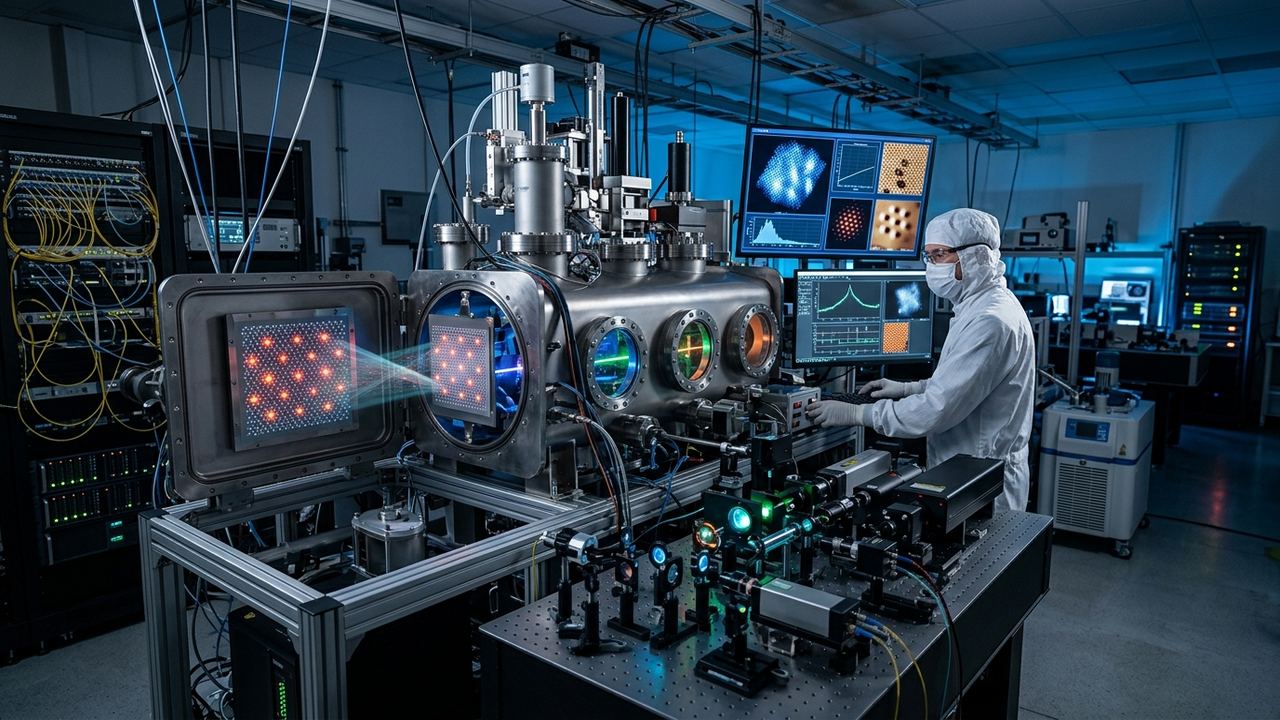
MIT and Oak Ridge National Laboratory (ORNL) have collaboratively developed an innovative “atomic photocopier” technology that precisely replicates identical columns of atomic defects. This breakthrough promises to accelerate the development of smaller and more robust quantum devices, representing a significant step towards achieving room-temperature stability for quantum technologies, which is crucial for their practical application.
Technical / Clinical Details
The “atomic photocopier” system operates by ingeniously combining low-dose detector feedback with state-of-the-art high-performance microscopes. This integration enables researchers to manipulate individual atoms with unprecedented precision while minimizing damage to the material. It allows for the exact creation of targeted columns of atomic defects at specific locations. Atomic defects are indispensable elements in quantum information processing, functioning as qubits or enhancing the sensitivity of quantum sensors. The system’s precise control capabilities enable rigorous tuning of defect placement and type, directly contributing to the construction of more reliable quantum devices.
Background & Context
Quantum technologies, such as quantum computing and quantum sensors, hold the potential to deliver computational power and sensing precision far beyond conventional technologies. However, their practical implementation faces significant challenges. In particular, maintaining quantum states stably often requires cryogenic temperatures and complex protection mechanisms, making device miniaturization and room-temperature operation long-standing goals. The precise control of atomic defects is a key technology for overcoming these challenges, and the atomic photocopier is a groundbreaking tool for achieving this.
Strategic Significance & Outlook
This “atomic photocopier” technology has the potential to revolutionize research and development in quantum technologies. It serves as a critically important element in the roadmap towards realizing smaller, more robust, and ultimately room-temperature operable quantum devices. This will accelerate applications across a wide range of fields, including the commercialization of quantum computing, next-generation medical imaging devices, and highly sensitive environmental sensors. For investors and technology developers, it is expected to attract significant attention as a technology that can resolve bottlenecks in quantum device manufacturing and create new markets.
Source: https://www.thecooldown.com/green-tech/mit-ornl-quantum-devices-photocopier-atomic-defects/
Get our weekly technology intelligence — free
Receive an infographic that lets you judge at a glance whether each field’s analysis report is worth reading.
Subscribe Free — Weekly Tech Intelligence
By subscribing, you’ll receive Troy-Technical’s weekly technology intelligence newsletter.
- Your email and selected fields are used only to deliver the newsletter.
- We never share your information with third parties.
- You can unsubscribe anytime via the link in each email.
See our Privacy Policy for details.
Takes about a minute · Unsubscribe anytime








Comments