Key Findings
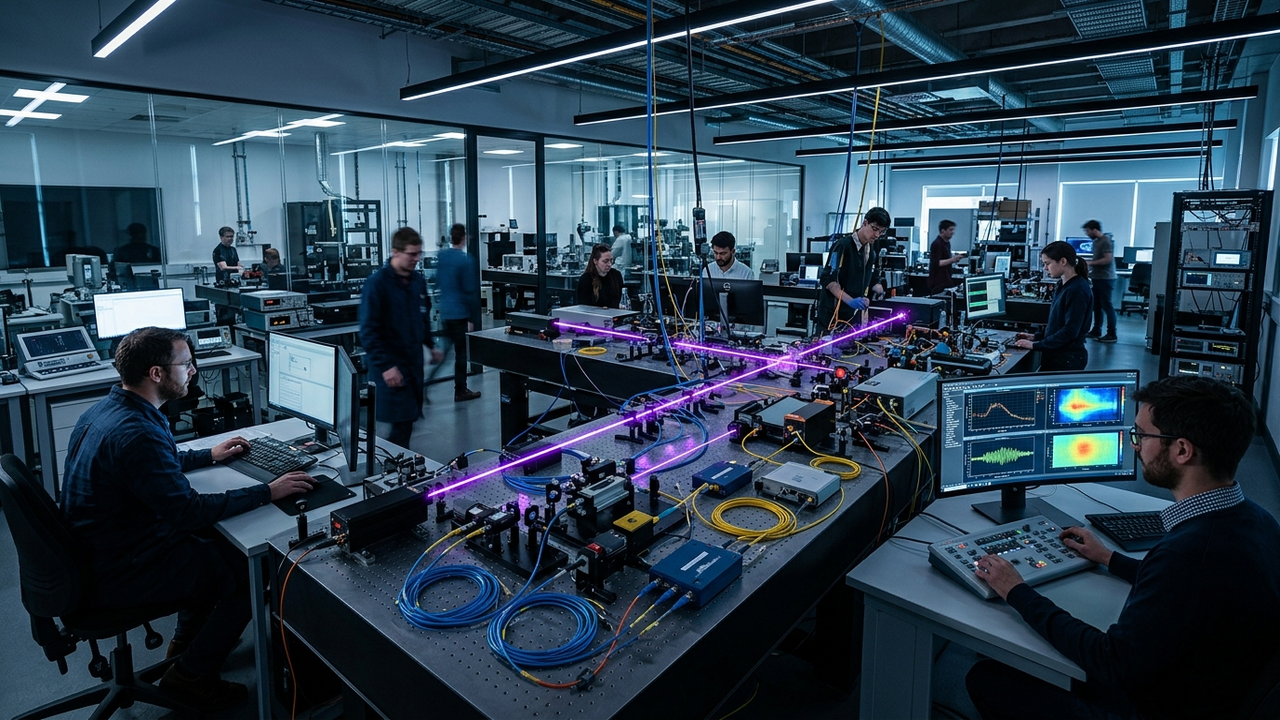
A research team from the University of Bristol, in collaboration with international partners, has engineered a groundbreaking quantum network that can dynamically establish and reconfigure quantum entanglement links among multiple users. Operating over metropolitan-scale fiber infrastructure, this system represents a crucial milestone towards the realization of a practical quantum internet.
Technical/Clinical Details
- Dynamic Entanglement Reconfiguration: The developed network boasts a “dynamic” capability, allowing for the real-time creation and termination of entanglement links. This flexibility enables the assignment of quantum communication channels among different users on an as-needed basis, optimizing resource allocation.
- Q-ROADM Integration: At the heart of the network is a quantum reconfigurable optical add-drop multiplexer (q-ROADM). This device is instrumental in efficiently distributing polarization-entangled photon pairs across multiple nodes, making optimal use of existing optical fiber cables.
- Multi-User Connectivity: The system successfully connected six distinct users, demonstrating stable quantum communication. This extends beyond conventional point-to-point connections, showcasing the feasibility of more complex, distributed quantum network architectures.
- Stability and Durability: The network maintained stable operation for over 150 hours, proving its robustness and practical reliability. This stability provides a solid foundation for supporting various quantum protocols, including Quantum Key Distribution (QKD) and distributed quantum computing.
Background & Context
The ultimate goal of a quantum internet is to connect quantum computers, enabling secure communication and distributed quantum computation across vast distances. Current quantum networks are largely limited to point-to-point connections, making the construction of scalable multi-user networks a significant challenge. This research from the University of Bristol offers a promising approach to overcome this scalability issue by leveraging and enhancing existing telecommunications infrastructure.
Strategic Significance & Outlook
The success of this dynamic quantum network is a vital step toward a globally accessible quantum internet. Future developments are expected to connect even more users and support increasingly complex quantum applications. The technology holds particular promise for sectors requiring high levels of security and computational power, such as finance, healthcare, and government, accelerating the practical implementation of quantum technologies worldwide.
Source: https://quantumzeitgeist.com/university-bristol-dynamic-entanglement-network/
Get our weekly technology intelligence — free
Receive an infographic that lets you judge at a glance whether each field’s analysis report is worth reading.
Subscribe Free — Weekly Tech Intelligence
By subscribing, you’ll receive Troy-Technical’s weekly technology intelligence newsletter.
- Your email and selected fields are used only to deliver the newsletter.
- We never share your information with third parties.
- You can unsubscribe anytime via the link in each email.
See our Privacy Policy for details.
Takes about a minute · Unsubscribe anytime







Comments