Key Findings
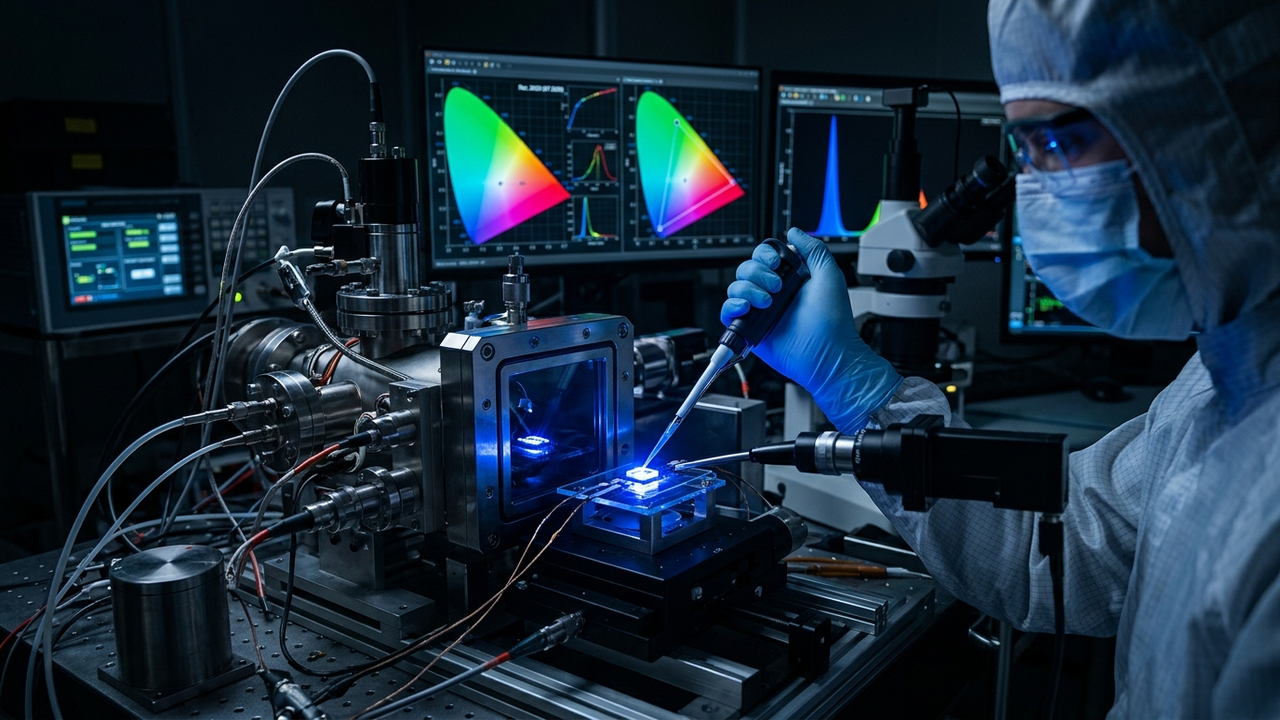
This research reports the successful development of high-performance deep-blue LEDs that closely approach the Rec. 2020 standard, achieved through an innovative Lewis acid-driven perovskite quantum dot (PQD) surface reconstruction strategy. This pure bromide deep-blue PQD LED demonstrates a narrow electroluminescence (EL) peak at 461 nm, a record-setting peak external quantum efficiency (EQE) of 8.5%, and an operational half-life of 41 minutes, marking one of the highest efficiencies for this class of materials.
Technical / Clinical Details
The enhanced performance of the developed deep-blue PQD LED was achieved through the following technical mechanisms:
- Lewis Acid-Driven Surface Reconstruction: Strong ionic interactions between Sr2+ (strontium ions) and octanoic acid (a type of Lewis acid) effectively reconstruct the surface structure of PQDs. This process facilitates the protonation of octylamine and plays a crucial role in passivating surface defects on the PQDs.
- PQD Size Reduction and Defect Suppression: As a result of surface reconstruction, the crystal size of the PQDs is optimally reduced, and simultaneously, non-radiative defects on both the surface and within the material are efficiently suppressed. This reduction in defects prioritizes radiative recombination pathways and minimizes non-radiative recombination, leading to a significant increase in luminous efficiency.
- Enhanced Photoluminescence Quantum Yield (PLQY): As a direct consequence of defect suppression and size optimization, the PLQY of the PQDs is substantially improved. This boosts their ability to efficiently generate light from absorbed energy.
- High-Performance Deep-Blue Emission: The optimized PQDs exhibit an extremely narrow EL peak at 461 nm, signifying pure deep-blue emission that strictly conforms to the blue standard of Rec. 2020 (a wide-gamut standard for UHDTV). This high color purity dramatically improves the color reproduction capabilities of next-generation displays.
- Peak External Quantum Efficiency (EQE) of 8.5%: This figure represents one of the world’s highest efficiencies for pure bromide deep-blue PQD LEDs, indicating a significant step towards commercial application.
- Operational Half-Life of 41 Minutes: This metric indicates the stability of the LED, which is relatively good for deep-blue PQD LEDs, though further extension is needed for practical use.
This approach offers a novel strategy for enhancing the performance of PQD-based LEDs.
Background & Context
Next-generation display technologies, particularly micro-LEDs and QD-OLED displays, demand broader color gamuts, higher brightness, and improved energy efficiency. Within these demands, deep-blue emission has been a primary bottleneck, limiting overall display performance due to persistent challenges in both efficiency and stability compared to red and green emissions. Compliance with wide-gamut standards like Rec. 2020 is essential for the proliferation of high-definition televisions and VR/AR devices. Perovskite quantum dots have attracted significant attention as next-generation display materials due to their tunable bandgap, high quantum yield, and narrow emission spectra, but improving stability and efficiency, especially for blue emission, has been a long-standing challenge. This research presents a practical solution to this critical issue.
Strategic Significance & Outlook
The breakthrough in deep-blue PQD LEDs achieved through the Lewis acid-driven surface reconstruction strategy is poised to accelerate the evolution of next-generation display technology. Future research and development challenges will include further extending the operational half-life, simplifying and scaling up manufacturing processes, and expanding applications to other colors (green, red). If this technology is commercialized, it is expected to promote the widespread adoption of high-definition displays capable of reproducing more vivid and realistic colors, significantly impacting consumer electronics markets such as televisions, smartphones, wearable devices, and VR/AR headsets. This marks a crucial milestone in the development of high-performance blue-emitting materials and will shape the future of quantum dot technology globally.
Get our weekly technology intelligence — free
Receive an infographic that lets you judge at a glance whether each field’s analysis report is worth reading.
Subscribe Free — Weekly Tech Intelligence
By subscribing, you’ll receive Troy-Technical’s weekly technology intelligence newsletter.
- Your email and selected fields are used only to deliver the newsletter.
- We never share your information with third parties.
- You can unsubscribe anytime via the link in each email.
See our Privacy Policy for details.
Takes about a minute · Unsubscribe anytime



Comments