Key Findings
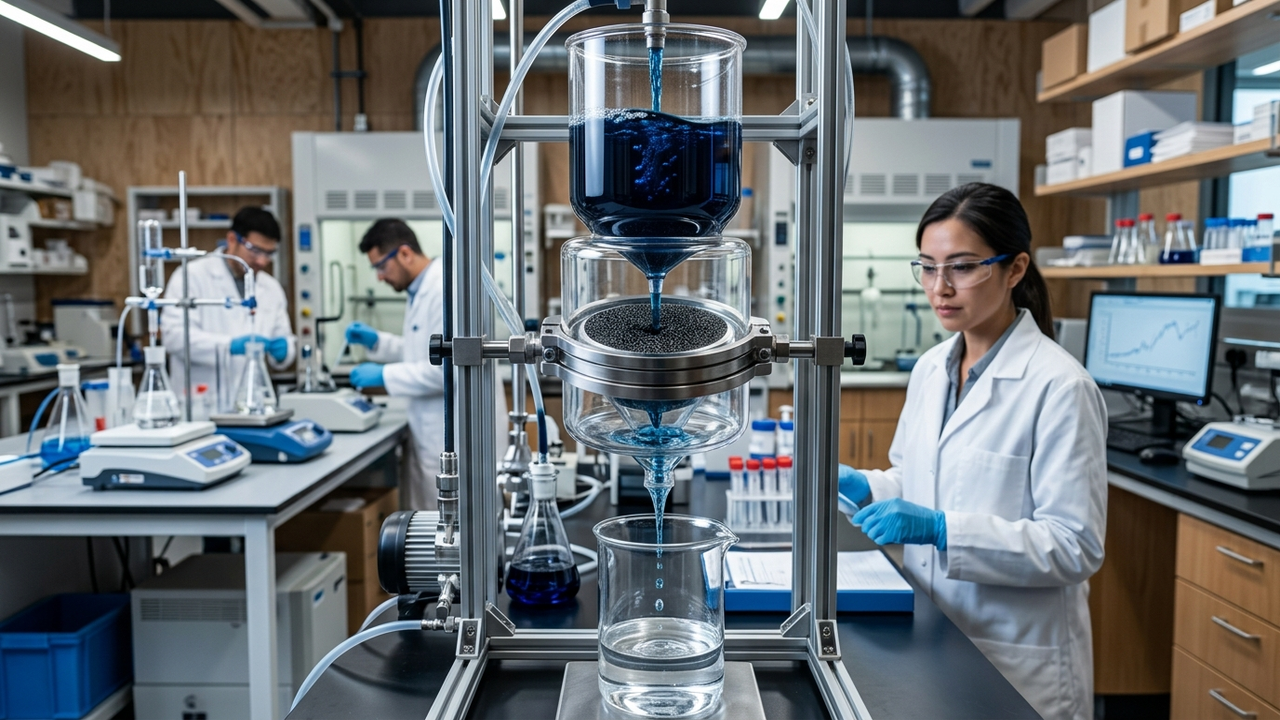
This research reports the development of a novel membrane material that achieves high performance in dye separation by reinforcing upcycled eggshell membranes (ESMs) with graphene oxide (GO). This GO-reinforced ESM, owing to its nanoporous structure, delivers high filtration efficiency compared to traditional thin films, thus contributing to more effective water purification solutions.
Technical / Clinical Details
The developed GO-reinforced ESM membrane exhibits superior performance in dye separation through the following mechanisms and properties:
- Nanoporous Structure of Graphene Oxide (GO): GO, with its two-dimensional layered structure and abundant functional groups (hydroxyl, epoxy, carboxyl, etc.), forms a porous material with a very high specific surface area and tunable nanopore sizes. These nanopores act as a ‘sieve’ to efficiently capture and separate molecules of specific sizes, such as dye molecules.
- High Filtration Efficiency: The uniform nanoporous structure of the GO membrane effectively blocks the permeation of dye molecules, resulting in excellent filtration efficiency. This achieves higher separation performance compared to conventional polymer thin films.
- High Adsorption Capacity and Tunable Surface Properties: The oxygen-containing functional groups present on the GO surface form strong hydrogen bonds and electrostatic interactions with dye molecules, enabling high adsorption capacity. Furthermore, by chemically modifying these functional groups, the membrane’s surface properties (hydrophilicity/hydrophobicity, charge, etc.) can be adjusted to further enhance selectivity for specific dyes.
- Manufacturing via Drop-Casting Method: This membrane is produced using a low-cost, scalable drop-casting method. This technique involves simply coating a substrate with a GO solution, allowing for precise control over coating thickness and surface properties, thereby enabling the efficient production of uniform, high-quality membranes.
ESM, with its natural porous structure and biocompatibility, exhibits synergistic effects when combined with GO.
Background & Context
Industrial wastewater, particularly from the textile industry, contains high concentrations of dyes, which are harmful to aquatic life and a major cause of water resource pollution. Existing dye removal technologies (e.g., coagulation-flocculation, activated carbon adsorption) face challenges related to cost, efficiency, regenerability, and secondary pollution. Against this backdrop, there is a strong demand for new water treatment technologies that are environmentally friendly, sustainable, and highly efficient. This approach, which upcycles a biological waste product (eggshell membranes) and combines it with high-performance graphene oxide, offers an innovative solution to the dual challenges of waste reduction and environmental purification.
Strategic Significance & Outlook
The dye separation technology using GO-reinforced eggshell membranes holds significant potential to impact the wastewater treatment sector. Future research priorities will include scaling up this technology, demonstrating long-term stability and reusability, and expanding its applicability to different types of dyes and other contaminants (e.g., heavy metals, pharmaceuticals). This technology, capable of balancing low-cost and environmentally friendly manufacturing with high separation performance, is expected to contribute to improving access to safe water, especially in developing countries, and fostering sustainable industrial development. This breakthrough represents a significant step towards integrating circular economy principles into water treatment technology.
Source: https://pubs.rsc.org/ma/article/7/17/8569/1282753/Upcycled-eggshell-membranes-reinforced-with
Get our weekly technology intelligence — free
Receive an infographic that lets you judge at a glance whether each field’s analysis report is worth reading.
Subscribe Free — Weekly Tech Intelligence
By subscribing, you’ll receive Troy-Technical’s weekly technology intelligence newsletter.
- Your email and selected fields are used only to deliver the newsletter.
- We never share your information with third parties.
- You can unsubscribe anytime via the link in each email.
See our Privacy Policy for details.
Takes about a minute · Unsubscribe anytime







Comments