

Key Findings
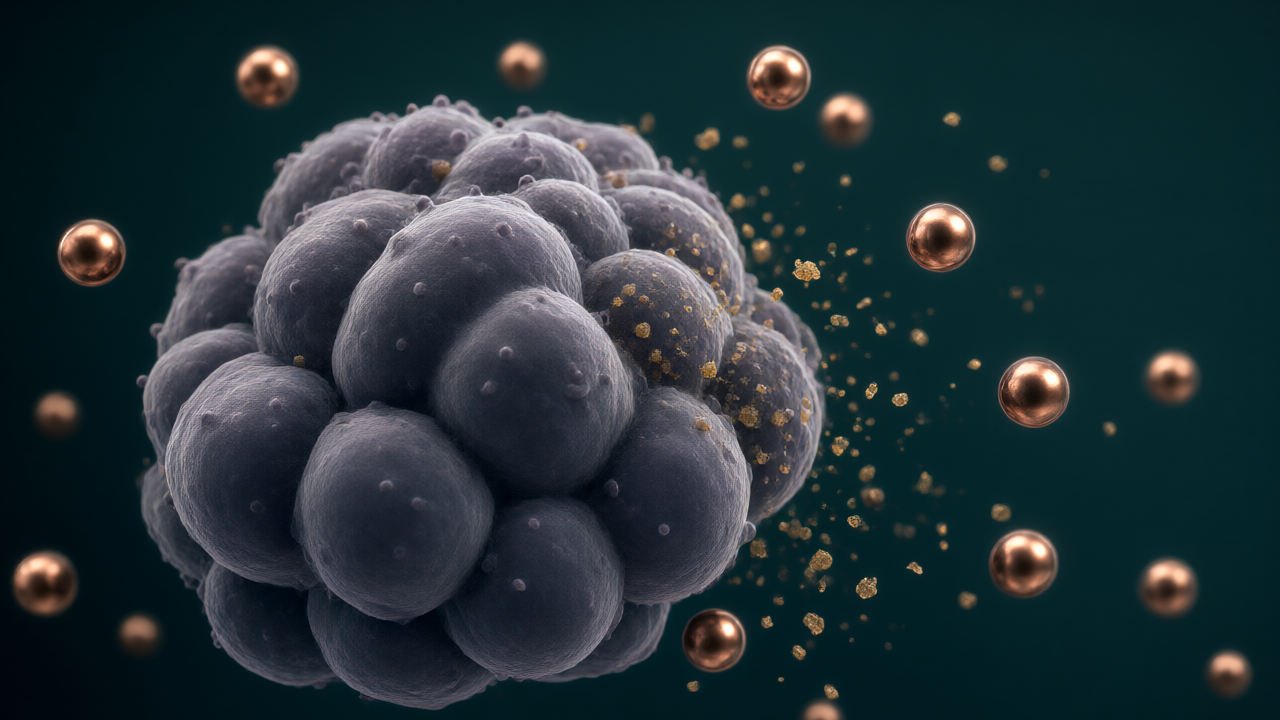
The CaO2/CZ/GOX nanoparticle system significantly shrinks tumors in mouse models by simultaneously starving cancer cells of glucose and triggering two programmed cell-death pathways: pyroptosis and cuproptosis. In Hepa1-6 mouse liver cancer cells, the system proved potently cytotoxic while showing negligible toxicity toward AML12 normal hepatocytes, even at high concentrations. This selectivity is driven by the high glucose metabolism and acidic environment of cancer cells, which trigger the release of the nanoparticle’s active components.
Technical Details
The nanoparticle consists of a calcium peroxide (CaO2) core wrapped in a copper-doped ZIF-8 zeolite framework (CZ) and studded with glucose oxidase (GOX). The system operates as a cascade: GOX consumes glucose to generate hydrogen peroxide, which, combined with copper ions released in acidic environments (pH 5.0), drives Fenton-like reactions to produce hydroxyl radicals and reactive oxygen species (ROS).
- Composition: Mass analysis shows 6.14 percent calcium and 2.17 percent copper; GOX loading efficiency is 4.3 percent.
- Stability: Particles remained stable without aggregation in water, buffered saline, or 10 percent fetal bovine serum over seven days.
- Release Profile: At pH 5.0, 75 percent of GOX was released within 24 hours, compared to significantly lower release at pH 7.4.
- Mechanism: Calcium and copper ions accumulate in mitochondria, collapsing membrane potential and reducing FDX1 and LIAS proteins. This triggers the Caspase-1/GSDMD pathway, resulting in cellular swelling and membrane rupture.
Background & Context
The system leverages the enhanced permeability and retention effect, with fluorescence imaging showing peak accumulation in tumors at 12 hours and persistence up to 72 hours. To ensure safety, intravenous dosing was monitored for 30 days; histological examinations of major organs showed no pathological changes, and hemolysis remained below 5 percent at 150 micrograms per milliliter.
Significance & Outlook
By inducing immunogenic cell death, the nanoparticles expose calreticulin and release HMGB1, flagging tumor cells for phagocytosis. This activates the immune system, as evidenced by increased CD8-positive and CD4-positive T cells within tumors and elevated CD80 and CD86 maturation markers in the spleen and tumors.
Get our weekly technology intelligence — free
Receive an infographic that lets you judge at a glance whether each field’s analysis report is worth reading.
Subscribe Free — Weekly Tech Intelligence
By subscribing, you’ll receive Troy-Technical’s weekly technology intelligence newsletter.
- Your email and selected fields are used only to deliver the newsletter.
- We never share your information with third parties.
- You can unsubscribe anytime via the link in each email.
See our Privacy Policy for details.
Takes about a minute · Unsubscribe anytime