

Key Findings
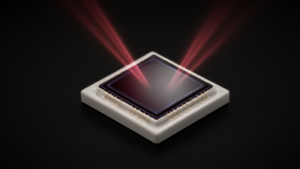
The study reports the development of CsEuI3@mCP nanocrystals capable of efficient single-component white electroluminescence. The devices reached a maximum luminance of 8,941 cd m−2 and a peak external quantum efficiency of 8.3%. To demonstrate practical application, the team integrated these white perovskite LEDs onto a 256 × 256 active-matrix display chip, which successfully displayed dynamic video and full-colour images with a 124% NTSC colour gamut.
Technical Details
The white light emission is achieved through a combination of two mechanisms within the CsEuI3@mCP nanocrystals (where mCP is 1,3-bis(N-carbazolyl)benzene):
- Blue Emission: The intrinsic CsEuI3 inorganic field preserves the blue emission from Eu2+ ions.
- Long-Wavelength Emission: Surface ligand interactions modify the local Eu2+ environment to introduce complementary longer-wavelength components.
This spectral combination results in a high colour rendering index of 85.7 and CIE chromaticity coordinates of (0.33, 0.34). Furthermore, the mCP ligand promotes the electrical activation of Eu2+ emissive centres and enables ligand-assisted excitation involving singlet- and triplet-related states.
Background & Context
Conventional full-colour active-matrix displays using perovskite LEDs face bottlenecks because efficiency varies across red, green, and blue primary colours. Additionally, these materials are often incompatible with high-resolution patterning techniques. The authors propose using white perovskite LEDs paired with colour filters as a simplified alternative to avoid the complexity of patterning separate RGB emitters.
Significance & Outlook
The research establishes ligand engineering as a viable method for simultaneously controlling charge injection and emission colour within a single material system. By monolithically integrating the emitter onto a thin-film transistor backplane, the team demonstrated a path toward high-resolution displays that avoid traditional RGB patterning challenges. The work was published in Nature Photonics on 29 October 2026, with contributions from Jiang Tang, Jinghui Li, and Longbo Yang.
Get our weekly technology intelligence — free
Receive an infographic that lets you judge at a glance whether each field’s analysis report is worth reading.
Subscribe Free — Weekly Tech Intelligence
By subscribing, you’ll receive Troy-Technical’s weekly technology intelligence newsletter.
- Your email and selected fields are used only to deliver the newsletter.
- We never share your information with third parties.
- You can unsubscribe anytime via the link in each email.
See our Privacy Policy for details.
Takes about a minute · Unsubscribe anytime