Key Findings
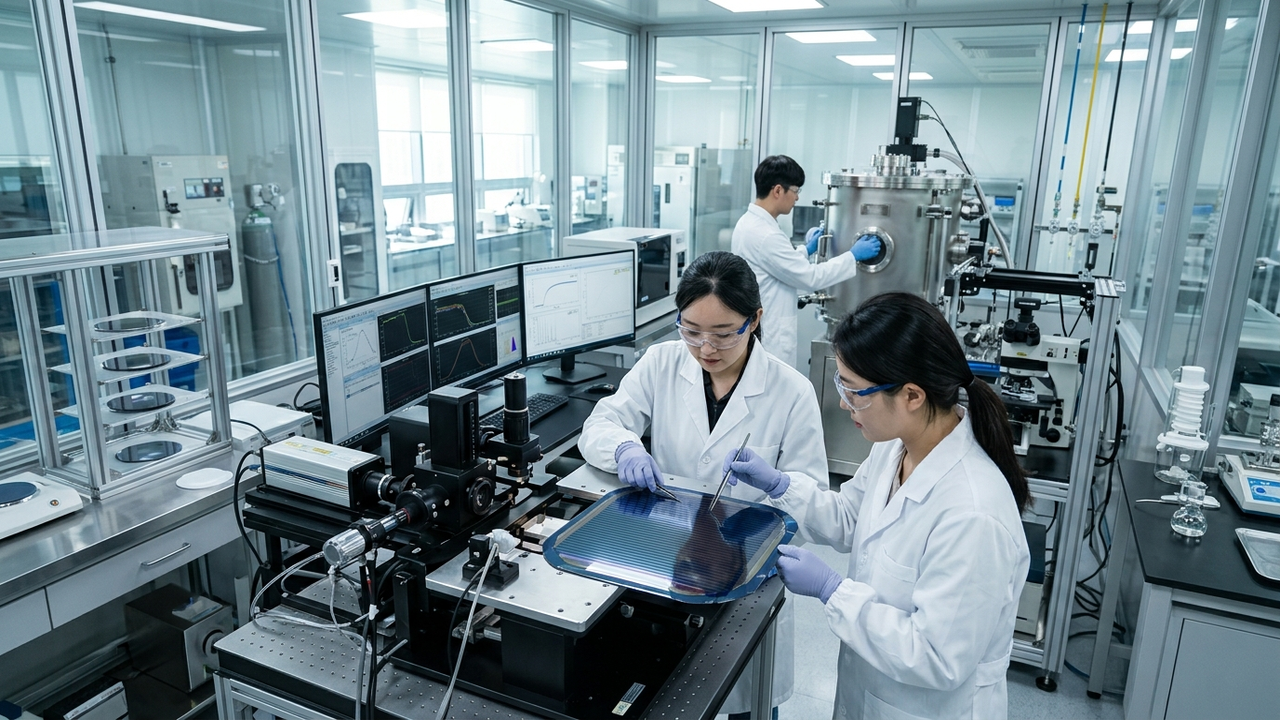
The Photovoltaic Research Department at the Korea Institute of Energy Research (KIER) has set a new world record in perovskite/CIGS tandem solar cell efficiency, achieving 26.7% power conversion, as independently certified by the Fraunhofer Institute for Solar Energy Systems (ISE) in Germany. This groundbreaking achievement is officially recognized on the “Best Research-Cell Efficiencies Chart” published by the U.S. Rockies National Laboratory (formerly NREL), underscoring the rapid evolution of perovskite technology and the significant synergistic potential when combined with established thin-film solar cells like CIGS.
Technical & Clinical Details
The 26.7% conversion efficiency was recorded on a small-area research cell, less than 1 cm². Perovskite/CIGS tandem solar cells offer similar advantages to perovskite-silicon tandem structures by efficiently absorbing different parts of the solar spectrum. CIGS solar cells are a proven thin-film technology known for high stability and power generation efficiency, already applied in industry. Combining them with perovskites allows for high-efficiency beyond the bandgap limitations of individual cells, leveraging the strengths of both technologies. The KIER research team achieved this high efficiency through advances in interface optimization and defect passivation techniques. This multi-junction architecture maximizes solar light utilization, enabling more power generation from a smaller installation footprint.
Background & Context
As the conversion efficiency of conventional single-junction solar cells approaches their physical limits, multi-junction (tandem) solar cells are gaining traction globally as the next generation of high-efficiency photovoltaics. Perovskites, with their tunable bandgap and excellent light absorption properties, are particularly promising as top cells in tandem configurations. CIGS solar cells, alongside amorphous silicon and CdTe, are a leading thin-film technology with established industrial applications. KIER’s achievement demonstrates that tandem integration with various solar cell substrates beyond silicon opens new avenues for high-efficiency development. This expands the diverse application possibilities of perovskite technology and is expected to drive new competition and innovation across the entire solar power market.
Strategic Significance & Outlook
The KIER research team now aims to replicate this world-record conversion efficiency in large-area modules. Scaling up high efficiency from research cells to practical module sizes is always a significant challenge, but this success suggests that perovskite/CIGS tandem technology is nearing market introduction as a commercially competitive product. In the future, with sustained improvements in power conversion efficiency, cost-effective manufacturing processes, and long-term reliability, perovskite/CIGS tandem solar cells are poised to accelerate solar power adoption in diverse settings and significantly contribute to achieving a sustainable energy society. Particularly, their combination with flexible CIGS substrates holds promise for opening new markets, such as building-integrated photovoltaics (BIPV) and lightweight modules.
Source: https://www.eurekalert.org/news-releases/1142560
Get our weekly technology intelligence — free
Receive an infographic that lets you judge at a glance whether each field’s analysis report is worth reading.
Subscribe Free — Weekly Tech Intelligence
By subscribing, you’ll receive Troy-Technical’s weekly technology intelligence newsletter.
- Your email and selected fields are used only to deliver the newsletter.
- We never share your information with third parties.
- You can unsubscribe anytime via the link in each email.
See our Privacy Policy for details.
Takes about a minute · Unsubscribe anytime





Comments