Key Findings
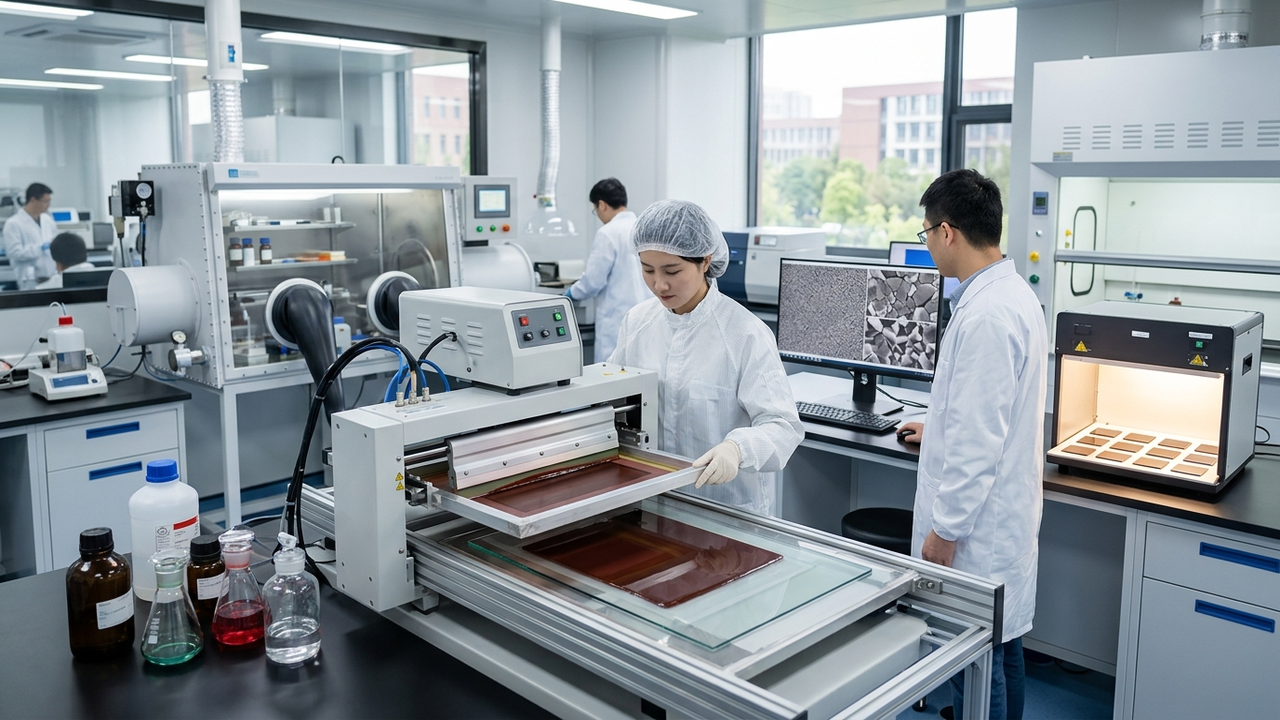
A research team at Nanjing Tech University has announced a breakthrough in perovskite solar cell manufacturing technology. They developed perovskite solar cells where all functional layers were formed by screen-printing in an ambient air environment, achieving a high power conversion efficiency (PCE) of 22.41%. This efficiency has been independently verified as 21.86%, making it exceptionally significant for realizing performance comparable to conventional lab-scale manufacturing methods, but with a more scalable process. This technology substantially enhances the commercial viability of perovskite solar cells for low-cost, large-scale mass production.
Technical & Clinical Details
The core of this research lies in depositing all functional layers of the perovskite solar cell—the electron transport layer, perovskite active layer, hole transport layer, and electrodes—using screen printing under ambient atmospheric conditions. Screen printing is a mature industrial printing technology, which, similar to inkjet printing and slot-die coating, allows for large-area fabrication, high throughput, and cost reduction. Previous perovskite solar cell research often utilized methods like spin-coating (limited to small areas) or vacuum deposition (high cost, requires vacuum environment) to achieve high efficiencies. However, these methods are not suitable for large-scale production. Nanjing Tech University’s technology achieved high-quality film formation by minimizing environmental control and optimizing the composition of printable perovskite inks and printing parameters. This process can be carried out at relatively low temperatures and is easily adaptable to flexible substrates, making it suitable for integration into existing solar cell manufacturing lines or for establishing new manufacturing platforms.
Background & Context
Perovskite solar cells are considered a strong candidate for next-generation photovoltaics due to their high conversion efficiency and low material costs. However, one of the biggest barriers to their commercialization has been maintaining efficiency and stability when scaling up laboratory achievements to large-scale industrial production. Specifically, reducing manufacturing costs is essential for ensuring competitiveness with conventional silicon solar cells. Screen printing technology, which enables low-cost and high-throughput manufacturing, is expected to be a key to solving the “last frontier” of mass production for perovskite solar cells. Nanjing Tech University’s achievement presents a concrete solution to this challenge, paving the way for perovskite solar cells to play a larger role in the energy market.
Strategic Significance & Outlook
The achievement of 22.41% efficiency in open-air screen-printed perovskite solar cells marks a significant step in the commercialization of this technology. The future outlook anticipates further optimization of this printing process to improve both efficiency uniformity and long-term stability. Particularly, evaluating performance degradation in outdoor environments and establishing large-area module scale-up techniques will be the next crucial steps. If this manufacturing method is established, perovskite solar cells could accelerate adoption in diverse applications, including building facades, windows, flexible roofing materials, and even power sources for IoT devices. The establishment of low-cost, environmentally friendly mass production technology is a strategically important achievement that will accelerate the global adoption of renewable energy and significantly contribute to achieving a sustainable society.
Get our weekly technology intelligence — free
Receive an infographic that lets you judge at a glance whether each field’s analysis report is worth reading.
Subscribe Free — Weekly Tech Intelligence
By subscribing, you’ll receive Troy-Technical’s weekly technology intelligence newsletter.
- Your email and selected fields are used only to deliver the newsletter.
- We never share your information with third parties.
- You can unsubscribe anytime via the link in each email.
See our Privacy Policy for details.
Takes about a minute · Unsubscribe anytime








Comments