Key Findings
A research team at Berkeley Lab has made a significant quantitative insight into the mechanism of ion transport in ionic liquids by employing an innovative hybrid machine learning approach that integrates experimental data with computational descriptors. Their study demonstrated that ion transport is primarily governed by ion dissociation mechanisms, rather than the previously assumed simple viscosity-based ion mobility. This discovery is expected to substantially enhance the rational design of safer and more efficient electrolytes for next-generation batteries, particularly halide solid electrolytes, and will significantly contribute to the overall advancement of battery electrolyte technology.
Technical & Clinical Details
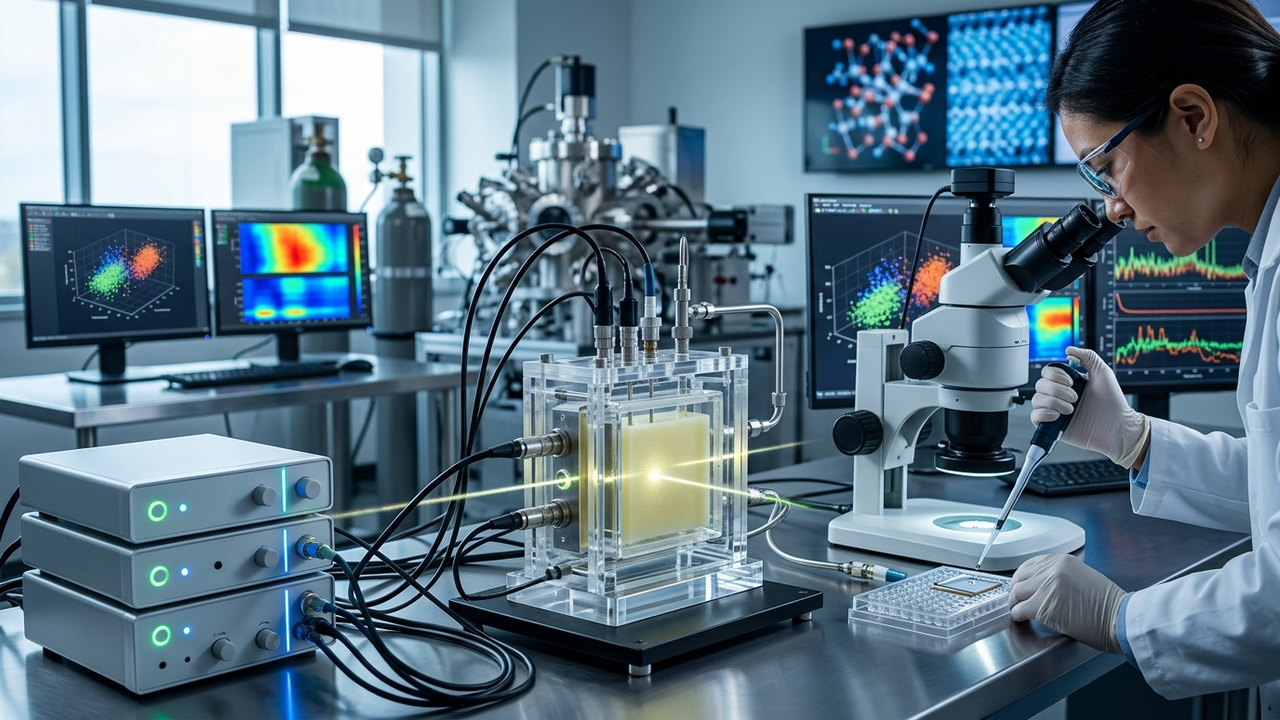
In this study, the researchers combined high-precision experimental measurements (e.g., electrical conductivity, viscosity, diffusion coefficients) with computational descriptors derived from Density Functional Theory (DFT) calculations—such as ion charge distribution, solvation structures, and intermolecular interactions—for a diverse range of ionic liquid systems. The machine learning models learned these varied data points to identify complex, nonlinear relationships between the energy barriers for ion dissociation, the propensity for ion pair formation, and the macroscopic ionic conductivity. Specifically, the models quantitatively predicted how microscopic behaviors, such as how ions dissociate from solvent molecules to become freely mobile or behave as ion pairs, affect the overall ion transport performance in particular ionic liquids. This approach elucidated phenomena that could not be explained by the traditional simple Stokes-Einstein relationship (which correlates viscosity with ion mobility), providing clear guidance on which molecular-level parameters should be optimized in the design of ionic liquids. This represents a major leap forward in design strategies for maximizing the ionic conductivity of materials like halide solid electrolytes, which are highly promising for all-solid-state batteries.
Background & Industry Context
In the development of next-generation batteries, especially all-solid-state batteries, electrolytes are key components determining performance and safety. As conventional liquid electrolytes pose risks of flammability and leakage, there is a strong demand for a shift to safer solid electrolytes. Halide solid electrolytes are attracting attention due to their high ionic conductivity and stability, but a deep understanding of ion transport mechanisms and optimization of material design are essential to further improve their performance. However, finding electrolytes with optimal compositions and microstructures from a vast material space has been an extremely challenging task. The fusion of machine learning with experimental data offers a powerful tool to overcome this challenge and accelerate the material discovery process. This research serves as an excellent example of data-driven scientific discovery bridging the gap between theory and experiment.
Strategic Significance & Outlook
The insights gained from this research will be directly applied to the rational design of all types of next-generation electrolytes, including halide solid electrolytes. By further refining machine learning models and exploring more diverse chemical spaces and operating conditions, new electrolytes could be rapidly discovered that dramatically improve battery energy density, cycle life, and safety. In the future, this hybrid approach could be integrated with autonomous research labs (Self-Driving Labs), realizing a ‘closed-loop’ material development ecosystem where the entire process of electrolyte design, synthesis, characterization, and optimization is executed without human intervention. This is expected to accelerate the commercialization of all-solid-state batteries and establish new standards for battery technology in electric vehicles and renewable energy storage systems, marking a crucial step towards a safer and more sustainable energy future.
Get our weekly technology intelligence — free
Receive an infographic that lets you judge at a glance whether each field’s analysis report is worth reading.
Subscribe Free — Weekly Tech Intelligence
By subscribing, you’ll receive Troy-Technical’s weekly technology intelligence newsletter.
- Your email and selected fields are used only to deliver the newsletter.
- We never share your information with third parties.
- You can unsubscribe anytime via the link in each email.
See our Privacy Policy for details.
Takes about a minute · Unsubscribe anytime






Comments